
Heated extensions on East Grinstead's detached houses
Detached houses built between 1945 and 1999 make up a large part of East Grinstead, and homes from 1945 to 1972 alone are 29% of the total. Houses of that age were rarely built with underfloor heating, so it usually arrives with an extension, a knocked-through kitchen or a garden room.
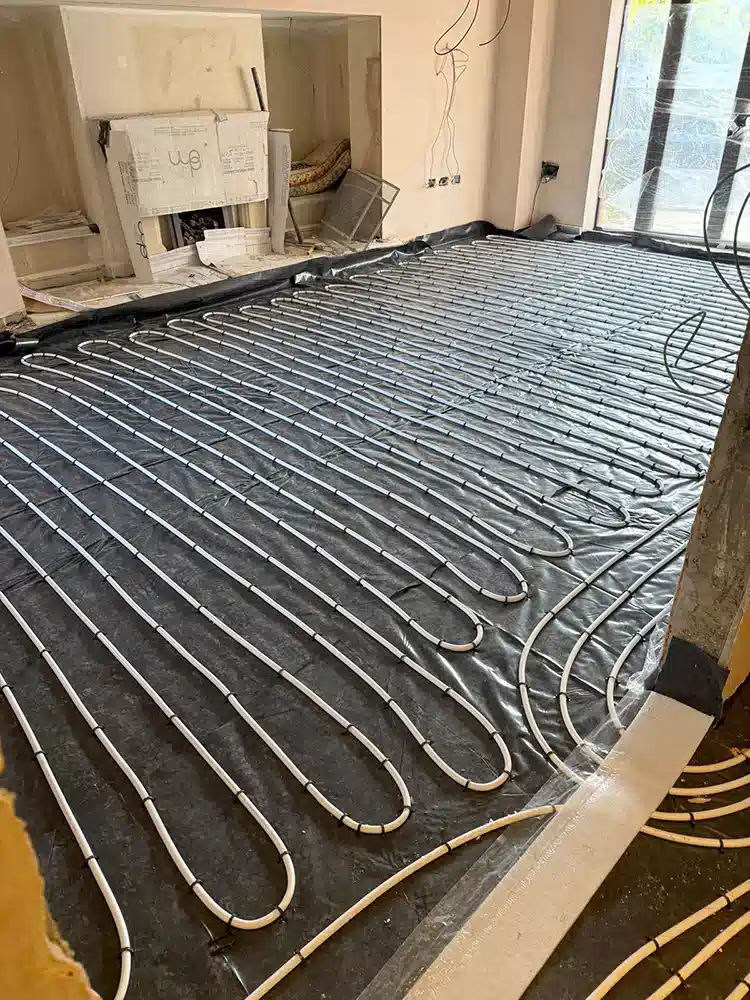
Without the right screed over them, the pipes cannot do their job. It has to surround every pipe with no air pockets and have the right cover above them. For a liquid pour, the pipes are buried under 25mm or more, so the layer totals 45 to 50mm. Sand and cement laid by hand calls for roughly 45mm above the pipework, and the floor grows deeper as a result. Too thin and it can crack over the pipes; too thick and the room is slow to warm.
Where an extension joins the house, its floor has to come out at precisely the same height. We work back from that level: finished floor, screed, pipes, insulation, slab. If the old floor is uneven at the join, levelling compound can bring the two into line before the finish.
Liquid screed is the usual choice because it flows round the pipes and gives a thinner, more responsive floor. Read about liquid screed in East Grinstead for how the pour runs.
Adding heating to an older East Grinstead house is the harder job. There is rarely much height to spare, and digging out the old floor may be the only way to fit insulation and pipes. Our insulation and membranes service supplies what goes beneath the pipes.
Commissioning a new heated floor in East Grinstead
Heat should not go on straight after the pour. Calcium sulphate normally lets the heating run from around day 7. Sand and cement holds off until day 21 or later. Begin with the water cool and raise it bit by bit across several days, which stops the young screed being shocked into cracking.
That schedule comes to you on paper, for your heating engineer to follow when commissioning the system around the screed. If the pipes are tested and the room is weathertight, the pour date can be fixed with the engineer at the same time, which keeps the gap between screed and commissioning short.
Commissioning also speeds drying. A heated calcium sulphate floor can be force dried, and a hygrometer test then shows when it is ready for flooring. A calcium sulphate floor also has its laitance sanded away and a matching primer put down before any adhesive.
Garden rooms need a decision about winter use. A garden room left unheated will dry slowly, delaying the flooring, so tell us how it will be used, and whether it will have its own heating zone. The screed thickness guide shows the build-ups behind each option.
Underfloor Heating Screed prices in East Grinstead
Liquid screed over underfloor heating: £20 to £35 per m² supplied and laid (trade2base, June 2026), so £700 to £1,230 for 35 m². trade2base gives these figures excluding VAT. See our floor screeding cost guide or screed calculator.
Who lays your underfloor heating screed in East Grinstead
K & B Screeding’s own team, led by director Donatas Bardisevicius. Founded 2019, company 12298780.
See what customers say in our Google reviews and on our testimonials page.
Underfloor Heating Screed from Slough to East Grinstead
As the crow flies, our yard in Slough is about 39.4 miles from East Grinstead, which lies to the south-east. Postcodes here include RH19, and Horley (7.5 miles), Crawley (7.9 miles), Crowborough (8.6 miles) and Oxted (9.3 miles) are close by.
More on underfloor heating screed, part of our screeding services.