
Screed over heating pipes in Cage Green extensions
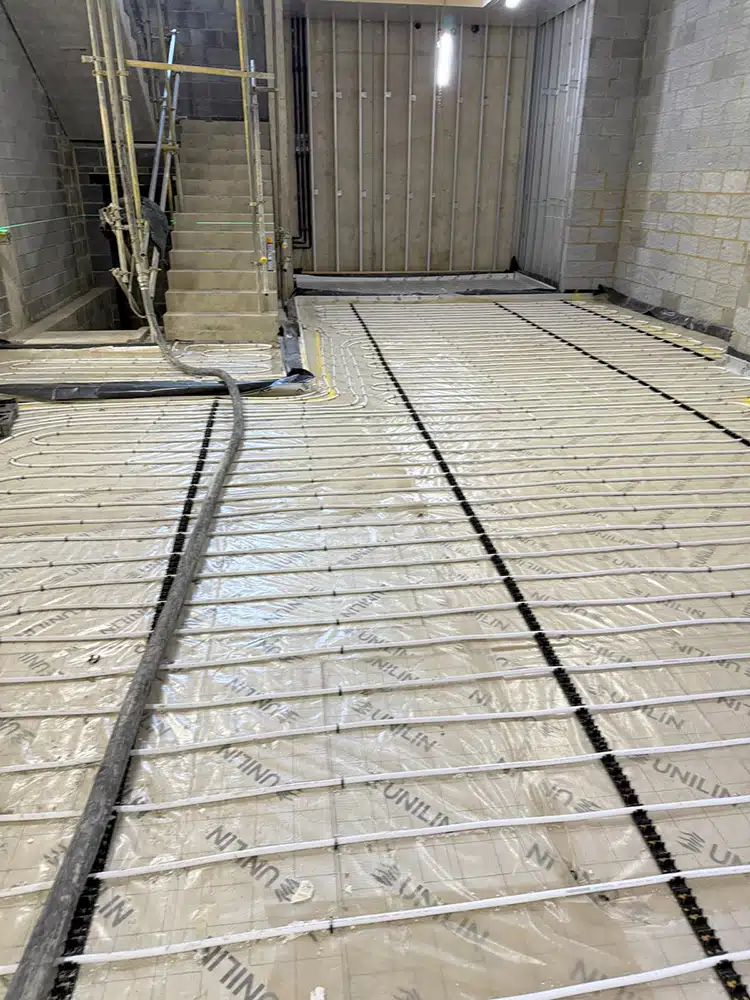
In a typical post-war semi in Cage Green or Trench Wood, a rear extension adds a new insulated slab that has to meet the existing floor, and the heating pipes are clipped down on top of the insulation before the screed goes in. The screed then does two jobs: it protects the pipes and it spreads their heat evenly across the room.
How much screed sits above the pipes is what we measure most carefully. With a liquid pour the minimum is 25mm over the top of them, so the floor usually ends up 45 to 50mm deep. A sand and cement floor wants roughly 45mm over them, so the whole build is deeper. Skimp on it and cracks can follow the line of the pipes; overdo it and the extension takes ages to warm.
Pumped screed wraps itself round every loop without trapping air, which is the main reason heated extensions usually get it. A hand-laid floor is still fine over pipes, provided it is tamped in tightly so nothing hollow is left beside them.
Before we pour, the heating engineer should have pressure tested the circuit and left it under pressure. On the day we inspect the boards, the membrane and the perimeter strip; if you would rather we provided them, that comes under our insulation and membrane supply. For a heated floor in liquid screed, published UK prices sit between £20 and £35 per m².
Retrofitting underfloor heating in older Tonbridge homes
Putting pipes into a floor that is already there is trickier than designing them into an extension, mainly because there is rarely height to spare. In the older houses south of the river, relaying a solid floor gives the chance to fit insulation and pipes, but only if the new build-up fits under the doors and against the hallway. A thinner liquid screed over the pipes can save useful millimetres against sand and cement.
Newer homes are simpler. Just 6% of the town's housing dates from 2015 or later, so most heated floors in Tonbridge go into extensions or relaid floors in existing houses rather than new builds.
After the pour, hold back. A calcium sulphate floor will usually take heat from about day 7, while sand and cement must be left for 21 days or more. In both cases the flow temperature goes up a little at a time across several days, to a written commissioning plan, so the floor dries evenly and does not crack. Even when the heating is helping to dry the floor, that first warm-up stays slow, as our screed drying article explains.
Underfloor Heating Screed prices in Tonbridge
Liquid screed over underfloor heating: £20 to £35 per m² supplied and laid (trade2base, June 2026), so £700 to £1,230 for 35 m². trade2base gives these figures excluding VAT. See our floor screeding cost guide or screed calculator.
Who lays your underfloor heating screed in Tonbridge
K & B Screeding’s own team, led by director Donatas Bardisevicius. Founded 2019, company 12298780.
See what customers say in our Google reviews and on our testimonials page.
Underfloor Heating Screed from Slough to Tonbridge
As the crow flies, our yard in Slough is about 46.1 miles from Tonbridge, which lies to the east-south-east. Postcodes here include TN9 and TN10, and Royal Tunbridge Wells (4.1 miles), Sevenoaks (6.4 miles), Crowborough (10.3 miles) and Snodland (12 miles) are close by.
More on underfloor heating screed, part of our screeding services.