
Grinding unit and workshop floors in Tonbridge
A diamond grinder works rather like a heavy sander for concrete. Segments set in rotating heads cut the top of the slab away a fraction at a time, so the operator can take down one raised ridge or skim a whole bay evenly. On working floors that means removing whatever stops a new finish sticking: old floor paint, worn line markings, glue left by vinyl or carpet tiles, and the weak, dusty skin on top of the concrete.
Industry has a long thread here. Tonbridge became a centre for plastic moulding in the early 20th century, and its economy today includes printing and publishing, light engineering and distribution. Print works and workshops take heavy, constant wear, and when a unit is refitted the finishes laid by the last occupant generally have to go.
Grinding is the step before the new floor. Once the surface is clean and open, it can take a new wearing screed for commercial use, a levelling compound, or a resin system laid by a specialist firm. We prepare for resin but do not lay it, and we do not produce polished concrete.
Joints between bays are another target. Where one section of slab has settled or was cast slightly high, the lip catches pallet trucks and shows through thin vinyl. Grinding it down to its neighbour is quicker and cleaner than breaking the slab out. Where the concrete itself is cracked or spalling, concrete floor repair comes first.
Extensions, garages and dust control in Tonbridge homes
Grinding has domestic uses too. Post-war semis in Trench Wood and Cage Green are commonly extended on a new slab tied into the existing floor, and the line where old meets new is rarely perfect. A raised edge of a few millimetres can be ground away so the flooring runs through without a step.
Garages are similar. Converting one usually means dealing with oil stains, paint and a rough surface before insulation or a bonded topping goes down. In older houses, lifting carpet or vinyl can reveal years of adhesive that new glue will not grip.
There are limits. Grinding flattens local high spots, but a floor that falls away across a whole room cannot be ground level, because far too much would have to come off. Take too much from a screed and it may drop below its minimum depth and weaken. In that case we grind the highs and bring the low areas up with compound.
Dust is the real hazard. Concrete, screed and tiles contain silica, and grinding them releases respirable crystalline silica dust. Every grinder we run is connected to an extractor, doorways are sealed and adjoining rooms sheeted. We are contractors, so we do not hire out grinders or sell diamond tooling.
How we price floor grinding in Tonbridge
A fixed written price within 24 hours, once we know the area and what has to come off. See our floor screeding cost guide.
Who grinds your concrete floor in Tonbridge
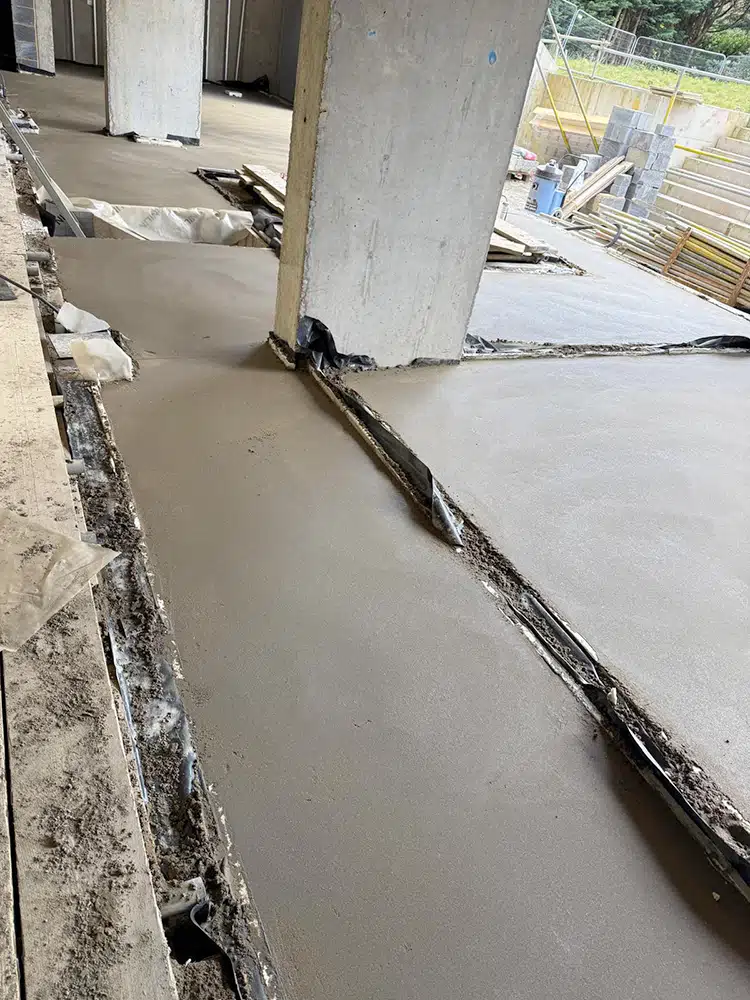
K & B Screeding’s own team, led by director Donatas Bardisevicius. Founded 2019, company 12298780.
See what customers say in our Google reviews and on our testimonials page.
Concrete Floor Grinding from Slough to Tonbridge
As the crow flies, our yard in Slough is about 46.1 miles from Tonbridge, which lies to the east-south-east. Postcodes here include TN9 and TN10, and Royal Tunbridge Wells (4.1 miles), Sevenoaks (6.4 miles), Crowborough (10.3 miles) and Snodland (12 miles) are close by.
More on floor grinding, part of our screeding services.
