
Heated floors in Epsom kitchen rebuilds and extensions
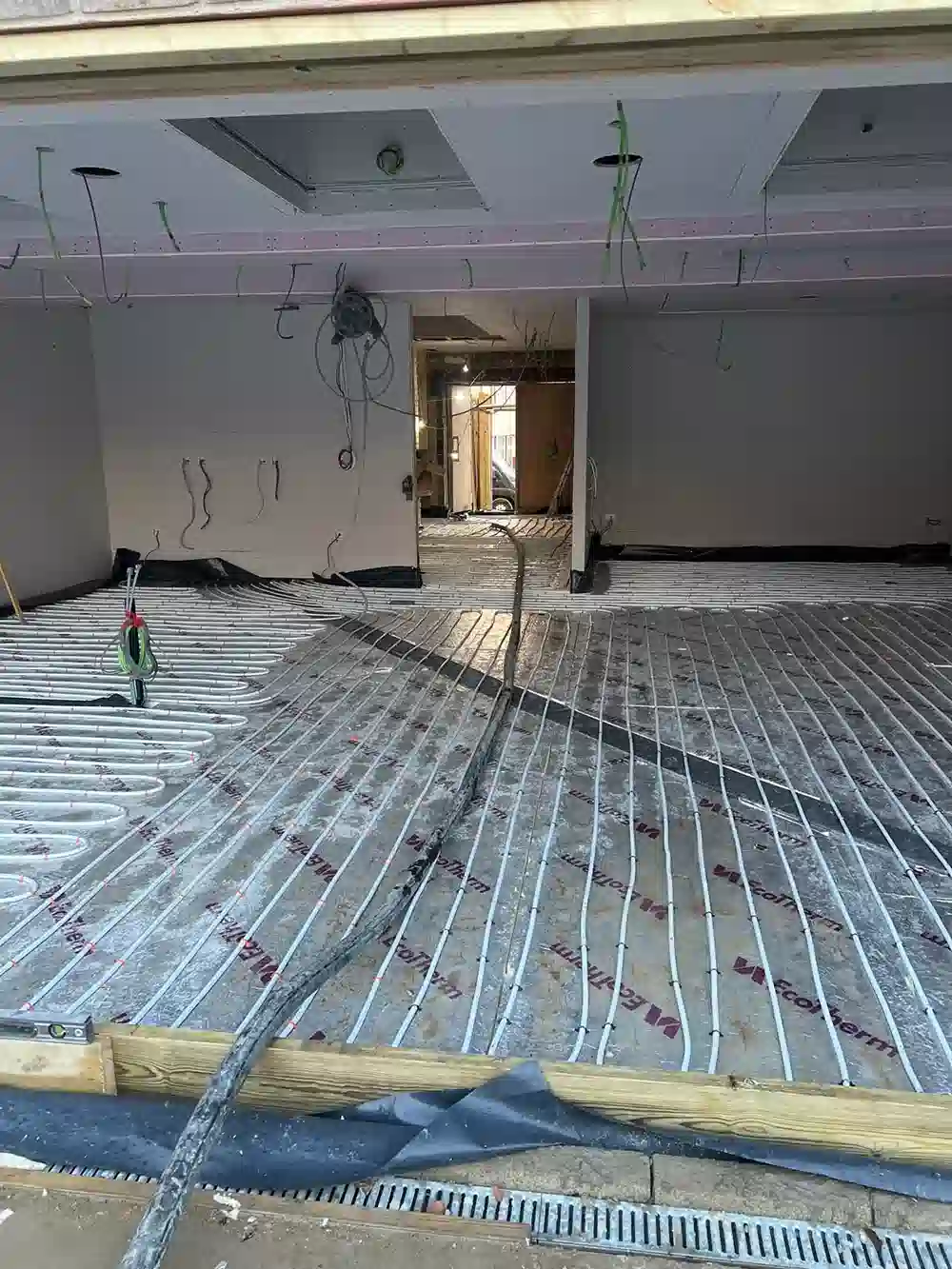
A heated floor in an extension has three layers that matter: insulation below, pipes on top of it, and the screed covering them. The insulation stops heat escaping downwards. The screed spreads heat sideways and carries the finish. The cover over the pipes is what balances strength against warm-up time.
Over the pipes, liquid screed needs a 25mm minimum, for a total of 45 to 50mm as a rule, whereas sand and cement needs nearer 45mm on top of them. Liquid screed flows round the pipes without leaving voids, which gives faster warm-up and better efficiency, and that is why it is the usual choice for a new extension floor. Our liquid screed page for Epsom covers the pour itself.
Before the screed goes down, we check the edge strip is fitted all round, the insulation is tight and the pipes are fixed and pressure tested. If the insulation, membrane or edge strip is missing, we can bring it. K & B does not install the heating pipes; that stays with your plumber or heating engineer.
The join with the existing house needs thought. A kitchen rebuild often carries a heated floor into an old room with a different floor build-up. Setting the levels at the start avoids a step, and any small difference left can be levelled before the finish goes down.
Horton new builds and Epsom retrofit heating
A new build house can have heating planned into the floor from the outset. At Horton, where the former hospital land mixes new build houses with converted Victorian buildings, that is simplest in the new houses. In a conversion, floor height is usually set by the existing structure, and adding heating means keeping the build-up thin.
The same squeeze applies to older houses near Epsom's centre. Where a floor without a membrane is being dug out anyway, it can take insulation, pipes and screed at full depth. Where it cannot be dug out, a liquid screed at minimum cover keeps the height down.
Warming up is the final step, and the easiest one to rush. Calcium sulphate can have the heating on at about 7 days, but sand and cement must wait until 21 days or later. It starts cool and is turned up in small steps across several days. We provide the schedule in writing.
Liquid screed poured over underfloor heating has a published 2026 price of £20 to £35 per square metre. Heated floors in Sutton are handled the same way.
Underfloor Heating Screed prices in Epsom
Liquid screed over underfloor heating: £20 to £35 per m² supplied and laid (trade2base, June 2026), so £700 to £1,230 for 35 m². trade2base gives these figures excluding VAT. See our floor screeding cost guide or screed calculator.
Who lays your underfloor heating screed in Epsom
K & B Screeding’s own team, led by director Donatas Bardisevicius. Founded 2019, company 12298780.
See what customers say in our Google reviews and on our testimonials page.
Underfloor Heating Screed from Slough to Epsom
As the crow flies, our yard in Slough is about 21.3 miles from Epsom, which lies to the south-east. Postcodes here include KT19 and KT18, and Ewell (1.4 miles), Leatherhead (3.8 miles), Kingston upon Thames (4.1 miles) and Sutton (4.7 miles) are close by.
More on underfloor heating screed, part of our screeding services.