
Digging out and relaying floors near Epsom's centre
Around 17% of Epsom's homes date from before 1919, when ground floors were often laid without any membrane beneath them. Moisture then rises into the floor and on into whatever covers it. Timber skirtings rot, adhesives fail and new flooring lifts. Patching the surface does not stop it.
What actually cures it is taking the floor out and building it again. We dig the ground lower to create space, lay and compact a base, then put down a membrane against damp, rigid insulation boards and finally the screed. Epsom sits where the chalk of the Downs meets London Clay, so the ground under an old floor is looked at once it is exposed, before the new build-up goes on it.
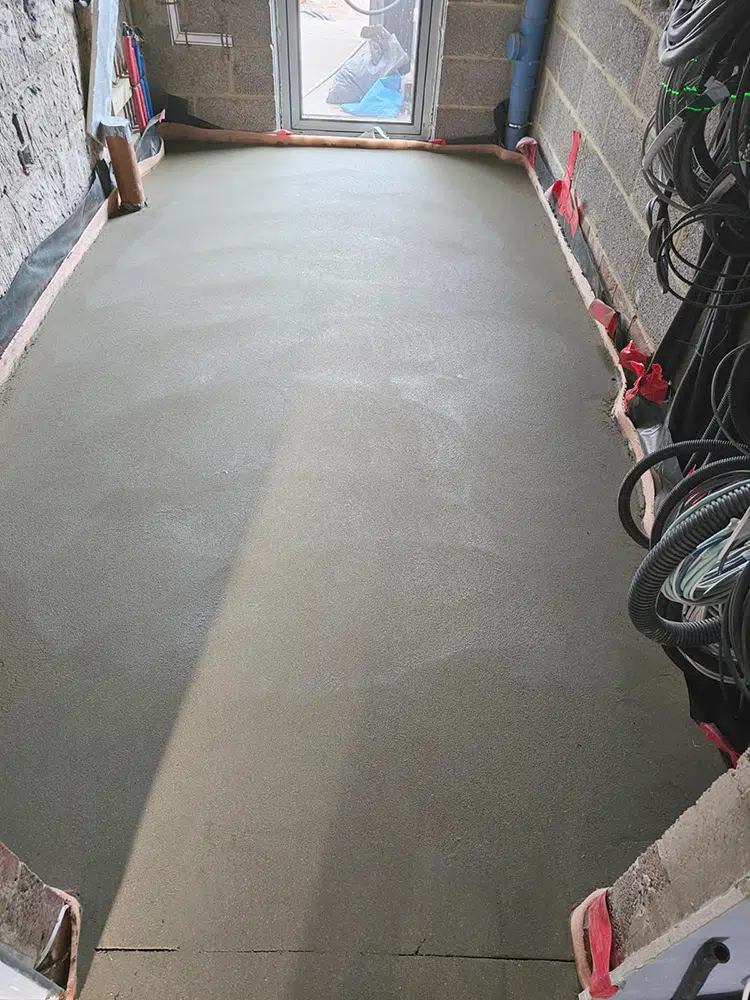
Over insulation, a house gets 65mm of sand and cement and a commercial building 75mm. Where it can bond to sound concrete, 25 to 40mm is enough, handy in an older Epsom house whose doors and stairs leave the floor height no room to move. The mix is made on site, compacted by hand and finished dense and level, so the team can work through narrow rooms with nothing parked outside but a delivery.
At Horton, the converted Victorian buildings on the former hospital land are a separate case. Floors in those conversions may need levelling or a latex smoothing layer before finishes; see levelling for Horton conversions.
Epsom garages, wet rooms and bonded screeds
Sand and cement is the material for rooms that stay damp or need a slope. A shower you walk into, or a full wet room, needs its floor sloped to the drain, which is shaped by hand, and it needs cement underneath because cement will not soften when wet. Calcium sulphate has no place in those rooms.
Garage conversions often start with a slab that sits lower than the house. A screed over insulation raises it to the level of the hall. The garage conversion floor guide covers that build-up in more detail.
Bonded screeds are another option where depth is short. Laid 25 to 40mm on a clean, prepared concrete base, a bonded screed is priced at £12 to £18 per m² (trade2base, June 2026) in published 2026 figures. If a floor has to carry weight soon after laying, a workshop for instance, a stronger mix can be used.
Drying is the drawback. Tiles or wood on a 65mm floor are weeks away, since the first 40mm dries at roughly a millimetre daily and the rest more slowly. Heating on a sand and cement screed should wait at least 21 days. If the timetable is tight, a fast drying mix brings things forward; the standard mix has a published price of £18 to £25 per square metre.
Sand and Cement Screed prices in Epsom
Sand and cement screed: £18 to £25 per m² supplied and laid (MyJobQuote, August 2026), so £450 to £630 for 25 m². MyJobQuote does not say whether these figures include VAT. See our floor screeding cost guide or screed calculator.
Who lays your sand and cement screed in Epsom
K & B Screeding’s own team, led by director Donatas Bardisevicius. Founded 2019, company 12298780.
See what customers say in our Google reviews and on our testimonials page.
Sand and Cement Screed from Slough to Epsom
As the crow flies, our yard in Slough is about 21.3 miles from Epsom, which lies to the south-east. Postcodes here include KT19 and KT18, and Ewell (1.4 miles), Leatherhead (3.8 miles), Kingston upon Thames (4.1 miles) and Sutton (4.7 miles) are close by.
More on sand & cement screed, part of our screeding services.