
Relaying Victorian ground floors across Merton
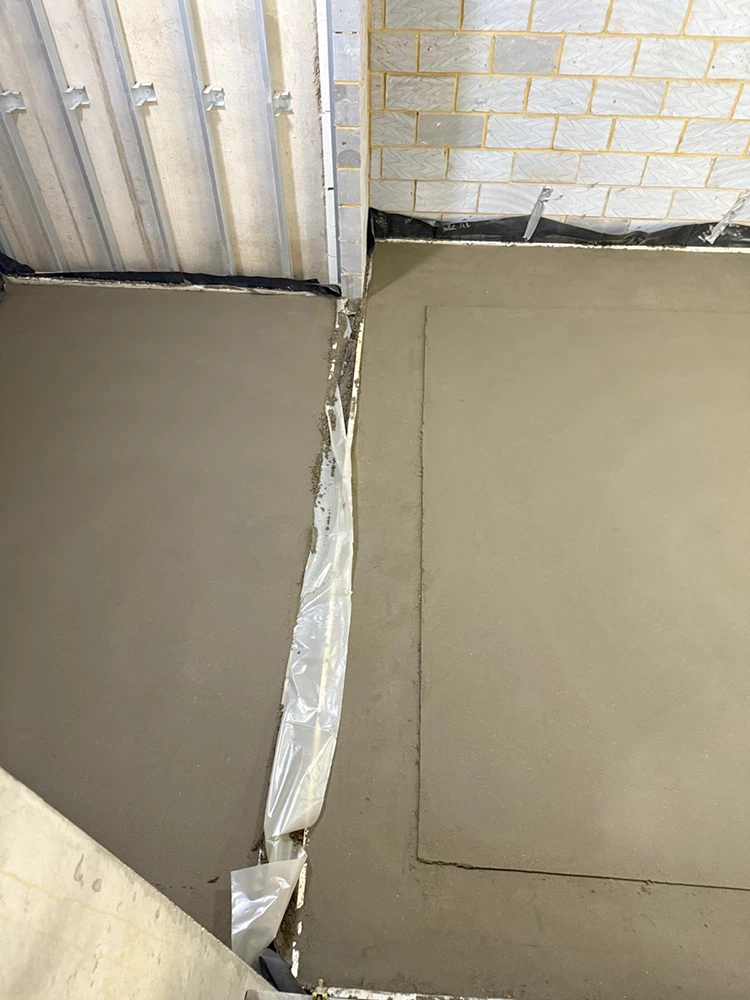
About 27% of Merton's homes were built before 1919, and the borough's Victorian terraces often need a membrane and new screed under a kitchen extension. When the original floor next to the extension is opened up, it is often found to have no membrane. Normally that old floor is broken out and replaced with insulation, a membrane against damp and a new screed, finished so the original rooms and the extension sit at the same height with no step between them.
This is work a traditional screed handles well. It can be laid room by room as the builders allow, it adapts to narrow hallways and small back rooms, and it gives a cement based surface where a tile adhesive or a wet area needs one.
What goes underneath sets the thickness. Floating over insulation, a domestic screed needs about 65mm. Bond it directly to a sound slab that has been properly prepared and 25 to 40mm can work; bonded screeds has the details on when that applies. Getting the finished level right against existing doors, skirtings and the extension threshold is often the hardest part of the job.
The membrane and insulation go in before the screed, and we can supply and fit both through our insulation and membranes service. For the depths each build-up needs, see our thickness guide for screeds.
Merton Abbey Mills, garages and wet rooms
Merton Abbey Mills, the former Liberty textile works on the River Wandle, is now a crafts market with Grade II listed buildings. Repairs to floors in buildings like that need care: matching levels, respecting the existing fabric and patching rather than replacing where possible. That sort of patient patching sits within our screed repair work.
Wet rooms are a more everyday reason to choose sand and cement. Laid with a gentle slope to a floor drain, it makes the base for a step-free shower, and, unlike calcium sulphate, it tolerates water. The tanking goes over the finished screed before the tiles.
Garage conversions are another. Garage floors are often lower than the rest of the house, so insulation with a hand-laid screed on top is used to raise them to the right height.
Plan your programme around drying. The first 40mm take roughly a day each and the rest longer, so a 65mm Merton kitchen floor needs several weeks before most coverings, and you only know it is ready when a moisture test says so. In 2026 UK terms the screed costs £18 to £25 per m², plus £1 to £3 per m² for fibres in the mix if needed.
Sand and Cement Screed prices in Merton
Sand and cement screed: £18 to £25 per m² supplied and laid (MyJobQuote, August 2026), so £450 to £630 for 25 m². MyJobQuote does not say whether these figures include VAT. See our floor screeding cost guide or screed calculator.
Who lays your sand and cement screed in Merton
K & B Screeding’s own team, led by director Donatas Bardisevicius. Founded 2019, company 12298780.
See what customers say in our Google reviews and on our testimonials page.
Sand and Cement Screed from Slough to Merton
Merton is about 20.6 miles east-south-east of our Slough base as the crow flies, with postcodes including SW20, SW19, SM4 and CR4. The nearest towns to it are Wandsworth (2.8 miles), Kingston upon Thames (3.4 miles), Sutton (3.7 miles) and Ewell (4.5 miles).
More on sand & cement screed, part of our screeding services.
