
Retrofitting heated floors in Morden and St Helier homes
Inter-war homes are the largest group in Merton: 37% of the borough's homes were built between 1919 and 1944. In Morden and on the St Helier estate, many have suspended timber ground floors, and when those are replaced with insulated solid floors there is space in the build-up for heating pipes.
Floor height is the first constraint in any retrofit of this kind. The new floor has to finish level with the rooms, doors and stairs that stay. For a Morden or St Helier house the numbers run like this: a liquid screed must sit at least 25mm above the pipes, typically 45 to 50mm in total, but sand and cement needs roughly 45mm over them, giving a deeper floor. Where the depth is tight, the liquid option is often the one that fits.
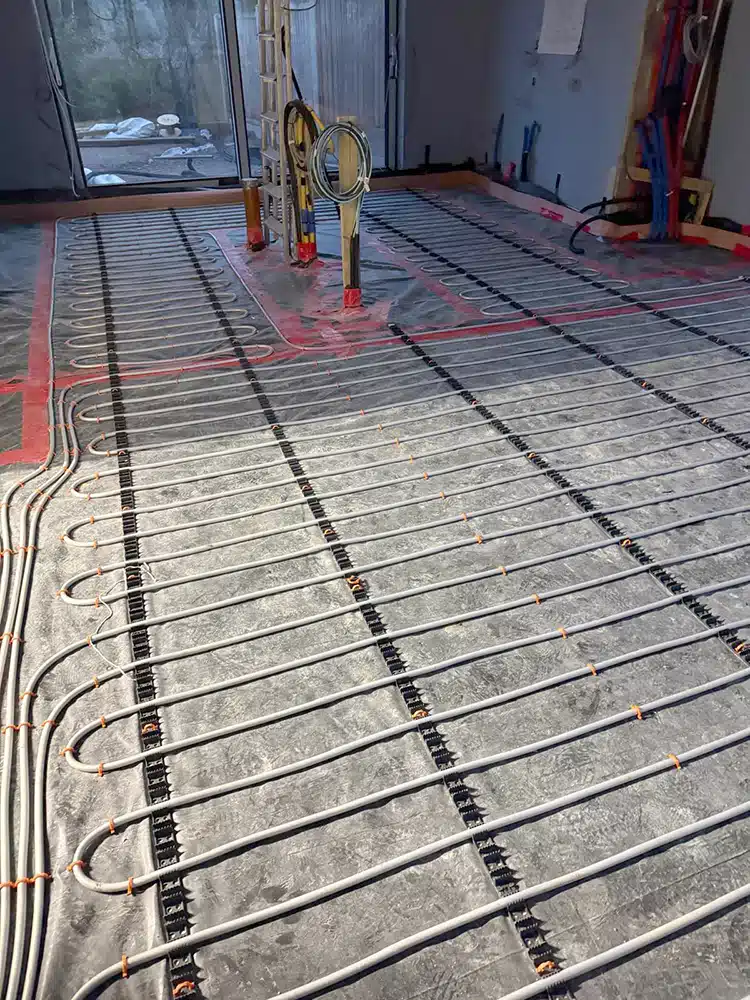
Pipe encapsulation is the second. Any void round a pipe slows the heat, wastes energy and can leave cold spots across the room. Poured screed surrounds each pipe without gaps by itself; with sand and cement, the mix must be packed round them by hand.
By the time we get there, your installer should have the pipework down and pressure tested. Our first job on site is the edge strip, membrane and insulation, which we either check or provide through our insulation and membrane supply, and then the screed goes in. For the practicalities of the pumped option in Merton, see liquid screed for Merton homes.
Heated screeds at High Path, Eastfields and Ravensbury
The Clarion Housing Group programme at High Path in South Wimbledon and Eastfields and Ravensbury in Mitcham, around 2,550 new homes over fifteen years, will see its new blocks fitted with underfloor heating and floating screeds. In new blocks like these the screed is part of the design from the start, but the heat-up still has to be done properly.
The rule of thumb depends on the material. Heating under calcium sulphate can usually be started about 7 days after pouring, and under sand and cement after 21 days at the earliest. Both begin cool, with the flow temperature lifted a few degrees at a time each day as the manufacturer's heat-up table directs. Jumping to full heat in one go can leave cracks.
Log each day's setting, since the person laying your floor may want to see it. Tiles, LVT or wood still wait until a moisture test shows the screed suits that covering. For what makes drying quicker or slower, read our screed drying times guide.
Working in Sutton instead? See underfloor heating screeds there.
Underfloor Heating Screed prices in Merton
Liquid screed over underfloor heating: £20 to £35 per m² supplied and laid (trade2base, June 2026), so £700 to £1,230 for 35 m². trade2base gives these figures excluding VAT. See our floor screeding cost guide or screed calculator.
Who lays your underfloor heating screed in Merton
K & B Screeding’s own team, led by director Donatas Bardisevicius. Founded 2019, company 12298780.
See what customers say in our Google reviews and on our testimonials page.
Underfloor Heating Screed from Slough to Merton
Merton is about 20.6 miles east-south-east of our Slough base as the crow flies, with postcodes including SW20, SW19, SM4 and CR4. The nearest towns to it are Wandsworth (2.8 miles), Kingston upon Thames (3.4 miles), Sutton (3.7 miles) and Ewell (4.5 miles).
More on underfloor heating screed, part of our screeding services.
