Thin heated screeds in St Margarets and Richmond houses
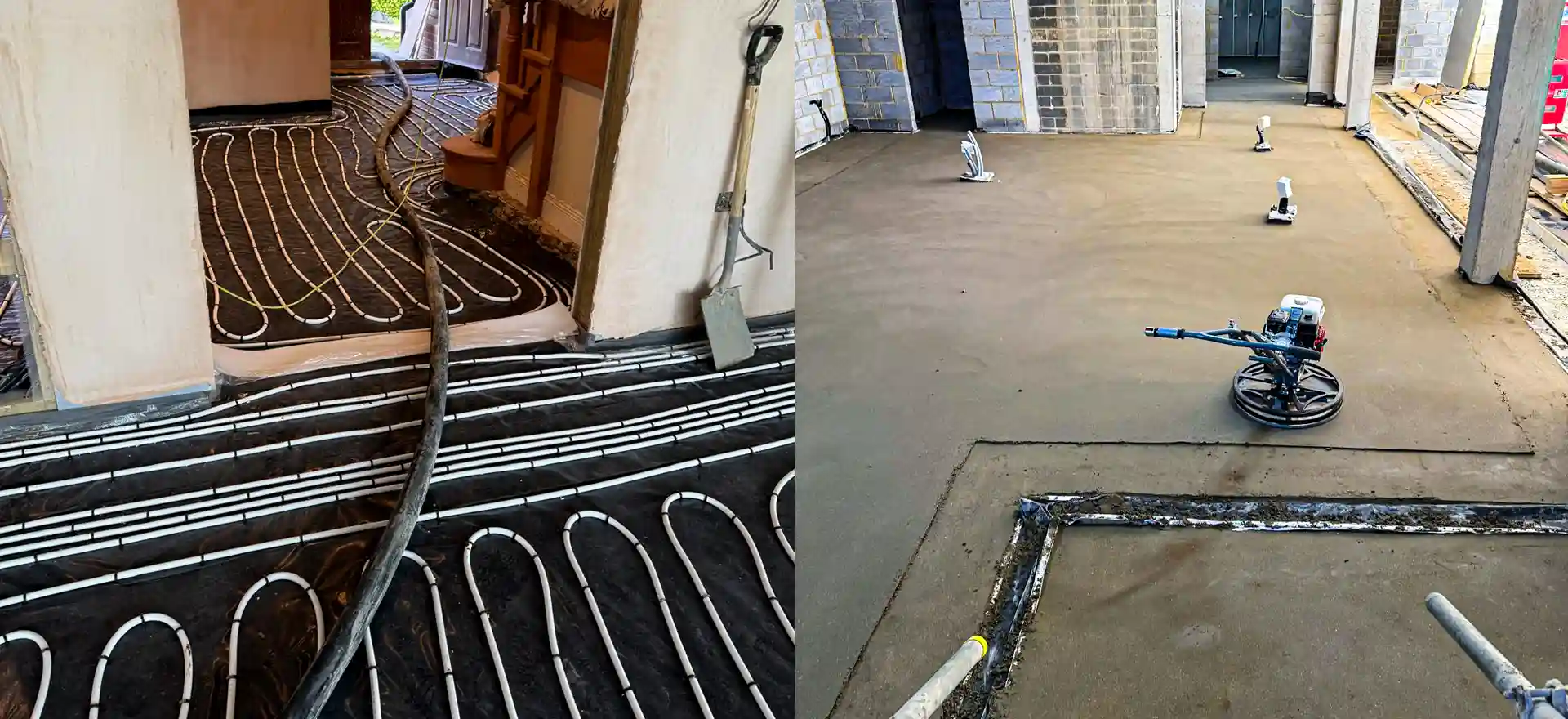
In a Victorian house, a heated floor usually means lowering or rebuilding the ground floor. The finished level is fixed by the hall and doorways, so the build up has to fit: insulation, membrane, pipes and screed, all within the depth that can be dug.
That is why a thin screed matters. Liquid screed can sit with as little as 25mm over the pipes, about 45 to 50mm for the whole floor, whereas sand and cement needs roughly 45mm above the pipework alone and so builds up deeper. In a lowered Victorian floor in St Margarets, Twickenham or Richmond, pumped liquid screed over the pipes is usually the one that fits, and because it flows fully around each pipe there are no air pockets to slow the heat.
Stone and engineered timber add their own demands. Stone needs a stiff, flat base and a screed that is dry. Timber needs moisture well below the level at which it can swell. Both suit a screed that is flat to SR2 or better and dried properly before fixing. A floor that is flat and dry costs less to finish, because the stone fitter does not have to pack out hollows in adhesive.
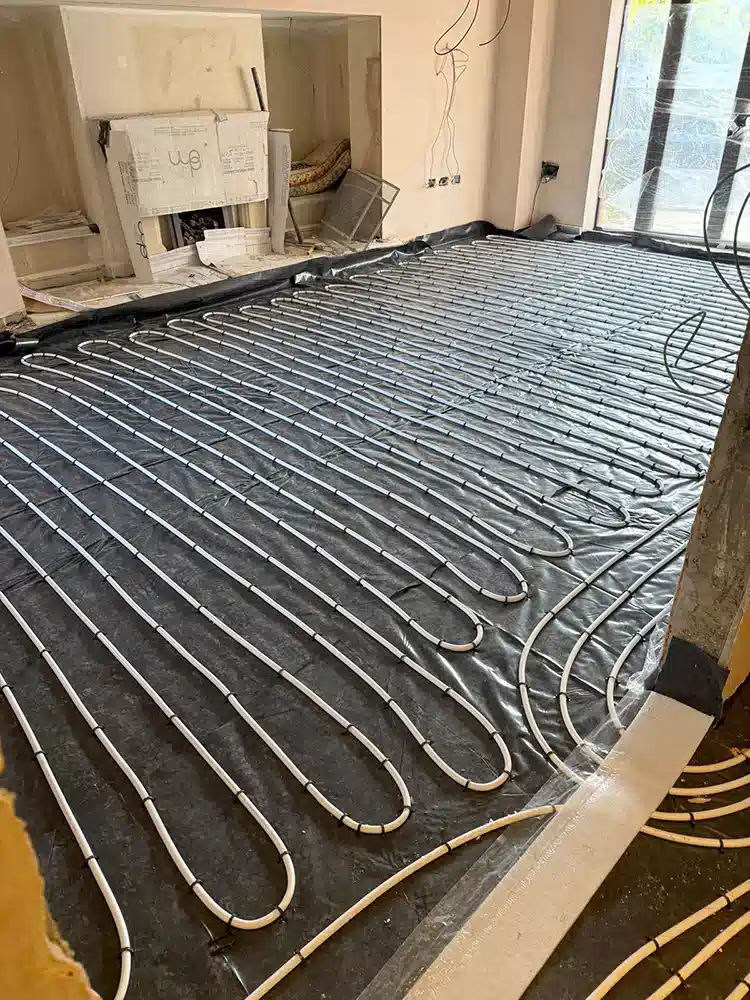
Before the pour, the heating engineer fills and pressure tests the pipes and leaves them under pressure. Should the insulation, membrane or perimeter strip not be there yet, we can provide them as part of our insulation and membranes work.
Heated extensions on Richmond upon Thames inter-war semis
Homes built between 1919 and 1944 make up 24% of the borough, and inter-war semis here take large rear extensions. Underfloor heating suits those rooms well, as it frees the walls and spreads heat evenly across a wide floor. The screed must still meet the existing floor precisely, so cover depth and insulation are planned from the finished level down. The heating engineer's pipe layout, the insulation thickness and the screed depth should be agreed together before the extension slab is cast.
Commissioning follows the screed. A calcium sulphate floor can take its first heat about 7 days on, while sand and cement must be left for 21 days or more. The water goes in cool and is turned up gradually across several days, to the pipe maker's schedule, then held there until the stone or timber is laid.
A floor heated straight to full can crack, and stone or timber laid on a screed that is still wet can fail later. The how long screed takes to dry guide explains how the warm up and drying work together.
Heated shower and wet room floors in Richmond refurbishments
Where a high specification refurbishment carries underfloor heating into a bathroom or walk-in shower as well as the kitchen, the choice of screed changes, because the floor has to fall to a drain and may get wet.
Calcium sulphate screed is not suited to a floor that may get wet, and a self-levelling screed will not hold a fall. So a heated wet room is usually laid in sand and cement, shaped by hand to fall toward the drain. The pipes sit level, so the cover is measured at the lowest point of the fall, near the drain, and must still be about 45mm there. The screed is deeper toward the edges of the room as a result.
That means the build-up starts lower than in a dry room. Insulation goes under the pipes, a membrane over it and an edge strip round every wall. Waterproofing goes on the finished screed later and belongs to the bathroom fitter or tiler.
Upstairs is a different question. A first floor bathroom in a Victorian house often sits on timber joists, so a full-depth sand and cement screed is only an option once a structural engineer has confirmed the floor can carry it.
Where the bathroom opens off a heated room in liquid screed, the two floors meet at the doorway with a joint between them. Each part is laid in the material that suits it, and one written heat-up schedule covers both.
Underfloor heating screed prices in Richmond upon Thames
Liquid screed over underfloor heating: £20 to £35 per m² supplied and laid (trade2base, June 2026), so £700 to £1,230 for 35 m². trade2base gives these figures excluding VAT. See our liquid screed cost per m² guide, the floor screeding cost guide or the screed calculator.
Who lays your underfloor heating screed in Richmond upon Thames
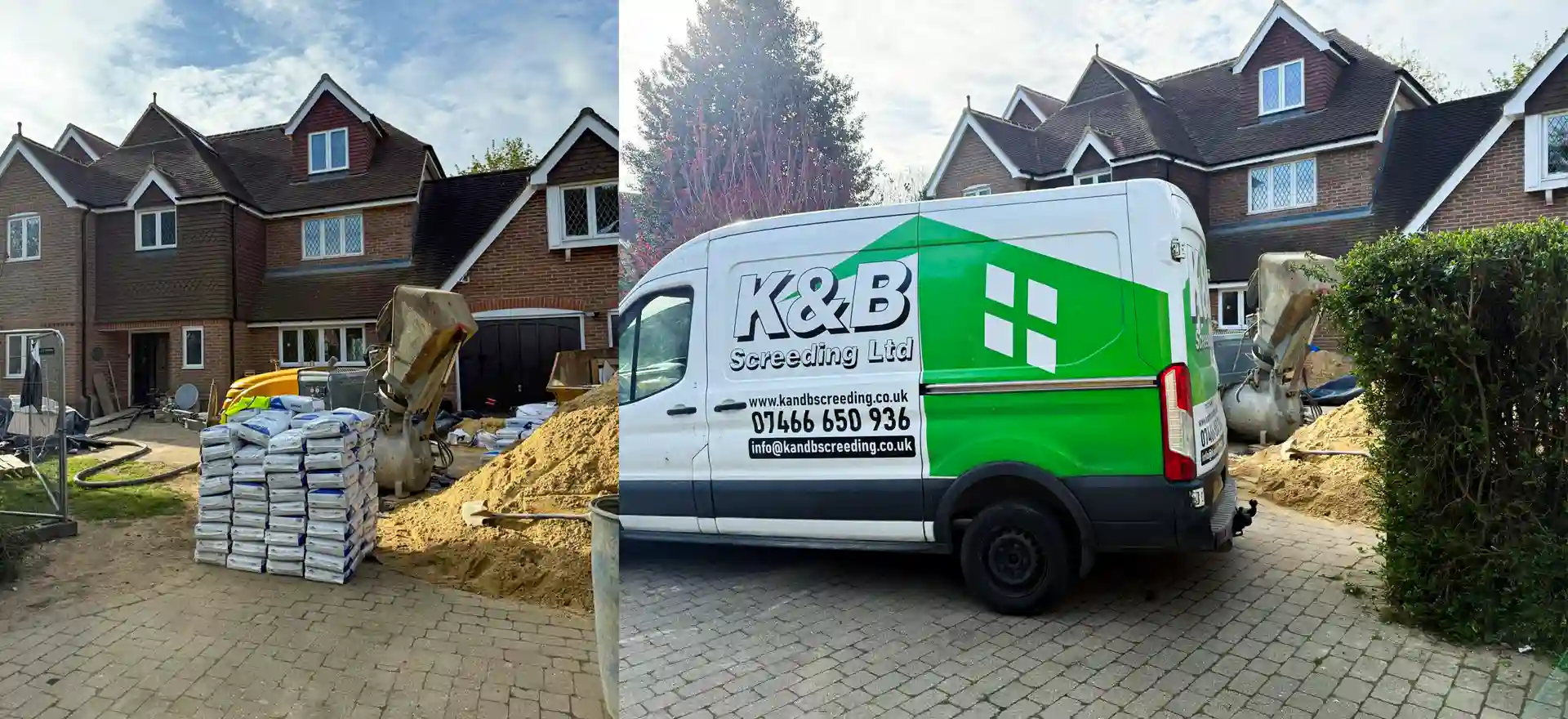
K & B Screeding’s own team, led by director Donatas Bardisevicius. Founded 2019, company 12298780.
See what customers say in our Google reviews and on our testimonials page.
Underfloor heating screed from Slough to Richmond upon Thames
Richmond upon Thames is about 15.6 miles east-south-east of our Slough base as the crow flies, with postcodes including SW13, SW14, TW10 and TW12. The nearest towns to it are Hounslow (2.5 miles), Kingston upon Thames (4 miles), Ealing (4.9 miles) and Sunbury-on-Thames (5 miles).
In Richmond upon Thames, road space for the screed lorry means a bay suspension from Richmond Council (parking suspension), and your quote will say whether one is needed. For an extension in Richmond upon Thames, the floor usually needs building regulations approval, including Part L insulation in England. Local building control is Richmond Council Building Control.
More on underfloor heating screed, part of our screeding services. For every screed we lay locally, see floor screeding in Richmond upon Thames.
Further reading: screed thickness guide and underfloor heating on a concrete floor.