
Specifying calcium sulphate for new flats at Mortlake
New building is rare in this borough. Just 2% of homes were built in 2015 or later, so a scheme on the scale of the Stag Brewery stands out. New build flats are the kind of floor where calcium sulphate flow screed may be specified, often over insulation and underfloor heating.
A calcium sulphate screed is graded under the European screed standard, and the code on the drawing tells everyone on site what the floor must achieve. Reading CA-C25-F5 from left to right: CA for calcium sulphate, then compressive strength after the C and flexural strength after the F, each in N/mm2. For homes with little wear, CA-C20-F4 is enough. One step up, CA-C25-F5 is what most housing and office drawings name. Floors that see more wear, such as busy common areas, take CA-C30-F6. The engineer sets the grade, and that grade is what is poured.
Sometimes the engineer picks an alpha hemihydrate product instead, because the floor has to dry sooner or be laid thinner. In that case the maker's data sheet decides the depth and heating, and it overrides the usual guidance.
Because it hardly shrinks while curing, calcium sulphate can go down in wide bays with few joints, which helps across open flats and long corridors. The bay and joint layout, over thresholds and between heating zones, is fixed before the pour. For background on the binder itself, read anhydrite screed explained.
Laitance and moisture before stone in Richmond upon Thames
Beyond new build, anhydrite can also go into house refurbishments where the finish is stone or engineered timber. Either way, the pour is only half the job, and the steps after it decide whether the finish stays down.
While it dries, a soft, chalky film called laitance rises to the surface. We sand that away before any adhesive or compound is applied, then seal the floor with a primer that suits calcium sulphate. Moisture testing follows. Flooring and adhesive makers are often stricter about moisture in calcium sulphate than in cement, so the go ahead for stone or timber comes from a hygrometer reading, not the programme. Where heating is fitted, it can be used to dry the floor out from around 7 days.
Wet rooms and showers are the exception. In a Twickenham or St Margarets refurbishment, those floors take a cement based flowing screed or a cement screed laid to falls toward the drain, because anhydrite should not sit where it may get wet. Where a sanded floor needs SR1 before thin vinyl, a skim of levelling compound on sanded anhydrite finishes it.
Anhydrite & Flow Screed prices in Richmond upon Thames
Liquid flowing screed (which includes anhydrite): £24 to £31 per m² supplied and laid (MyJobQuote, August 2026), so £960 to £1,240 for 40 m². MyJobQuote does not say whether these figures include VAT. See our floor screeding cost guide or screed calculator.
Who lays your anhydrite and flow screed in Richmond upon Thames
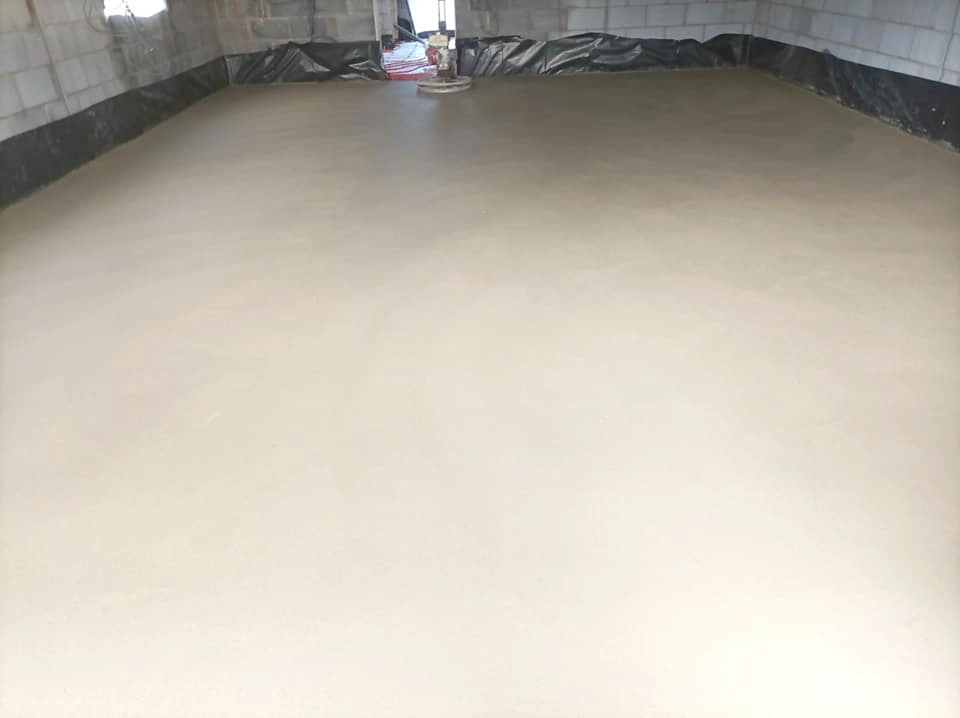
K & B Screeding’s own team, led by director Donatas Bardisevicius. Founded 2019, company 12298780.
See what customers say in our Google reviews and on our testimonials page.
Anhydrite & Flow Screed from Slough to Richmond upon Thames
Richmond upon Thames is about 15.6 miles east-south-east of our Slough base as the crow flies, with postcodes including SW13, SW14, TW10 and TW12. The nearest towns to it are Hounslow (2.5 miles), Kingston upon Thames (4 miles), Ealing (4.9 miles) and Sunbury-on-Thames (5 miles).
More on anhydrite screed, part of our screeding services.
