
Specification grades for Old Oak and Earls Court apartments
The grade printed on a White City or Earls Court drawing follows the coding that the British Standard for screed materials lays down. In the code, C is followed by the compressive strength and F by the flexural strength, each in N/mm2. Three grades cover most buildings. For a domestic floor that sees light traffic, CA-C20-F4 is enough. Most flats, houses and offices take CA-C25-F5. Heavier use moves you up to CA-C30-F6.
On a new block at Old Oak, Earls Court or White City, the engineer sets the grade and we pour what is written. Now and then an engineer opts for an alpha hemihydrate, because it can go down thinner or dry out sooner. Each has its own product sheet setting depth and drying times, which we follow to the letter.
Apartment floors suit it because it hardly shrinks as it sets. That lets big bays go down with few joints; the ones still needed, at door thresholds or between heating zones, are set out and agreed before pouring. The whole build-up beneath, from insulation to edge strip, is prepared by our own team, so the screed is not poured onto someone else's gaps or loose insulation boards. When we finish, you get our advice on drying and laitance in writing.
Homes dating from 2015 or later account for 11% of the total here. Before refitting a floor in a recent flat, ask the developer or managing agent which grade and product went down. To understand what calcium sulphate does as it cures, see how anhydrite screed works.
Sanding and moisture tests before Hammersmith floors are finished
Pouring calcium sulphate is only part of the job. Drying leaves laitance behind: a thin, weak layer on the surface. Unless it is sanded away before any adhesive or levelling compound, the new finish is bonded to nothing better than a crust. With the weak skin sanded away, we roll on a primer that calcium sulphate will accept.
Moisture testing comes next. Wood and LVT suppliers often cap moisture lower for this material than for cement, so an Earls Court floor can seem dry underfoot yet be too damp to lay on. We go by the hygrometer, never by counting days. With heating in the floor, force drying can normally start at around 7 days.
Lasting moisture weakens calcium sulphate, so it has no place in rooms that might get wet. Anywhere water may sit, whether a wet room or a plant room where a pipe might leak, we use cement based flowing screed or traditional screed trowelled by hand. A base that needs work before pouring is a job for our floor preparation team. The same specification points apply on apartment schemes in Westminster.
Anhydrite & Flow Screed prices in Hammersmith and Fulham
Liquid flowing screed (which includes anhydrite): £24 to £31 per m² supplied and laid (MyJobQuote, August 2026), so £960 to £1,240 for 40 m². MyJobQuote does not say whether these figures include VAT. See our floor screeding cost guide or screed calculator.
Who lays your anhydrite and flow screed in Hammersmith and Fulham
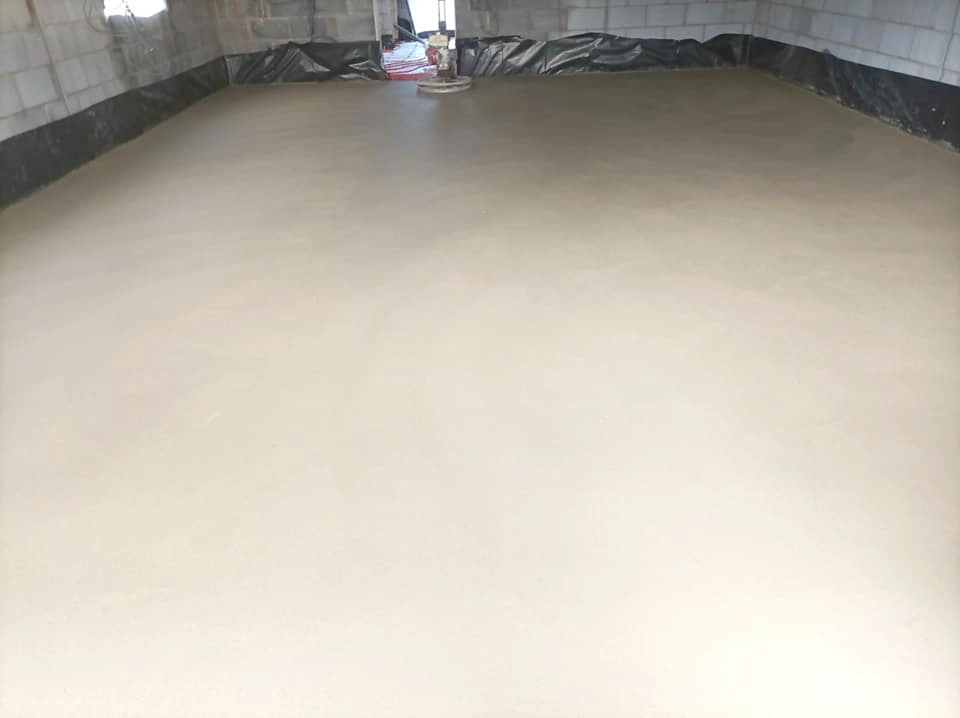
K & B Screeding’s own team, led by director Donatas Bardisevicius. Founded 2019, company 12298780.
See what customers say in our Google reviews and on our testimonials page.
Anhydrite & Flow Screed from Slough to Hammersmith and Fulham
On the map, Hammersmith and Fulham sits east of Slough, about 18.6 miles from our base in a straight line (postcodes including W6, NW10, W3 and SW6), next to Kensington and Chelsea (1.2 miles), Westminster (2.8 miles), Wandsworth (3.7 miles) and Brent (4.3 miles).
More on anhydrite screed, part of our screeding services.