
Where pumped liquid screed suits White City and Earls Court
Liquid screed earns its place on big, open floors. It is pumped straight from the mixer, flows out level under its own weight and can cover a large area in a single visit. That is why new buildings at White City and Earls Court use it across their floor plates, and why it suits flats in purpose-built blocks, which make up 48% of homes here.
Homes built from 2000 onwards make up 18% of the borough's total. Newer floors like these are usually designed around a flowing screed laid over insulation, so a refit or repair in one of those flats often means matching the same material.
Depth depends on use. In a flat or house, a floating pour starts at about 35mm deep; on commercial floors, about 40mm. It reaches SR1 or SR2 regularity without much trouble, and that counts when a thin finish is going on top. It also shrinks less than sand and cement, which means far fewer joints.
The term covers two materials: calcium sulphate based and cement based liquid screeds. Both go through the pump; which one you want comes down to the room and what is going on top. Torn between pumping and hand laying for a Fulham back extension? Our comparison of flowing and traditional screeds weighs them up. How we set up the pump and lay out the hose on site is explained under screed pumping. Pumps and machines are not available to hire from us.
Getting the hose into a Fulham terrace or upper flat
On a Fulham terrace, the question is rarely whether liquid screed will work in the room. It is how the pump reaches it. The mixer and pump stand in the street, so a space close to the frontage makes the day far simpler. From there the hose runs through the front door and along the hall, or over the side return, to the extension at the back. Before any screed comes through, we cover the floors and doorways on its path.
Upper floor flats need a little more thought. A hose can be run up a communal stair or lifted through a window, depending on the building and what the freeholder allows. Photos of the frontage, the stair and the room make the plan accurate.
Light foot traffic can start 24 to 48 hours on. Tiles and timber are another matter: below 40mm deep, each millimetre needs around a day to give up its moisture, beyond that it is slower still, and a moisture meter has the last word.
Liquid screed is also the usual choice over a new wet heating system, because it flows fully around the pipes with no voids. Depth over the pipes and how to warm the floor up are both covered on our heated screed page for the borough. For a comparable job to the west, see liquid screed in Ealing.
Liquid Screed prices in Hammersmith and Fulham
Liquid screed: £24 to £31 per m² supplied and laid (MyJobQuote, August 2026), so £960 to £1,240 for 40 m². MyJobQuote does not say whether these figures include VAT. See our floor screeding cost guide or screed calculator.
Who lays your liquid screed in Hammersmith and Fulham
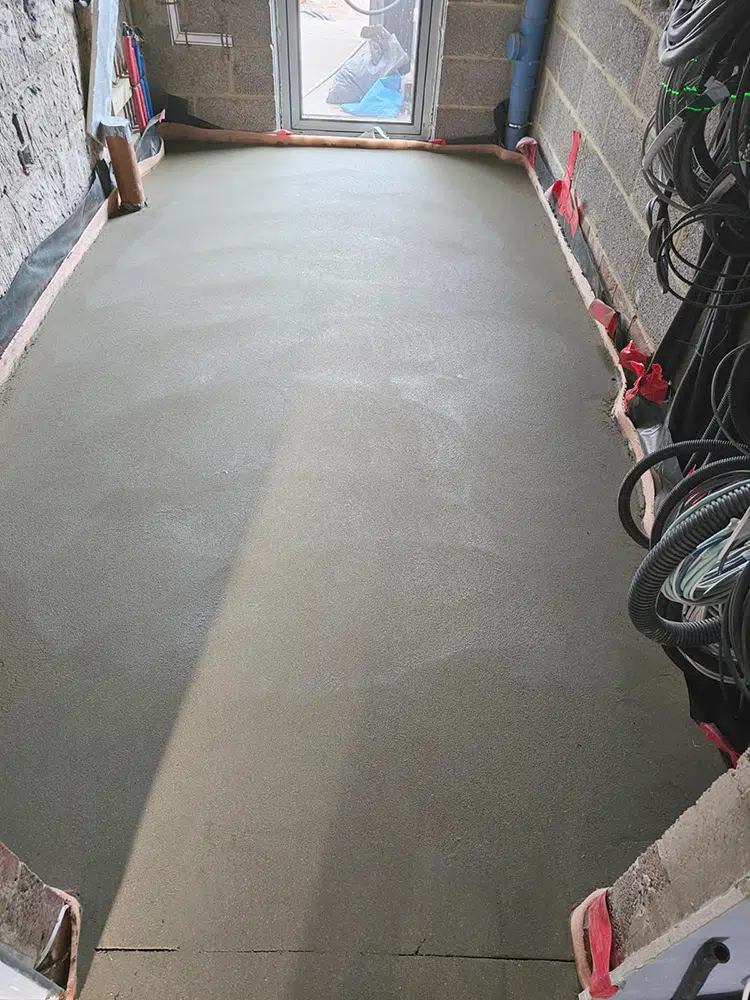
K & B Screeding’s own team, led by director Donatas Bardisevicius. Founded 2019, company 12298780.
See what customers say in our Google reviews and on our testimonials page.
Liquid Screed from Slough to Hammersmith and Fulham
On the map, Hammersmith and Fulham sits east of Slough, about 18.6 miles from our base in a straight line (postcodes including W6, NW10, W3 and SW6), next to Kensington and Chelsea (1.2 miles), Westminster (2.8 miles), Wandsworth (3.7 miles) and Brent (4.3 miles).
More on liquid screed, part of our screeding services.
