
Where pumped screed fits in Vauxhall and South Lambeth
Liquid screed pays off on floors that are large, open and ready for a single continuous pour. In Lambeth the clearest example is the building going on in Vauxhall and South Lambeth, where high density homes and offices are rising around the Northern line extension and Nine Elms. New floors of that scale are usually planned around a continuous pour over insulation, which is what a flowing screed is made for.
Newer stock is a real share of the borough: 18% of its homes were built since 2000. Buildings of that age tend to have level, well insulated floors that suit a pumped product, and they usually need less depth than a traditional screed. Laid floating over insulation in a house or flat, liquid screed can go down from about 35mm where sand and cement would want around 65mm, and that saved depth is useful when the new floor must line up with a door or threshold already in place.
Flatness is the other gain. Because it finds its own level, a flowing screed hits SR1 or SR2 without much trouble, and its shrinkage is low enough that a large open room needs far fewer joints. That makes it a good base for large tiles or engineered boards.
Flowing screed comes in two families: one uses a calcium sulphate binder, the other cement. The grades of the first are covered under anhydrite screed for Lambeth jobs, while our comparison of pumped and hand-laid screed weighs the two methods against each other.
Getting the hose to a Lambeth flat
Everything noisy stays parked up outside; only the hose travels in to the room being screeded. On an upper floor it goes up the stairwell or, in some blocks, through a window, so the route needs to be agreed with the building manager and protected before the day. Where the street has controlled parking, a suspended bay or a permit may be needed for the mixer, and that takes time to arrange.
Before the pour, each wall needs its edge strip fixed, the insulation needs a membrane laid over it with taped joints, and every doorway needs a dam to hold the screed in. In a flat, the acoustic layer below the screed is just as important, because it controls how much noise reaches the neighbour underneath.
For the first two days after the pour, shut the doors and windows and keep draughts off the floor. You can cross it on foot from 24 to 48 hours, though the finished flooring must wait until the screed is dry enough for the covering you have picked. As a rough rule, count a day for each millimetre up to 40mm, then longer again for anything thicker. For more on the pump side of the job, see our screed pumping service.
Liquid Screed prices in Lambeth
Liquid screed: £24 to £31 per m² supplied and laid (MyJobQuote, August 2026), so £960 to £1,240 for 40 m². MyJobQuote does not say whether these figures include VAT. See our floor screeding cost guide or screed calculator.
Who lays your liquid screed in Lambeth
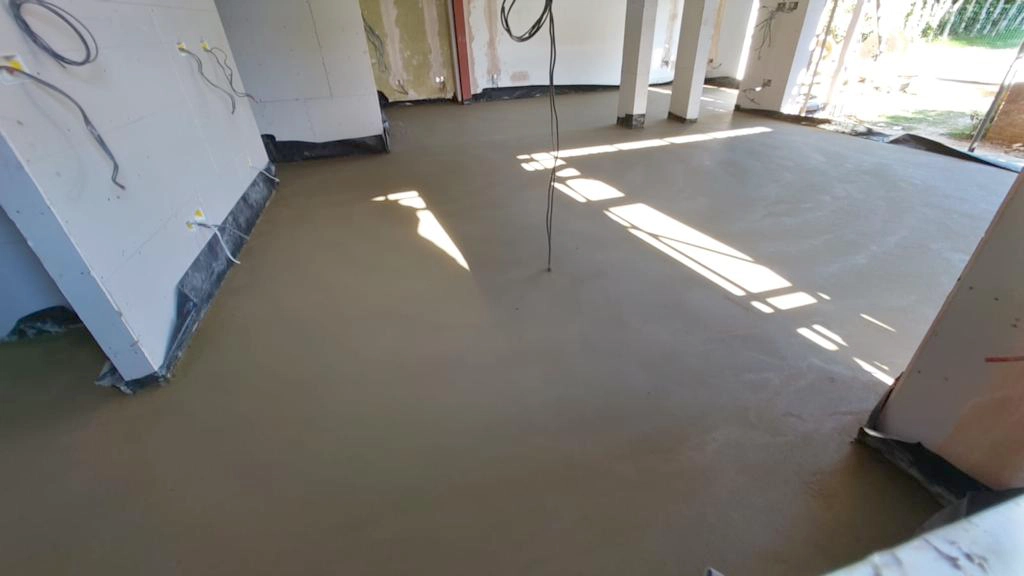
K & B Screeding’s own team, led by director Donatas Bardisevicius. Founded 2019, company 12298780.
See what customers say in our Google reviews and on our testimonials page.
Liquid Screed from Slough to Lambeth
Lambeth is about 23.3 miles east-south-east of our Slough base as the crow flies, with postcodes including SW9, SE24, SW4 and SW8. The nearest towns to it are Southwark (2.1 miles), Wandsworth (2.9 miles), Lewisham (4.2 miles) and Westminster (4.3 miles).
More on liquid screed, part of our screeding services.
