
Rebuilding old ground floors in Brixton's Victorian houses
Pull up the old solid floor in a Brixton house like this and you frequently find no membrane under it. Damp from the ground then rises into the floor and spoils any new covering laid over it. The fix is to dig the slab out, put in a fresh sub-base if needed, add insulation plus a membrane to stop the damp, then lay the new screed above them. That kind of rebuild is where sand and cement earns its keep.
The borough's conversions are part of the picture. About 22% of Lambeth homes are flats in converted houses or other converted buildings, and Brixton's grand Victorian houses are among them. Converted flats tend to have small rooms and narrow doorways, and a hand-laid screed adapts to that far more easily than a pumped one.
In a Brixton house, the depth depends on the base underneath. Over insulation in a house it floats and wants about 65mm; stuck directly to a sound, prepared slab as a bonded screed, 25 to 40mm can be enough. A floor that needs early foot traffic, or one where the substrate must be cementitious for a particular adhesive, also points to sand and cement.
We can put down that membrane and insulation ourselves ahead of the screed as part of our insulation and membrane service. Our screed thickness guide sets out typical depths for other floor build-ups.
Wet rooms, falls and drying in Lambeth flats
Bathrooms and wet rooms are a common reason to choose sand and cement in a converted flat. Hand-laid screed can be shaped to slope down to a floor drain, and it stands up to water where calcium sulphate would not. That makes it the usual base under a level access shower or a tiled wet room floor.
The downside is patience: it is slow to dry. Expect around one day for every millimetre up to 40mm and slower going after that, which means a 65mm floor in a Lambeth bathroom needs several weeks before it will take most finishes. Rapid drying additives can shorten that, and our quick drying screed is worth considering when a flooring date is fixed.
Only 15% of homes in the borough are terraced houses, but where one is being extended the join between the old floor and the new one needs care. Levels have to meet, and the two floors may need a movement joint. If the existing floor is sound but uneven after the work, levelling the Lambeth floor with compound can finish it off.
Across the border, Southwark's hand-laid screed page covers the same work.
Sand and Cement Screed prices in Lambeth
Sand and cement screed: £18 to £25 per m² supplied and laid (MyJobQuote, August 2026), so £450 to £630 for 25 m². MyJobQuote does not say whether these figures include VAT. See our floor screeding cost guide or screed calculator.
Who lays your sand and cement screed in Lambeth
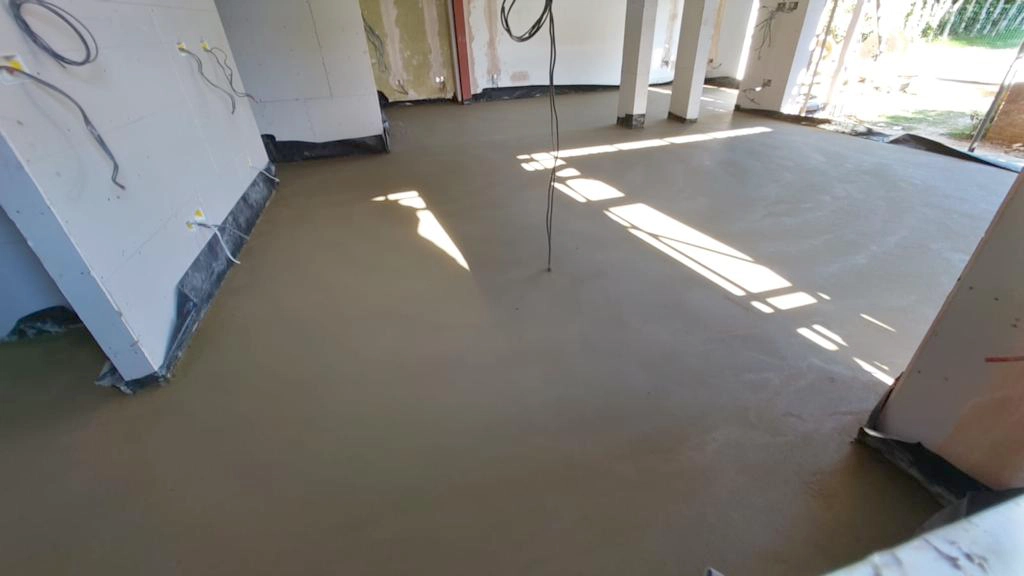
K & B Screeding’s own team, led by director Donatas Bardisevicius. Founded 2019, company 12298780.
See what customers say in our Google reviews and on our testimonials page.
Sand and Cement Screed from Slough to Lambeth
Lambeth is about 23.3 miles east-south-east of our Slough base as the crow flies, with postcodes including SW9, SE24, SW4 and SW8. The nearest towns to it are Southwark (2.1 miles), Wandsworth (2.9 miles), Lewisham (4.2 miles) and Westminster (4.3 miles).
More on sand & cement screed, part of our screeding services.
