
Full build-ups in Earlsfield and Tooting houses
The problem in a house of this age is usually what is missing. Without a membrane, moisture rises into the floor, and any modern finish laid on top can lift, stain or smell. Without insulation, the room loses heat through the ground.
The fix is to break up the old floor and dig deep enough to fit every layer it should have had. That means a damp proof membrane at the bottom, insulation above it and the screed on top. As a floating screed on insulation, a domestic sand and cement floor is laid at 65mm. That depth gives it the strength it needs because it is not bonded to anything below. Breaking out the old floor is part of our floor preparation work, and what goes beneath the screed is set out on our membranes and insulation page.
If the concrete under a Balham or Tooting kitchen is solid and only its top is poor, we can bond a 25 to 40mm screed straight onto it. That saves height, which helps where the new floor must line up with an original hallway or the step into a garden.
Because it is mixed on site and compacted by hand, sand and cement suits the awkward shapes that come with a side return: long, narrow strips, doorways at odd angles and junctions with old walls. We close the surface off hard and flat, ready to take tiles, wood or LVT.
Basements and wet rooms in Wandsworth homes
Basements are a regular part of house work in Wandsworth, and cement is the safer screed below ground. A basement floor may see moisture from the ground or from the waterproofing system around it, and calcium sulphate does not tolerate that. Sand and cement stays sound.
Wet rooms follow the same logic. Water must run off towards the drain, and only a screed laid by hand can be shaped into that slope; a self-levelling one flattens itself out. It is also the right base for the tanking and tiles that follow.
The trade-off is drying. At 65mm, this floor stays damp far longer than a thin liquid pour: roughly a day for each of the first 40 millimetres, and slower after that. A quick drying screed shortens that when the programme is tight.
In 2026 the published range is £18 to £25 per m² for standard sand and cement and £20 to £28 for a quick drying mix. On a small job with no pump to set up, it is often the more economical route.
Sand and Cement Screed prices in Wandsworth
Sand and cement screed: £18 to £25 per m² supplied and laid (MyJobQuote, August 2026), so £450 to £630 for 25 m². MyJobQuote does not say whether these figures include VAT. See our floor screeding cost guide or screed calculator.
Who lays your sand and cement screed in Wandsworth
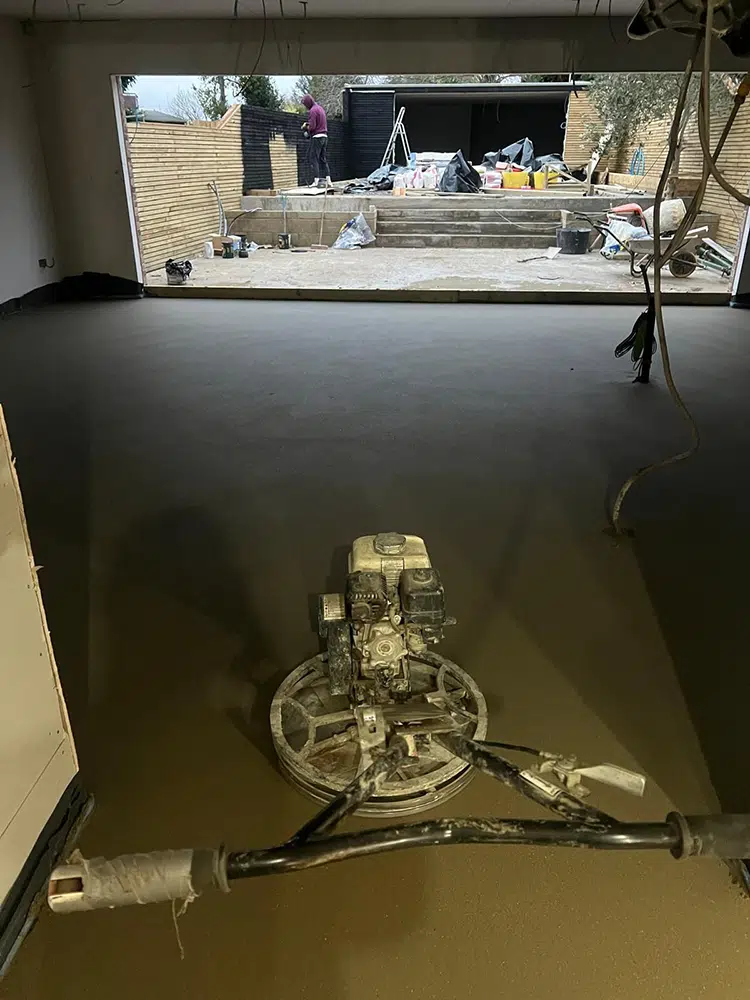
K & B Screeding’s own team, led by director Donatas Bardisevicius. Founded 2019, company 12298780.
See what customers say in our Google reviews and on our testimonials page.
Sand and Cement Screed from Slough to Wandsworth
On the map, Wandsworth sits east-south-east of Slough, about 20.8 miles from our base in a straight line (postcodes including SW12, SW11, SW4 and SW18), next to Merton (2.8 miles), Lambeth (2.9 miles), Hammersmith and Fulham (3.7 miles) and Kensington and Chelsea (3.8 miles).
More on sand & cement screed, part of our screeding services.
