Relaying old solid floors in Norbiton houses
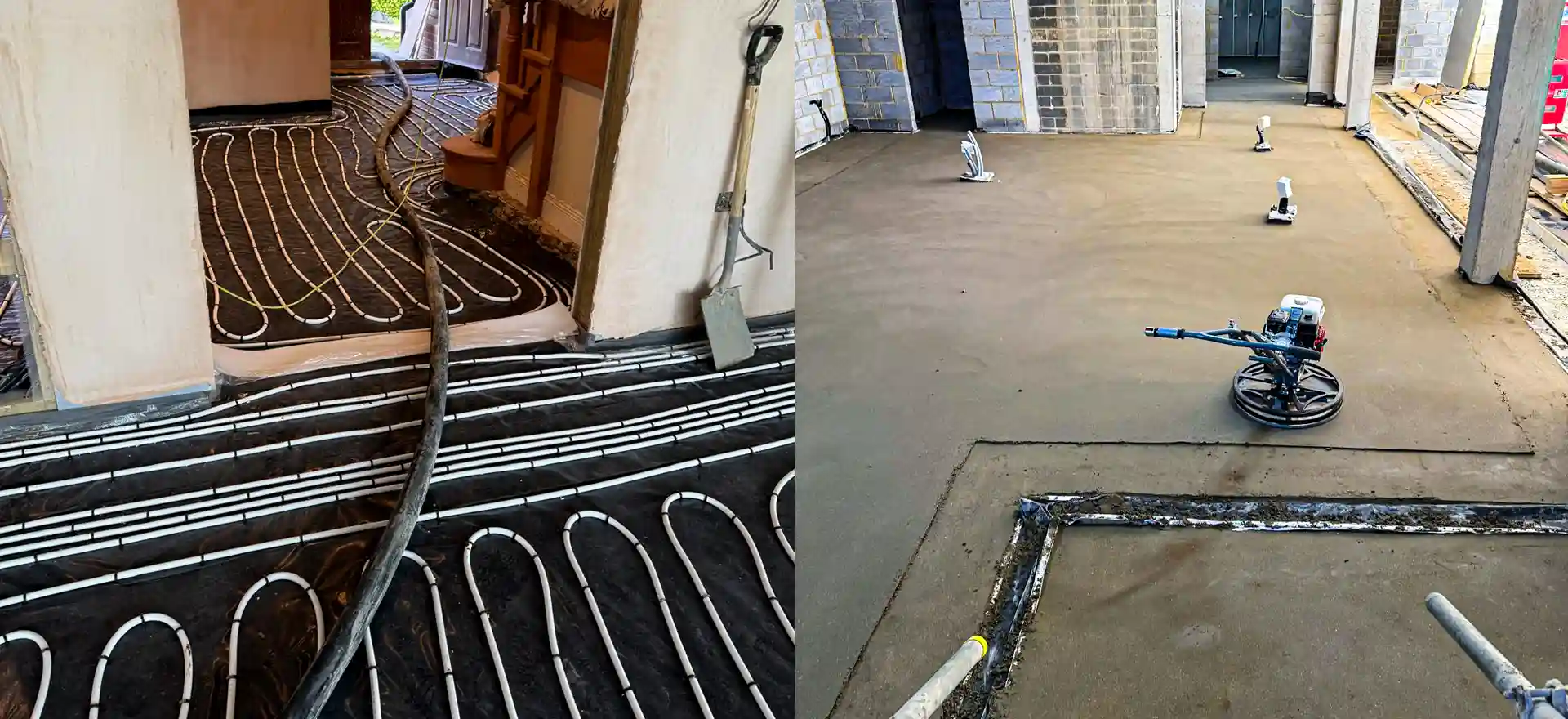
Older solid floors in Norbiton's Victorian and Edwardian houses may lack proper damp protection, and when one cracks, sinks or lets damp spoil the flooring above, patching a Norbiton hallway seldom holds for long. The lasting fix is to break the old floor out, put down a damp proof membrane and insulation, then float a fresh screed over them.
A hand-laid mix is well suited to that kind of Kingston renovation. Each batch is mixed on site, so a narrow hall, a front room and a back kitchen can each get the depth they need on the same day. Because it is spread and tamped by hand, the screed follows chimney breasts, alcoves and awkward doorways without fuss, and because cement is the binder it can sit in rooms that get wet, where calcium sulphate cannot.
Depth drives the plan. Floated over insulation in a Kingston house, this screed goes down at 65mm, while commercial floors in the town centre or on Cox Lane would take 75mm. Where the existing slab is sound, a thinner bonded layer of 25 to 40mm is possible, and published 2026 figures put bonded work at £12 to £18 per m² (trade2base, June 2026). Our bonded screed page covers when a slab qualifies.
Patience is the price. Drying runs at about a day per mm through the first 40mm and slows after that, so a 65mm Norbiton floor needs many weeks before the flooring fitter can start. The guide to screed thickness lists depths for each case.
Garages and interwar homes in Kingston upon Thames
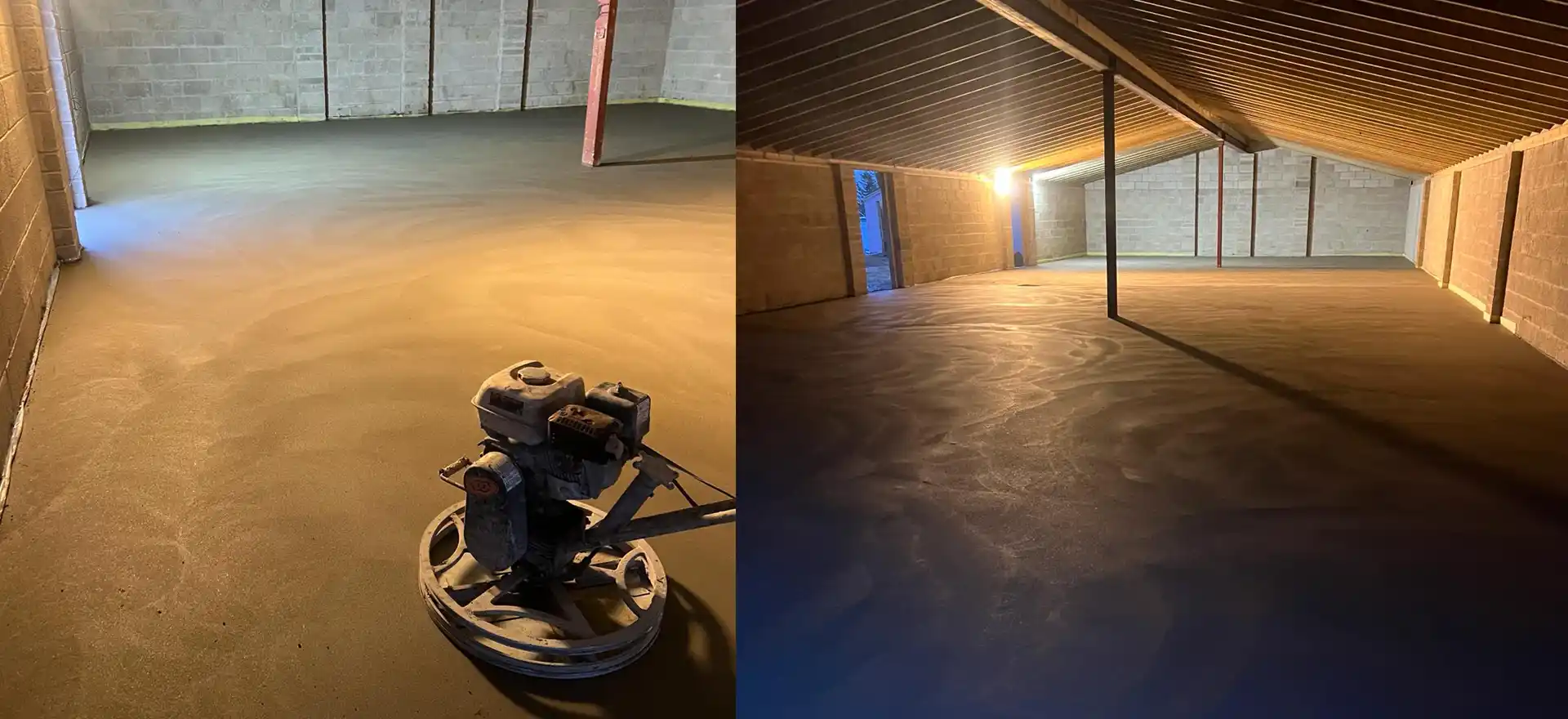
Kingston gained 34% of the homes standing in the borough today between 1919 and 1944, so interwar houses form its largest age group. For owners of suburban Kingston houses, turning an attached garage into a room is one way to gain space, and the floor is where that conversion starts. The garage slab normally sits lower than the house, so it is built up with insulation and a membrane and topped with screed to meet the hallway exactly. Sand and cement fits well because it can be laid to a precise height and gives a cement base that can take load early. Our guide to garage floor screed walks through the layers.
Shower rooms are the second place it earns its keep in a Kingston home. A level access shower needs the floor to fall gently towards the drain, and those falls are shaped by hand in a cement screed. A calcium sulphate floor is the wrong choice anywhere water may lie.
The mix can be tuned for each Kingston job too. Adding fibres costs £1 to £3 per m² and helps resist cracking, while fast drying mixes, at £20 to £28 per m² on published figures, suit a programme that cannot wait. For a broad open-plan extension, weigh this against liquid screed for wide floors.
Mixing screed on site at Kingston upon Thames houses
A hand-laid screed is made where it is laid, so the first question for any Kingston job is where the sand, cement and mixer will go. Sand normally arrives in bulk bags, set down on a driveway or a protected patch of front garden, and the mixer sits close by. Where a house has no off-street space, the bags and mixer need a spot on the road, so tell us about any parking restrictions outside when you ask for a price.
From the mixer, the screed travels by barrow or bucket to the room, and the house type decides the route. Semis make up 32% of the borough's homes, and in a semi with a side passage the route is often round the outside to the back. A terrace, 17% of homes, usually has no side access, so everything comes through the front door. Hall floors, stair carpets and door frames are covered first, and the route stays the same all day so the protection only goes down once.
A dig-out adds a second flow in the other direction. On a Norbiton floor being broken out, the old slab and hardcore come out before the new layers go in, and they need a skip or muck-away bags, which may need a permit if they stand on the road.
A floor that is ready, with the old surface removed and the membrane and insulation on hand, can be laid without stopping, and that saves a second visit.
Sand and cement screed prices in Kingston upon Thames
Sand and cement screed: £18 to £25 per m² supplied and laid (MyJobQuote, August 2026), so £450 to £630 for 25 m². MyJobQuote does not say whether these figures include VAT. See our screed cost per m³ and per tonne guide or screed calculator.
Who lays your sand and cement screed in Kingston upon Thames
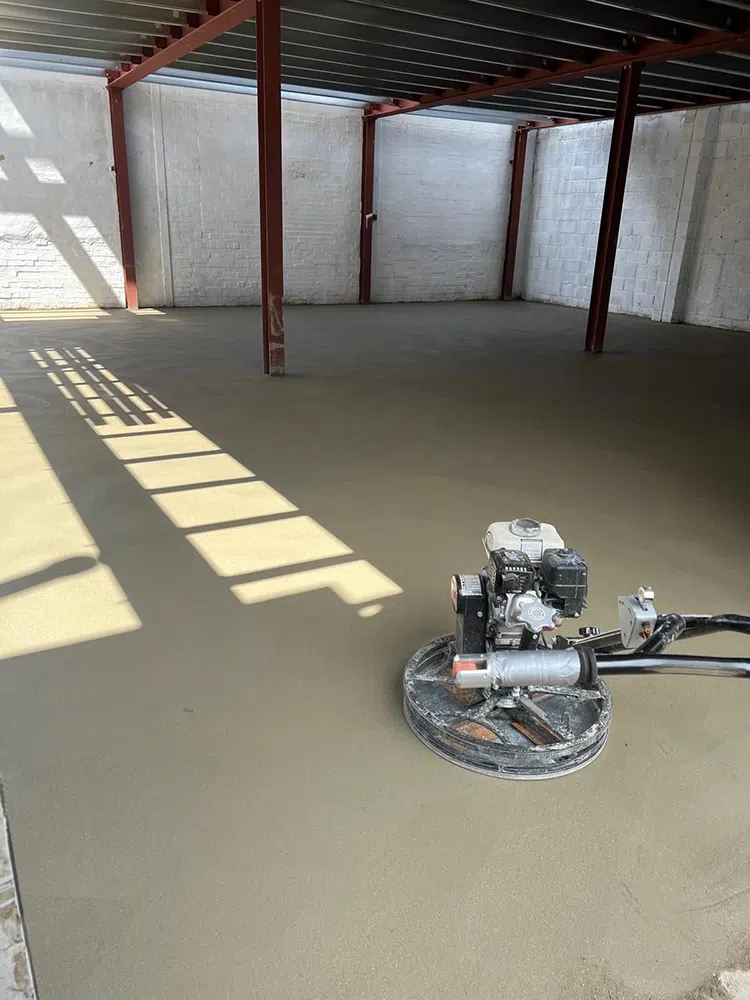
K & B Screeding’s own team, led by director Donatas Bardisevicius. Founded 2019, company 12298780.
See what customers say in our Google reviews and on our testimonials page.
Sand and cement screed from Slough to Kingston upon Thames
As the crow flies, our base in Slough is about 18.4 miles from Kingston upon Thames, which lies to the east-south-east. Postcodes here include KT5, KT9, KT3 and KT2, and Ewell (3.2 miles), Merton (3.4 miles), Richmond upon Thames (4 miles) and Epsom (4.1 miles) are close by.
On Kingston upon Thames streets where the screed pump cannot park off the road, a bay suspension comes from Kingston Council (service for suspending parking restrictions). We confirm on the quote whether it is needed. An extension floor usually needs building regulations approval (Part L sets the insulation standard in England); the council building control service for Kingston upon Thames is Kingston Council Building Control.
More on sand & cement screed, part of our screeding services. For every screed we lay locally, see floor screeding in Kingston upon Thames.
Further reading: screed thickness guide and sand and cement screed mix ratio.