
Anhydrite grades on Norbiton and Tolworth drawings
Open the floor specification for a block on the Cambridge Road Estate or the former government site in Tolworth and, if calcium sulphate has been chosen, the screed line will read something like CA-C25-F5. The letters CA say the binder is calcium sulphate. The number after C is how well the cured screed resists crushing, and the number after F is how well it resists bending, both in N/mm2 and both measured under the British and European standard for screeds.
Three grades cover nearly every Kingston floor. CA-C20-F4 is pitched at domestic rooms that see light foot traffic. CA-C25-F5 is the middle grade that most homes, apartments and offices in the borough would carry. CA-C30-F6 is kept for floors expected to work harder. Whichever one the Norbiton or Tolworth drawings name is the one delivered to the pump, and we never swap in a cheaper mix.
Some designers name an alpha hemihydrate product in place of a CA grade. That usually signals the programme needs the floor dry sooner, or the build-up leaves less room for depth. Those products carry their own data sheet for thickness, drying and heating, and we follow it line by line.
Low shrinkage is why calcium sulphate earns its place on long Kingston apartment floors. It barely moves as it cures, so one bay can run much further than a cement screed before a joint is needed. We still draw the bay and joint plan before pumping, with joints at door thresholds and where a flat opens onto a communal corridor. Our own team lays the insulation, membrane and edge strip underneath. For the chemistry, read how anhydrite screed works, and for pump access to a Kingston site see our Kingston liquid screed page.
Sanding, testing and priming anhydrite in Kingston upon Thames
Before a Kingston flat gets its tiles, LVT or engineered boards, a calcium sulphate floor has to clear three hurdles, in order.
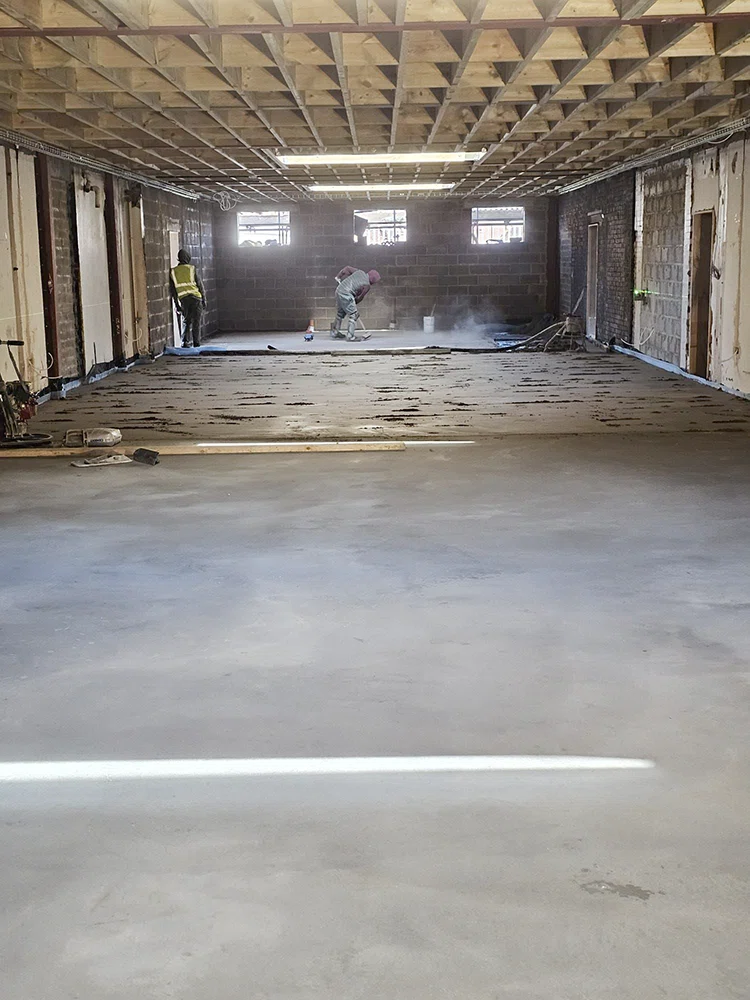
The first is the laitance. As the screed cures, fine material rises and sets as a brittle crust on top. Glue spread on that crust grips the crust rather than the screed, and the finish can let go months later. So once the floor has dried, the crust is ground off with a sander and the dust lifted with an industrial vacuum. If that step has been left undone on a New Malden or Berrylands job, our floor preparation work can pick it up.
The second is a moisture reading. Plenty of flooring brands publish a lower dampness ceiling for calcium sulphate than for cement, so a reading that a cement floor in the same Kingston block would pass can still be a fail here. A hygrometer, not a guess, decides it. Where pipes run through the flat, the heating can usually help the drying from about day 7, turned up a little at a time.
The third is primer. A product made for calcium sulphate seals the sanded surface so adhesive or levelling compound has a sound, compatible face to bond to.
Water is the one thing anhydrite is not built for. In a Kingston apartment, the shower room and any wet room get a cement based flowing screed or a hand-laid cement floor instead. Your drying and laitance notes come to you in writing at handover.
Anhydrite & Flow Screed prices in Kingston upon Thames
Liquid flowing screed (which includes anhydrite): £24 to £31 per m² supplied and laid (MyJobQuote, August 2026), so £960 to £1,240 for 40 m². MyJobQuote does not say whether these figures include VAT. See our floor screeding cost guide or screed calculator.
Who lays your anhydrite and flow screed in Kingston upon Thames
K & B Screeding’s own team, led by director Donatas Bardisevicius. Founded 2019, company 12298780.
See what customers say in our Google reviews and on our testimonials page.
Anhydrite & Flow Screed from Slough to Kingston upon Thames
As the crow flies, our yard in Slough is about 18.4 miles from Kingston upon Thames, which lies to the east-south-east. Postcodes here include KT5, KT9, KT3 and KT2, and Ewell (3.2 miles), Merton (3.4 miles), Richmond upon Thames (4 miles) and Epsom (4.1 miles) are close by.
More on anhydrite screed, part of our screeding services.
