
Reading a calcium sulphate specification in Nine Elms
Each anhydrite grade takes its name from a strength class set out in the European screed materials standard. Read CA-C25-F5 on a Nine Elms drawing like this: C25 is the compressive figure and F5 the flexural one, both in N/mm2. CA-C25-F5 is the usual match for houses, flats and offices, CA-C20-F4 is enough where a home's floor sees light use, and CA-C30-F6 is there for harder wear.
On the apartment and office floors going up around Vauxhall, South Lambeth and Nine Elms, the specification usually states the grade, the depth and the build-up beneath. We follow that spec, have our own crew set out the insulation and membrane, and work out bay sizes and joint positions ahead of pumping. Calcium sulphate shrinks very little, so large bays are possible with few joints, which suits the open floor plates of new blocks.
Some specifiers go for an alpha hemihydrate product instead, usually because they want quicker drying or a thinner layer; with these, the maker's data sheet sets the rules, not general guidance. On a tight programme, or where floor height is limited, a specifier may name one.
There is one clear limit. Anhydrite is the wrong material for floors that will see water in use, plant rooms and wash areas being two examples; for those, a flowing screed with a cement base is used instead. For a wider explanation of the material, read our anhydrite screed explained guide, and for pumped screeds in general, see liquid screed across Lambeth.
Laitance, testing and primers on Lambeth apartment floors
Drying anhydrite forms a weak crust on its surface, called laitance, and whether the floor is in a Kennington flat or a Nine Elms block, it has to go. Once the screed is dry enough, the crust is sanded back and every trace of dust cleared, so the adhesive bonds to sound material. Skipping this step is a common cause of floor coverings failing to bond.
Moisture is the next check. Flooring makers often allow less moisture in an anhydrite floor than in a cement one, which means a reading that would be fine for tiling onto sand and cement can still fail on this material. A hygrometer test tells you when the screed has reached the level the flooring maker requires. On a busy Nine Elms programme, running the underfloor heating to force dry the floor is normally possible from around 7 days.
Priming matters too. Before tiles or smoothing compound go down, the floor is sealed with a primer that is compatible with calcium sulphate, and the flooring contractor should check that their adhesive suits the material. Our written notes on drying and laitance removal come to you, so whoever lays the flooring can see exactly what has been done.
For the same material on sites nearby, see anhydrite screed in Westminster. If an older concrete floor needs grinding before any new screed, our concrete floor grinding service covers it.
Anhydrite & Flow Screed prices in Lambeth
Liquid flowing screed (which includes anhydrite): £24 to £31 per m² supplied and laid (MyJobQuote, August 2026), so £960 to £1,240 for 40 m². MyJobQuote does not say whether these figures include VAT. See our floor screeding cost guide or screed calculator.
Who lays your anhydrite and flow screed in Lambeth
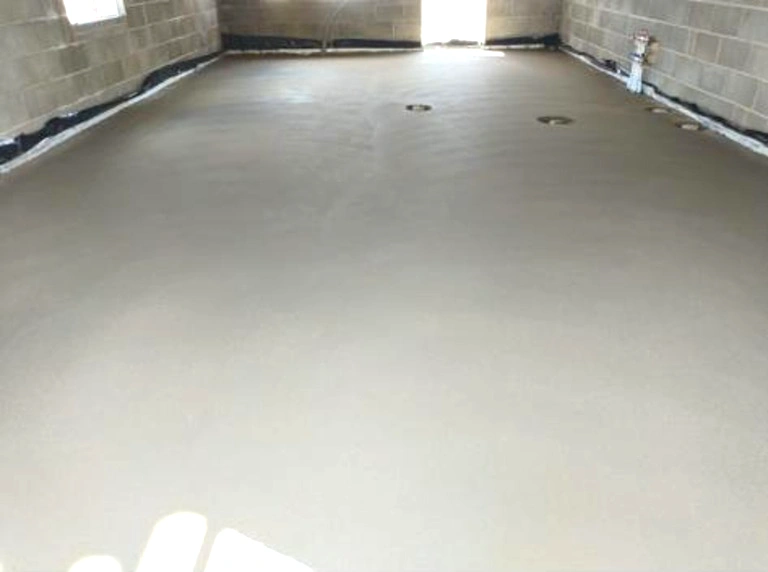
K & B Screeding’s own team, led by director Donatas Bardisevicius. Founded 2019, company 12298780.
See what customers say in our Google reviews and on our testimonials page.
Anhydrite & Flow Screed from Slough to Lambeth
Lambeth is about 23.3 miles east-south-east of our Slough base as the crow flies, with postcodes including SW9, SE24, SW4 and SW8. The nearest towns to it are Southwark (2.1 miles), Wandsworth (2.9 miles), Lewisham (4.2 miles) and Westminster (4.3 miles).
More on anhydrite screed, part of our screeding services.
