
Grades and bay layouts for Croydon apartment floors
Look at the screed line on a Croydon apartment drawing and you will see a code such as CA-C25-F5, set by the European screed materials standard. CA says calcium sulphate; the number after C is how much it withstands in compression, and the number after F its bending strength, each in N/mm2. A quiet bedroom floor needs no more than CA-C20-F4. CA-C25-F5 is the everyday grade, written into most specifications for homes, apartments and offices, and CA-C30-F6 steps in where wear gets harder.
Where an engineer has set the grade for a new plot or block, that is the grade we pump. Now and then the specification names an alpha hemihydrate product, picked because the programme needs quicker drying or the build-up needs a thinner layer. Its own technical sheet then governs depth and drying, rather than the usual rules of thumb.
Croydon has a good deal of newer housing where this applies, with 16% of its homes built since 2000. More is planned: the Purley Way masterplan sets out new homes around new centres at Valley Park, Waddon Marsh and Five Ways.
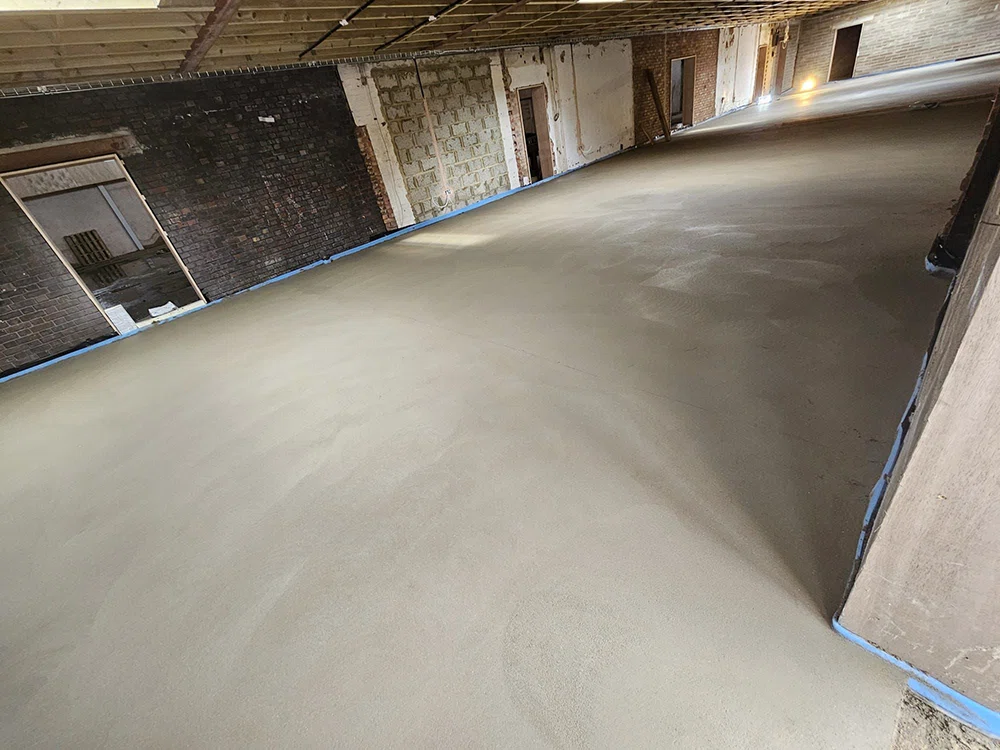
Because it barely shrinks, a whole apartment floor plate can often go down in wide bays with very few joints. Joints are still needed at door thresholds, between heating zones and at changes in shape, and on an apartment floor they are planned before the pour. Flat blocks in central Croydon also call for acoustic floors, so the acoustic layer and edge detail under the screed must be in place first, and our team prepares that full build-up.
Laitance and moisture checks before Croydon flooring goes down
Once poured, a calcium sulphate screed develops laitance, a weak surface skin that has to come off. We take it off with a sander once moisture readings allow, then seal the surface using a primer that is compatible with calcium sulphate. Flooring glued to laitance can debond, which is why this step is not optional.
Before flooring, we check moisture with a hygrometer. A good number of flooring brands allow calcium sulphate less moisture than cement screed, so the reading has to satisfy the data sheet for your chosen floor rather than a blanket figure. If the flat has underfloor heating, it can usually start forcing the drying at about 7 days, turned up slowly.
Anywhere that could see standing water is the wrong place for it. Bathrooms, wet rooms and plant rooms in a block are better in a cement based flowing screed, or in hand-laid sand and cement for Croydon wet areas. How the material works is set out simply in our anhydrite screed guide.
If a flow screed was laid earlier and the laitance was never removed, or the surface has broken down, our screed repairs service can assess it before any flooring goes on.
Anhydrite & Flow Screed prices in Croydon
Liquid flowing screed (which includes anhydrite): £24 to £31 per m² supplied and laid (MyJobQuote, August 2026), so £960 to £1,240 for 40 m². MyJobQuote does not say whether these figures include VAT. See our floor screeding cost guide or screed calculator.
Who lays your anhydrite and flow screed in Croydon
K & B Screeding’s own team, led by director Donatas Bardisevicius. Founded 2019, company 12298780.
See what customers say in our Google reviews and on our testimonials page.
Anhydrite & Flow Screed from Slough to Croydon
As the crow flies, our yard in Slough is about 26.8 miles from Croydon, which lies to the east-south-east. Postcodes here include CR0, CR5, CR8 and CR7, and Sutton (3.7 miles), Caterham (5.7 miles), Bromley (5.8 miles) and Merton (6.3 miles) are close by.
More on anhydrite screed, part of our screeding services.
