
Bathroom and kitchen refits in Croydon's older homes
Most people meet latex screed halfway through a refit, when the fitter lifts the old floor and says the base is not good enough for vinyl. What they mean is that every board joint, nail head, grout line and dip will show through a thin finish within weeks.
Latex screed is the trade's name for a particular levelling compound. It comes as a cement based powder plus a latex liquid, and the two are mixed together with no water added. The result spreads thin, cures with slight flexibility and grips well on surfaces where a water mixed product could let go, such as glazed tile or primed plywood.
In Croydon, 23% of homes were built between 1919 and 1944, and a kitchen or bathroom in a house of that age can have several generations of flooring beneath it. Typical bases include flooring grade plywood screwed over old boards, which gives the latex a stiff, stable surface; quarry or ceramic tiles that are still firmly bonded, cleaned and primed rather than broken out; older concrete with worn patches; and thin, sound residues of old adhesive.
The primer depends on the base. A calcium sulphate screed is always primed after its laitance has been sanded away, and tiles need a primer suited to a surface that absorbs nothing. Getting that wrong is the usual reason a latex layer lifts.
For a fall of more than a few millimetres, a deeper pour is needed instead; Croydon floor levelling explains how flatness classes and compound depths work.
Damp, bouncy boards and bad slopes in Croydon
Latex has limits, and knowing them saves a second refit. It is not a damp treatment, it will not stop boards that bounce, and it cannot take out a large slope.
Damp is the bigger worry in older terraces. Around Thornton Heath, Selhurst and South Norwood, Victorian houses often sit on old solid floors laid without any membrane against damp. Spread latex over one of those and moisture still comes through, lifting the compound and the vinyl together. A hygrometer reading tells us whether the floor is dry. If it is not, the answer is a membrane and new floor, set out on our Croydon sand and cement screed page.
Springy boards fail the same way, more slowly. A thin layer cannot hold a floor still, so loose boards or tired joists are dealt with, then ply is screwed down, before latex goes on.
Level is the last check. If a straightedge shows a dip far deeper than a few millimetres, latex is the wrong product. A thicker compound or a fresh screed comes first, with latex only as a final skim if the finish needs it. For the same service nearby, see latex screed in Bromley.
How we price latex screed in Croydon
A fixed written price within 24 hours, once we know the area and the base. See our floor screeding cost guide.
Who lays your latex screed in Croydon
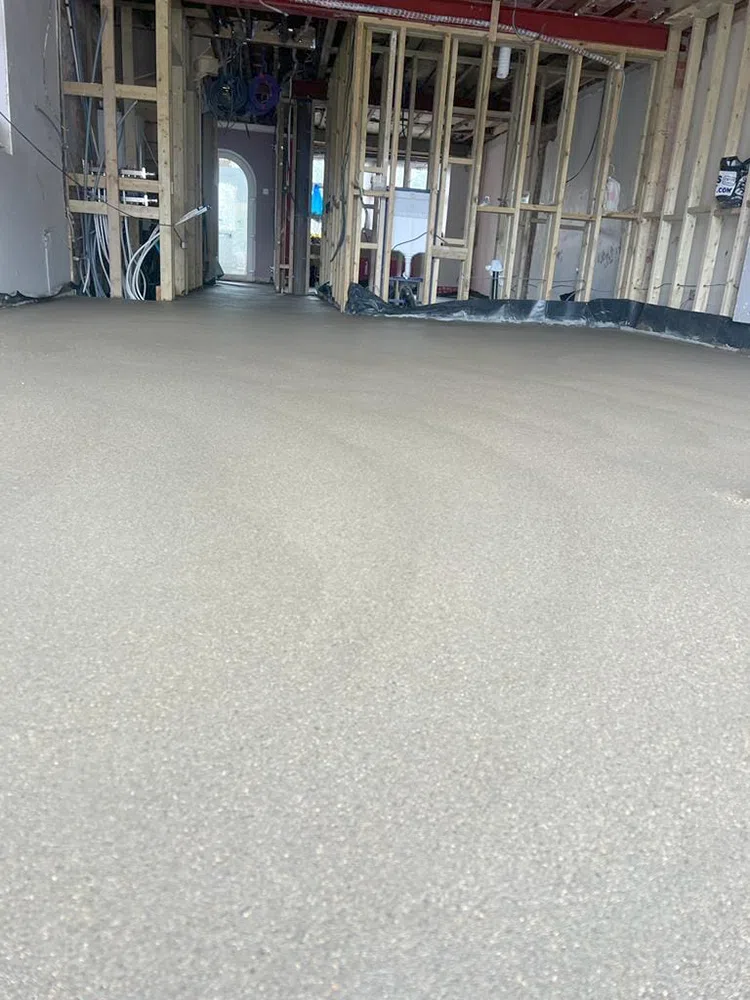
K & B Screeding’s own team, led by director Donatas Bardisevicius. Founded 2019, company 12298780.
See what customers say in our Google reviews and on our testimonials page.
Latex Screed from Slough to Croydon
As the crow flies, our yard in Slough is about 26.8 miles from Croydon, which lies to the east-south-east. Postcodes here include CR0, CR5, CR8 and CR7, and Sutton (3.7 miles), Caterham (5.7 miles), Bromley (5.8 miles) and Merton (6.3 miles) are close by.
More on latex screed, part of our screeding services.