
Calcium sulphate grades on Oxted drawings
If your architect or engineer has specified an anhydrite screed, the drawing will usually give a designation such as CA-C20-F4. The letters CA mean calcium sulphate, and the numbers after C and F give compressive and flexural strength, measured in N/mm2.
The common grades split by use. A house floor with light use can be CA-C20-F4. Homes in general, flats and offices mostly take CA-C25-F5. Where use is heavier, CA-C30-F6 is specified. Purpose-built flats make up 17% of Oxted's homes, and in shared blocks the stronger grades may be called for in communal corridors while the flats themselves use CA-C25-F5.
Alpha hemihydrate screeds are a separate route. They are chosen where faster drying matters or a thinner section is needed, perhaps to fit an extension floor under an existing threshold, and they follow their own product sheet for depth and drying rather than general rules.
Because the material barely shrinks, big areas go in as large bays with only a few joints. Even so, we mark out where each bay and joint will go before pouring, paying most attention to door openings and to the lines where one heating zone meets another.
Keep it away from anywhere water may sit. A shower or wet room in an Oxted extension should get a flowing screed bound with cement, or a traditional hand-laid floor in sand and cement. For the chemistry behind it, see what anhydrite screed is.
Sanding, testing and priming an Oxted anhydrite floor
Pouring the screed is only the first stage. Three more steps decide whether the flooring on top lasts.
First, the laitance, a fragile film that comes up to the surface while calcium sulphate dries. When drying has gone far enough, we take it off with a sander until firm screed shows, then vacuum the dust away. Left on, it is a weak layer that can make adhesive, primer or compound fail. This sanding is part of the floor preparation work that follows the pour.
Second, the moisture test. Flooring makers commonly allow calcium sulphate less moisture than cement screed, which means a floor that looks and feels dry may still be too damp for what you plan to lay. We test with a hygrometer, not the calendar. In a heated extension, the heating can normally be run from around day 7 to help dry the screed, stepping it up gradually.
Third, the primer. A product made for calcium sulphate goes down before tile adhesive or compound, to stop a reaction between cement based products and the screed. Everything about drying and laitance removal is given to you in writing. For a nearby borough, see anhydrite flow screed in Bromley.
Anhydrite & Flow Screed prices in Oxted
Liquid flowing screed (which includes anhydrite): £24 to £31 per m² supplied and laid (MyJobQuote, August 2026), so £960 to £1,240 for 40 m². MyJobQuote does not say whether these figures include VAT. See our floor screeding cost guide or screed calculator.
Who lays your anhydrite and flow screed in Oxted
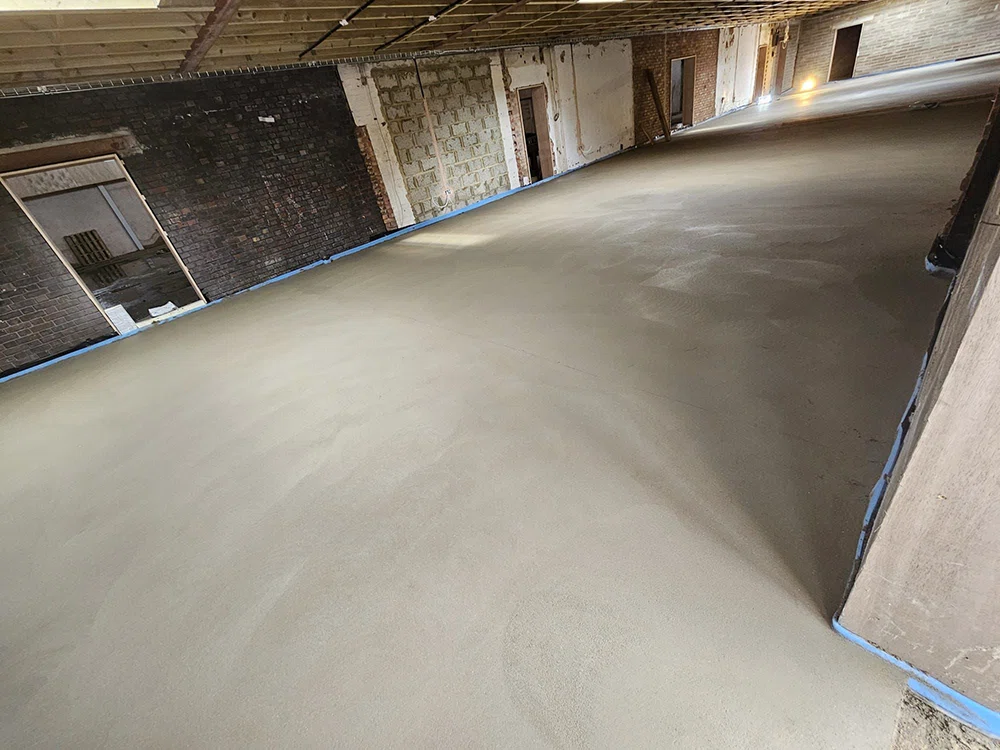
K & B Screeding’s own team, led by director Donatas Bardisevicius. Founded 2019, company 12298780.
See what customers say in our Google reviews and on our testimonials page.
Anhydrite & Flow Screed from Slough to Oxted
Oxted is about 33.6 miles east-south-east of our Slough base as the crow flies, with postcodes including RH8 and CR3. The nearest towns to it are Caterham (3.6 miles), Redhill (7.4 miles), Croydon (8.2 miles) and Sevenoaks (8.5 miles).
More on anhydrite screed, part of our screeding services.
