
Joining old and new floors in Oxted houses
A key levelling job in an Oxted house is at the join between an extension and the original building. The town's large block of post-war houses points to extension work, and even when the new floor is built carefully, it can finish a few millimetres higher or lower than the old one, or slightly out of plane.
Rigid LVT and large porcelain tiles show those differences immediately. Boards rock, tile edges lip, and a visible ridge runs across the room. A levelling compound feathered across the join brings both sides into one flat surface.
The standard for flatness comes from BS 8204, measured under a 2m straightedge. Many thin sheet floorings need SR1, with no more than 3mm under the straightedge. SR2 allows 5mm and suits most tiles and LVT. SR3 allows 10mm. Check the fitting instructions for your flooring: they name the class it needs.
Preparation is half the job. We strip off old adhesive, paint and anything loose, then prime with a product matched to the base, since concrete, sand and cement, calcium sulphate and old tiles each call for their own. For thin smoothing work, latex screed is one of the products used. Where old adhesive or contamination is heavy, concrete floor grinding may be needed first. The same principles apply to a shop or office refit, where fast drying compounds keep the programme moving.
When an Oxted floor needs more than levelling
Homes from 1919 to 1944 make up 15% of the housing in Oxted, and with older stock, it pays to check what is under the floor before choosing a compound.
Compound is a thin material, generally between about 2mm and 10mm deep, with a few products rated for more. It works over a sound, solid base. It does not fix a floor that is failing. In older Oxted homes, the solid floor may have no damp proof membrane, or the timber floor may be failing, and pouring compound over either only covers the problem until the flooring fails as well.
Deep pours of compound to correct a badly sunken floor are another risk. Thick layers like that may crack and come away from the base. If a straightedge shows more than about 10mm of variation, or the existing screed is hollow or breaking up, the honest answer is a new screed. Read about a hand-laid sand and cement screed for Oxted renovations for that route.
Once we have seen your floor, we will say which of those it needs. Croydon, 8.2 miles away, has a floor levelling page for Croydon.
How we price floor levelling in Oxted
A fixed written price within 24 hours, once we know the area and the base. See our floor screeding cost guide.
Who levels your floor in Oxted
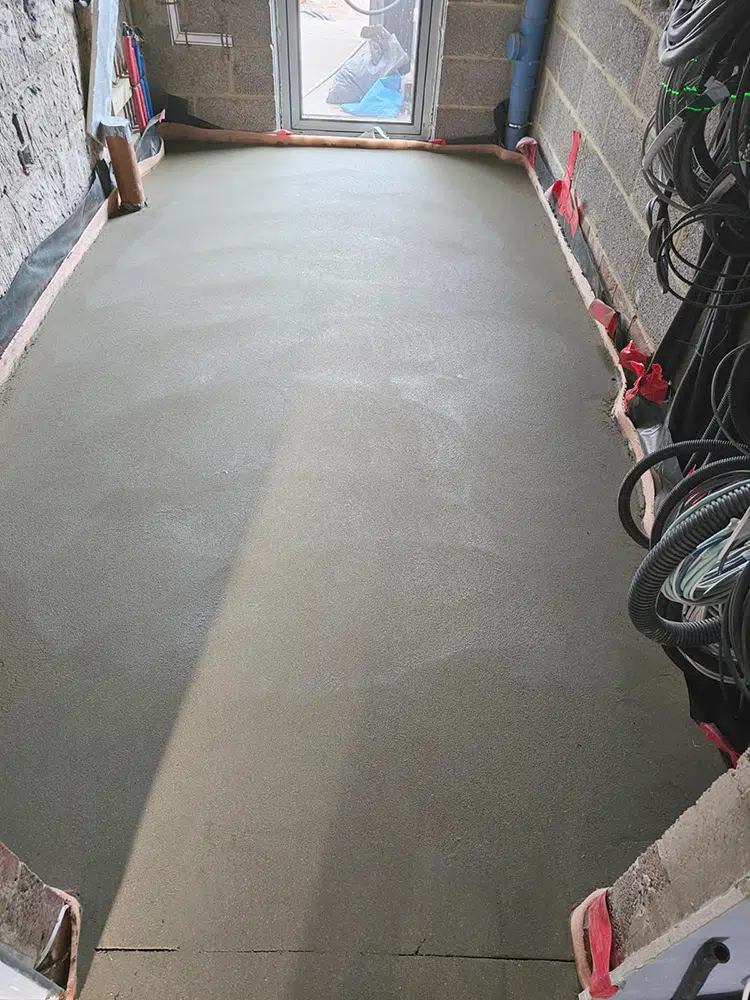
K & B Screeding’s own team, led by director Donatas Bardisevicius. Founded 2019, company 12298780.
See what customers say in our Google reviews and on our testimonials page.
Floor Levelling from Slough to Oxted
Oxted is about 33.6 miles east-south-east of our Slough base as the crow flies, with postcodes including RH8 and CR3. The nearest towns to it are Caterham (3.6 miles), Redhill (7.4 miles), Croydon (8.2 miles) and Sevenoaks (8.5 miles).
More on floor levelling, part of our screeding services. Not sure whether you need a thin compound or a full flowing screed? See self levelling screed explained.
