
Rebuilding old floors in Old Oxted and Chichele Road
Some 15% of Oxted's homes were built before 1919. Old Oxted itself is medieval, and New Oxted grew after the railway opened in 1884, much of it in a Tudor style with stucco frontages. Chichele Road came later, when land on the Barrow Green Estate was released from around 1908.
Homes of these ages can hide two kinds of floor problem. A solid floor laid without a damp proof membrane lets ground moisture through, which shows up as damp edges, lifting tiles and musty smells. A timber ground floor can rot or sag as it ages. Either way, the repair that lasts is to remove the floor entirely.
The sequence is straightforward. First the old floor comes up, by breaking out or lifting, and the ground beneath is excavated to the correct depth; a membrane and insulation follow, and a new screed finishes it. Sitting on insulation in a house, that new screed is about 65mm thick. We can lay those under-layers too, through our membrane and insulation service.
Hand-laid screed suits these rooms because it can be worked into alcoves, around chimney breasts and up to thresholds that cannot be raised. It also handles bathrooms, showers and wet rooms laid to falls, where calcium sulphate screed would not be suitable. If the threshold leaves little depth and there is a good slab below, bonding the screed to the slab at 25 to 40mm is worth considering.
Oxted terraces, small rooms and drying time
Terraced houses make up 19% of Oxted's homes, and in narrow houses the logistics of a screed matter as much as the material. Sand and cement is mixed on site and carried in, so it needs no pump and suits rooms at the back of a house with no outside access other than through the hall.
It is also the cost effective option on small or awkward jobs, such as a single hallway, a kitchen floor or a downstairs cloakroom. Mixing fibres in helps resist cracking and costs roughly £1 to £3 per m² extra, while a rapid drying additive cuts the wait.
That wait is the main trade-off. For the first 40mm, count on about one drying day per millimetre, then a slower pace below that; a 65mm hallway floor in a terraced house will need several weeks before timber or vinyl goes on. We only call it ready once a hygrometer says so. What helps and hinders drying is covered in our guide to drying times.
If the old floor is sound and dry, and only uneven, a floor levelling compound in Oxted may avoid a new screed altogether. Sevenoaks is 8.5 miles off and has a hand-laid screed page of its own.
Sand and Cement Screed prices in Oxted
Sand and cement screed: £18 to £25 per m² supplied and laid (MyJobQuote, August 2026), so £450 to £630 for 25 m². MyJobQuote does not say whether these figures include VAT. See our floor screeding cost guide or screed calculator.
Who lays your sand and cement screed in Oxted
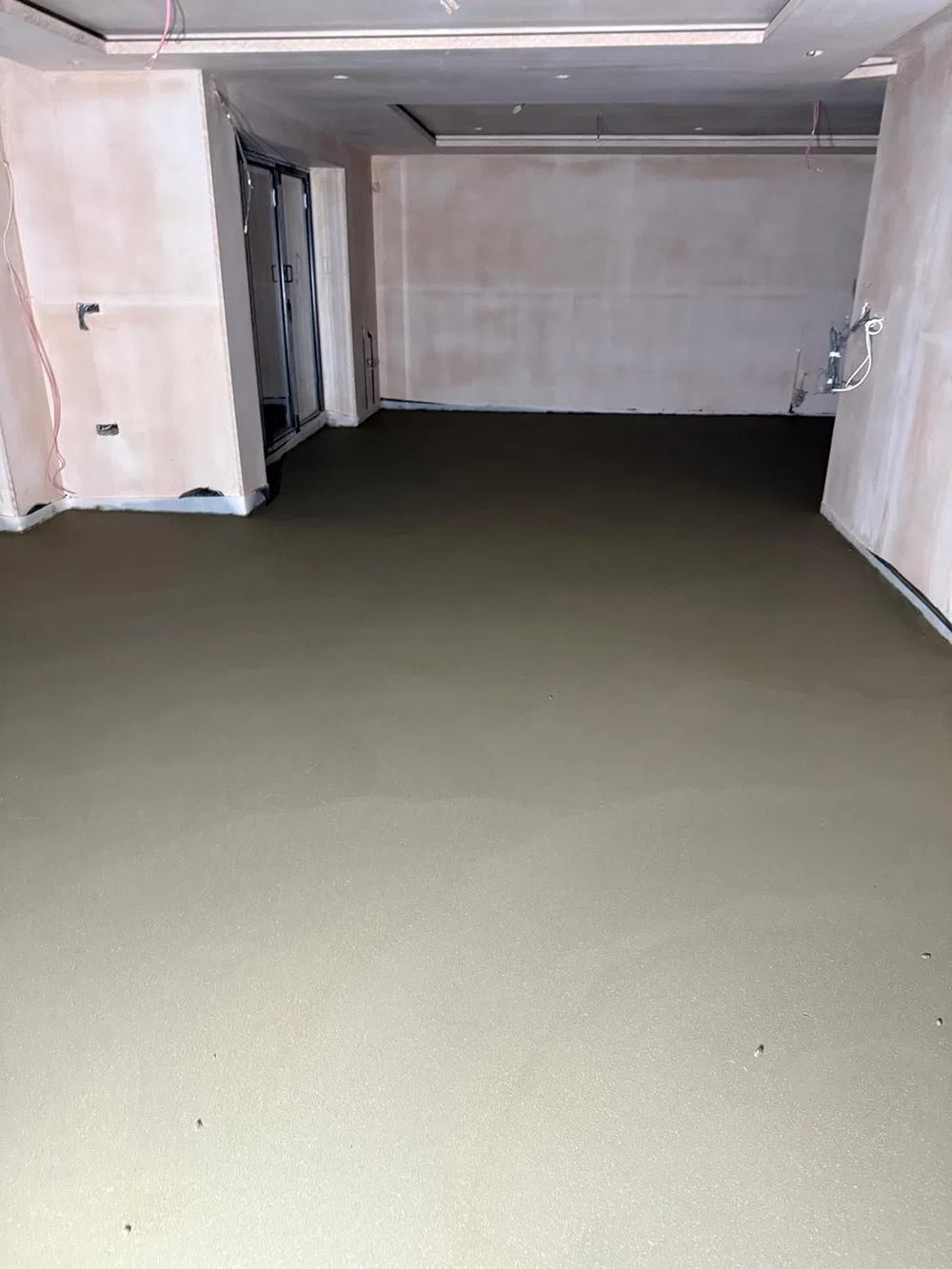
K & B Screeding’s own team, led by director Donatas Bardisevicius. Founded 2019, company 12298780.
See what customers say in our Google reviews and on our testimonials page.
Sand and Cement Screed from Slough to Oxted
Oxted is about 33.6 miles east-south-east of our Slough base as the crow flies, with postcodes including RH8 and CR3. The nearest towns to it are Caterham (3.6 miles), Redhill (7.4 miles), Croydon (8.2 miles) and Sevenoaks (8.5 miles).
More on sand & cement screed, part of our screeding services.
