
Replacing old floors in Sevenoaks period houses
When a floor in an older Sevenoaks house fails, the fix is rarely a thin topping. A house of pre-1919 age can have a solid floor laid on bare earth, with no insulation and no membrane, or boarded floors whose timbers have rotted. In most cases the answer is to take that floor out, dig to the depth the new build-up needs, then rebuild: slab, insulation, membrane and new screed on top.
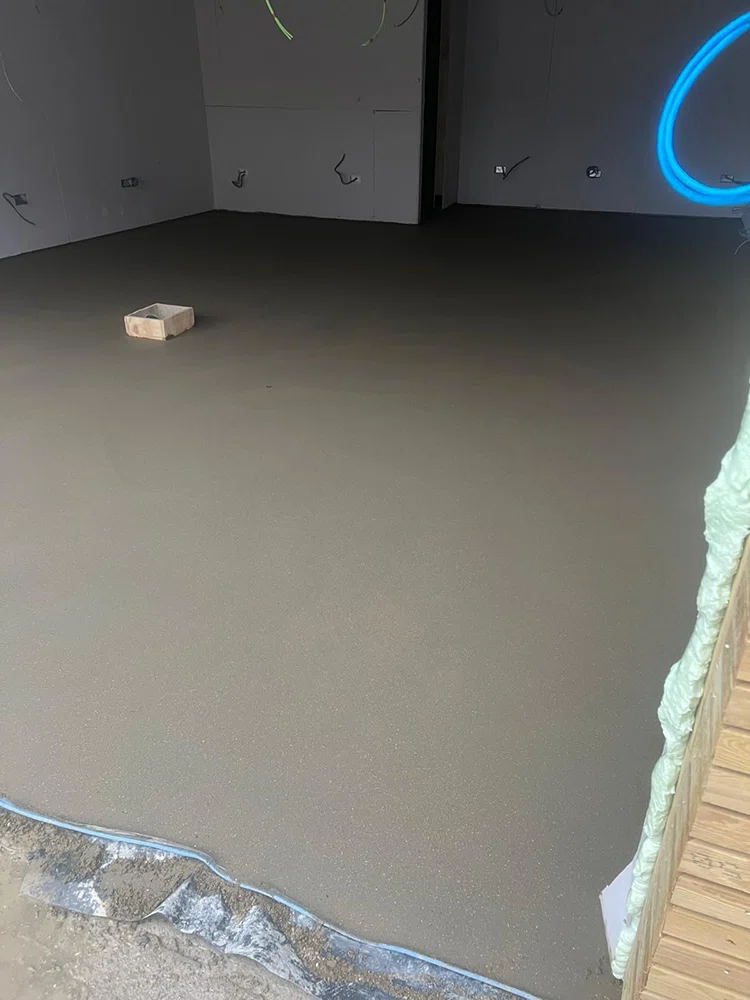
A hand-mixed screed suits that rebuild well. Because we mix each batch on site to the size of the room, the hallway, boot room and small kitchen of an older Sevenoaks house can be done in a single visit, with no pump hired for a few square metres. It is compacted by hand, so it follows awkward shapes, steps and doorways that a flowing screed would need damming around.
Depth is the thing to plan. Domestic floors floated over insulation are laid about 65mm deep in sand and cement, and commercial ones about 75mm. Bond it directly to a sound slab instead and 25 to 40mm is possible, which may get a new floor flush with an old threshold or a stone step. Our screed thickness guide goes through the options.
Interwar houses, 17% of the stock, raise similar questions, especially where an original solid floor has cracked or settled. If the damage is confined to one patch of a room, repairing the existing screed could be all that is required.
Wet rooms, garages and slower drying in Sevenoaks
Some Sevenoaks rooms need cement screed however large the house is. The shower area of a wet room has to fall to its drain, and we shape that slope by hand in sand and cement; calcium sulphate does not belong on floors that stay wet. The same applies to utility rooms and plant rooms with a risk of leaks.
Garages being converted into living space fall into the same group. Garage floors usually sit lower than the house, so the conversion gets insulation first and then enough screed to rise to the hall. Layer by layer, that build-up is explained in screeding a converted garage.
The cost is time. Count about one day of drying for each millimetre across the first 40mm, and slower progress beyond it, so a 65mm floor tends to need several weeks before it passes a moisture test. On a tight Sevenoaks timetable, a faster drying screed mix can claw back time, and 2026 published prices for those mixes sit between £20 and £28 per m². If the room is large and open with no wet areas, the liquid screed option dries flat and quickly and may suit better.
Sand and Cement Screed prices in Sevenoaks
Sand and cement screed: £18 to £25 per m² supplied and laid (MyJobQuote, August 2026), so £450 to £630 for 25 m². MyJobQuote does not say whether these figures include VAT. See our floor screeding cost guide or screed calculator.
Who lays your sand and cement screed in Sevenoaks
K & B Screeding’s own team, led by director Donatas Bardisevicius. Founded 2019, company 12298780.
See what customers say in our Google reviews and on our testimonials page.
Sand and Cement Screed from Slough to Sevenoaks
Sevenoaks is about 40.4 miles east-south-east of our Slough base as the crow flies, with postcodes including TN13 and TN15. The nearest towns to it are Tonbridge (6.4 miles), Oxted (8.5 miles), Swanley (8.8 miles) and Bromley (9.6 miles).
More on sand & cement screed, part of our screeding services.
