
Calcium sulphate grades for Kensington and Chelsea apartments
In the Royal Borough a calcium sulphate floor is usually ordered by code, and the code is easy to read. CA names the binder. The C number is crushing strength and the F number bending strength, both in N/mm2 under the BS EN standard for screeds, so a Kensington and Chelsea apartment drawn at CA-C25-F5 wants 25 and 5.
Three grades do most of the work across the borough. CA-C20-F4 suits lightly trodden domestic rooms. CA-C25-F5 is the general grade for houses, apartments and offices. CA-C30-F6 goes where wear will be heavier. The architect, engineer or developer of the block chooses; K & B pours that choice. Have the grade and the product name confirmed in writing before pump day, because between them they fix depth, drying and heat-up.
Sometimes a Royal Borough specification names an alpha hemihydrate product instead. That usually signals that the floor has to dry sooner or sit shallower, and the product's own data sheet then sets the rules we follow.
The appeal of calcium sulphate in a Kensington block is how little it moves while it cures. A whole apartment can go down in broad bays with very few joints. We still mark bays and joints before pouring, chiefly at thresholds and where a flat meets its corridor, and our crew builds the layers underneath. The Royal Borough liquid screed page covers pumping and access, and how anhydrite screed works goes into the chemistry.
Laitance and moisture before Kensington floors are finished
Before stone, tile or LVT goes onto a calcium sulphate floor in Kensington and Chelsea, three things need doing.
The surface skin has to go. Curing leaves a soft film on top, and anything glued to that film is only as secure as the film itself. Once the floor is dry it is sanded back, the dust is vacuumed away, and a primer made for calcium sulphate goes on. Loose stone or tile in a finished Chelsea flat is the price of skipping it.
The moisture reading has to pass. Many flooring makers allow less moisture in calcium sulphate than in a cement screed, so a level that would clear cement may still be too damp here. Check with a hygrometer against the flooring maker's own figure. Where heating pipes run below, a gentle warm-up can usually start at around seven days to help.
And the room has to stay dry. Lower ground floors in Chelsea and Kensington period houses were often laid without a membrane, and any such floor with a risk of water, like a shower room or wet room, is no place for calcium sulphate. Those get a cement based flowing screed, or a hand-laid screed formed to fall. If another firm poured the floor, our floor preparation team can sand and prime it.
Anhydrite & Flow Screed prices in Kensington and Chelsea
Liquid flowing screed (which includes anhydrite): £24 to £31 per m² supplied and laid (MyJobQuote, August 2026), so £960 to £1,240 for 40 m². MyJobQuote does not say whether these figures include VAT. See our floor screeding cost guide or screed calculator.
Who lays your anhydrite and flow screed in Kensington and Chelsea
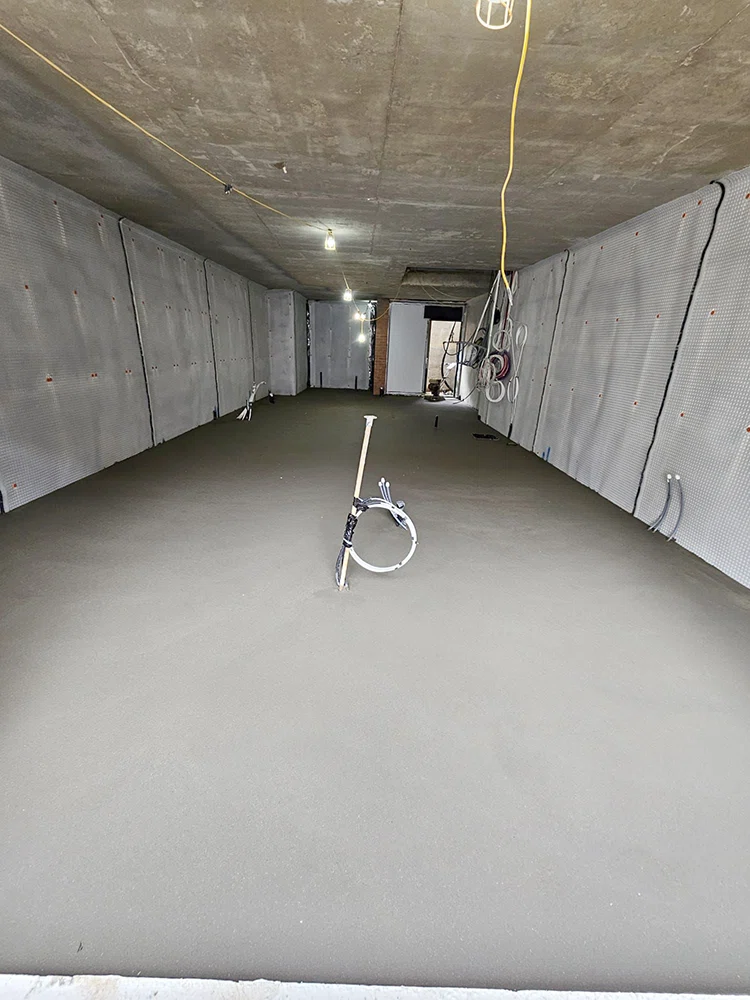
K & B Screeding’s own team, led by director Donatas Bardisevicius. Founded 2019, company 12298780.
See what customers say in our Google reviews and on our testimonials page.
Anhydrite & Flow Screed from Slough to Kensington and Chelsea
As the crow flies, our yard in Slough is about 19.6 miles from Kensington and Chelsea, which lies to the east. Postcodes here include SW7, SW3, SW5 and W10, and Hammersmith and Fulham (1.2 miles), Westminster (1.6 miles), Camden (3.4 miles) and Wandsworth (3.8 miles) are close by.
More on anhydrite screed, part of our screeding services.
