
Anhydrite grades for King's Cross flats and Camden estates
Anhydrite is ordered by a code, not a brand. A home floor with light footfall can take CA-C20-F4, the everyday grade for houses, flats and offices is CA-C25-F5, and CA-C30-F6 is there for harder wear. Read C as the crushing (compressive) figure and F as the bending (flexural) figure, in N/mm2. On a King's Cross block or an estate refurbishment, the structural engineer picks the code and we match it.
Then there are alpha hemihydrate screeds, a different family picked when a floor has to dry sooner or be thinner. In Camden, where floor height is often tight in conversions, that reduced depth can be decisive. With those, the maker's data sheet sets the depth and drying time, and general rules take a back seat.
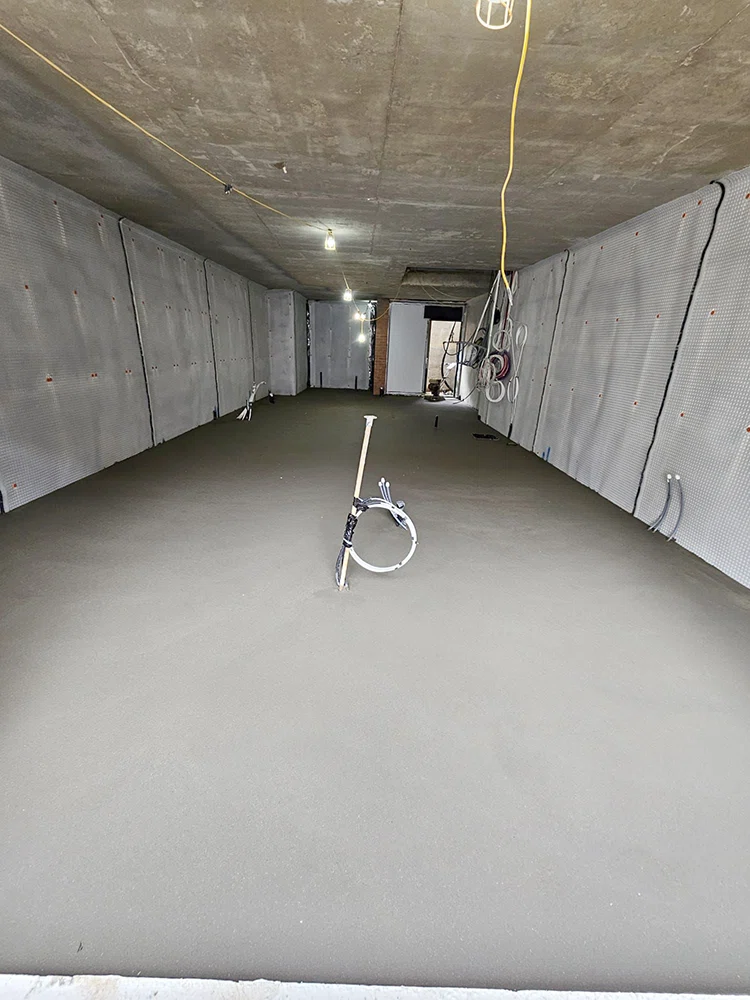
16% of Camden's homes were built between 1945 and 1972, and the council's post-war building continued into the 1970s with schemes such as the Alexandra Road Estate and its 520 flats. When flats of that era are stripped out and refurbished, a new flowing screed over fresh insulation is one way to renew the floor. The low shrinkage of calcium sulphate means a whole flat can often be poured as a single bay. Where a doorway or a change of heating zone calls for a joint, its line is marked out beforehand, and the layers underneath are put down by our own crew.
There is more background in our anhydrite guide.
Laitance, primers and moisture limits in Camden flats
Calcium sulphate leaves a surface skin called laitance as it dries. That skin is soft and adhesive will not hold to it, so it gets sanded away as soon as the floor has firmed and dried sufficiently. Next comes a primer made to suit calcium sulphate, ahead of any glue or compound, because the wrong cement based product can break down right at the joint with the screed.
Before flooring goes down, the screed is tested. Flooring makers frequently hold calcium sulphate to a stricter dampness figure than cement, so counting days is not enough and a hygrometer has the final say. Where the flat has underfloor heating, switching it on from about day 7 can usually hurry things along when the fit-out is tight.
Keep it out of anywhere that gets soaked. For a Camden bathroom with a walk-in level shower, or a full wet room, use a cement bound flowing mix, or hand-placed sand and cement, for that floor. Where an old concrete floor has to be broken out or mended before the new screed, see concrete floor repair.
Anhydrite & Flow Screed prices in Camden
Liquid flowing screed (which includes anhydrite): £24 to £31 per m² supplied and laid (MyJobQuote, August 2026), so £960 to £1,240 for 40 m². MyJobQuote does not say whether these figures include VAT. See our floor screeding cost guide or screed calculator.
Who lays your anhydrite and flow screed in Camden
K & B Screeding’s own team, led by director Donatas Bardisevicius. Founded 2019, company 12298780.
See what customers say in our Google reviews and on our testimonials page.
Anhydrite & Flow Screed from Slough to Camden
On the map, Camden sits east of Slough, about 21.3 miles from our base in a straight line (postcodes including WC1B, NW1, N6 and W1T), next to Islington (1.7 miles), Westminster (2.1 miles), Kensington and Chelsea (3.4 miles) and Haringey (3.5 miles).
More on anhydrite screed, part of our screeding services.