
Grades on Broadwater Farm and Tottenham Hale drawings
The British and European screed materials standard gives each calcium sulphate screed a code. Reading the code: CA means calcium sulphate, then C is the compressive strength and F the flexural strength, with both figures in N/mm2. A lightly used domestic floor gets CA-C20-F4, the usual Haringey house, flat or office takes CA-C25-F5, and heavier use calls for CA-C30-F6; between them those three cover most buildings.
On a council or developer scheme, such as the rebuilt Tangmere and Northolt blocks at Broadwater Farm, the grade comes from the engineer's specification and the screed is poured to it. Where the specification names an alpha hemihydrate product, it has usually been chosen for faster drying or a thinner section. Such a product has a data sheet that fixes its depth and drying, and our pour keeps to that sheet.
Homes from 2015 onwards are just 7% of Haringey's total. Outside the new blocks, a calcium sulphate floor is more likely to go into a single flat or an extension, where CA-C25-F5 is the usual domestic grade. With so little shrinkage, wide bays can go down with hardly any joints. Thresholds and the boundaries between heating zones still need them, so we set out the bays in advance.
Our own team lays everything beneath it, insulation through to edge strip. For a wider introduction to the material, read the guide to anhydrite screed.
Laitance, primers and moisture in Haringey anhydrite floors
While it dries, a calcium sulphate screed develops laitance, a weak, thin crust on top. Left in place, it stops adhesive or levelling compound gripping, so we sand it off. Then the clean surface is primed with a product designed for calcium sulphate. Miss out the sanding or the priming, and the tiles or LVT may come loose down the line. Sanding is done once the screed is dry enough to take it without tearing the surface.
Moisture is the other difference from cement. Plenty of wood and LVT manufacturers want calcium sulphate drier before fitting than they would a cement screed. Our hygrometer readings are handed to you along with written advice on drying and laitance. Underfloor heating, where fitted, normally lets you force dry the screed once it is about 7 days old.
Keep calcium sulphate out of any room that could get wet. So the shower, a wet room or a plant room where a leak is possible gets cement based flowing screed or traditional sand and cement trowelled in by hand. On a mixed scheme, that often means two materials on one site, poured on different days, with the joint between them planned in advance. For comparable apartment work next door, see anhydrite screed in Enfield.
Anhydrite and acoustic floors in Haringey's split terraces
Converted flats and shared houses make up 24% of Haringey's homes, and Victorian and Edwardian terraces split into flats need acoustic screeds so that footsteps and voices do not carry from one flat to the next. Where the drawings for a conversion call for a calcium sulphate screed over an acoustic layer, four details decide whether the floor works.
The first is the base. On a ground floor the screed usually goes over a new slab, membrane and insulation. On an upper floor of a terrace the structure is often timber, which has to be checked for load and stiffness before any wet screed is placed on it.
The second is the acoustic layer itself. It is laid with tight, taped joints and turned up at the walls, so the liquid cannot leak through and set in contact with the structure below.
The third is isolation. Edge strip runs round every wall, pipe and door lining. If the screed touches the structure at any point, sound can travel round the acoustic layer instead of being stopped by it.
The fourth is the grade and depth. CA-C25-F5 is the normal grade for flats, and the depth comes from the acoustic product and the specification, not a rule of thumb.
Calcium sulphate suits this build-up for practical reasons. It flows into place with no tamping, so nothing heavy is worked on top of the soft layer, and it shrinks so little that a whole flat can often go down as one bay.
Anhydrite and flow screed prices in Haringey
Liquid flowing screed (which includes anhydrite): £24 to £31 per m² supplied and laid (MyJobQuote, August 2026), so £960 to £1,240 for 40 m². MyJobQuote does not say whether these figures include VAT. See our liquid screed cost per m² guide or screed calculator.
Who lays your anhydrite and flow screed in Haringey
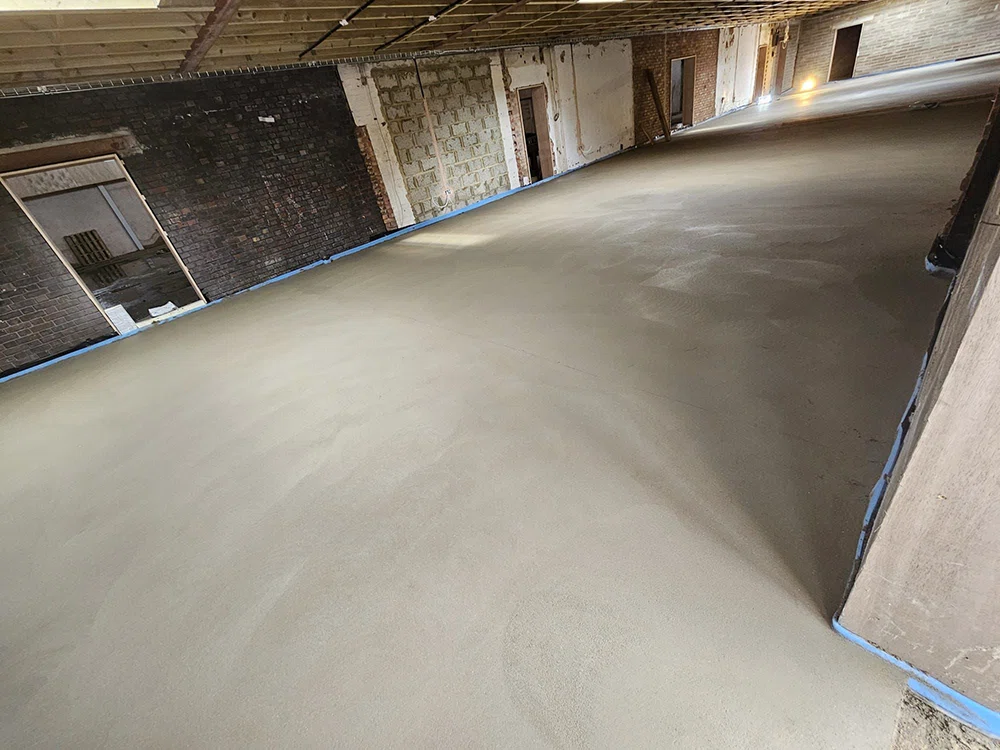
K & B Screeding’s own team, led by director Donatas Bardisevicius. Founded 2019, company 12298780.
See what customers say in our Google reviews and on our testimonials page.
Anhydrite and flow screed from Slough to Haringey
Haringey is about 23.1 miles east of our Slough base as the crow flies, with postcodes including N22, N11, N2 and N10. The nearest towns to it are Islington (3.1 miles), Hackney (3.5 miles), Camden (3.5 miles) and Barnet (4 miles).
In Haringey, road space for the anhydrite delivery means a bay suspension from Haringey Council (parking bay suspension), and your quote will say whether one is needed.
More on anhydrite screed, part of our screeding services. For every screed we lay locally, see floor screeding in Haringey.
Further reading: calcium sulphate screed guide.
