
Uneven subfloors in Haringey's older terraces and conversions
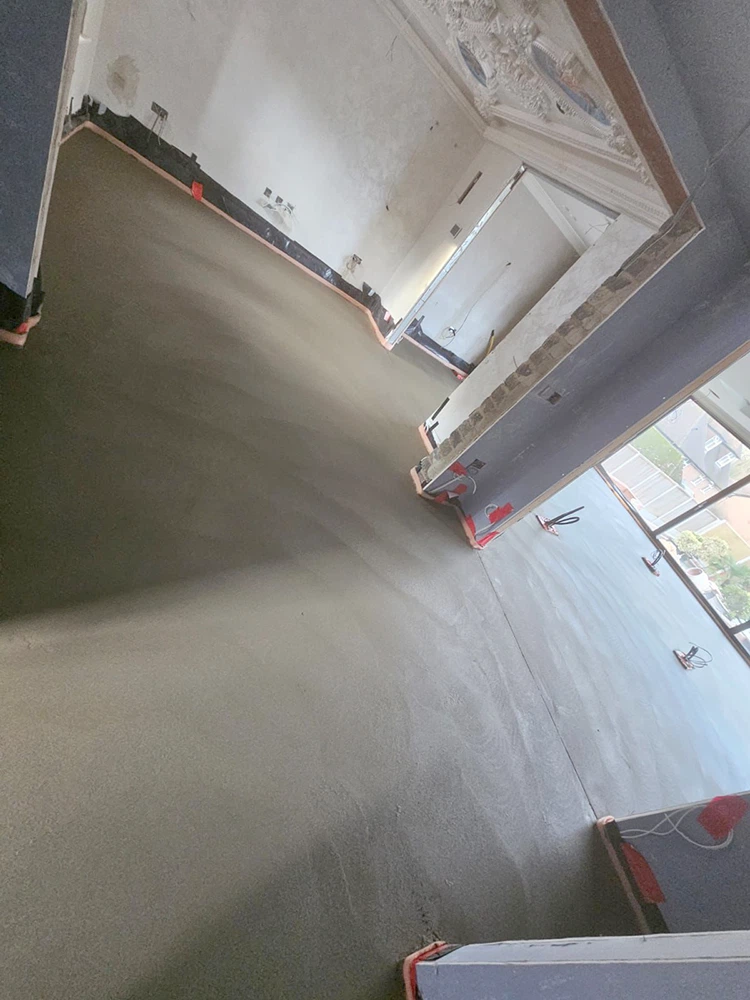
Flats make up 59% of homes in Haringey, and 24% are in converted buildings. When a terraced house is split into flats, floors are often left as a patchwork of original solid floors, patched concrete, old screed and newer infill where walls or fireplaces were removed. Each area sits at a slightly different height.
Modern floor finishes show all of that. A thin LVT or sheet vinyl telegraphs every dip and ridge, and large format tiles rock on an uneven base. Engineered wood can creak or flex where it bridges a hollow. Levelling sorts it out before the fitter starts.
Under BS 8204, flatness is measured as the biggest gap you find below a 2m straightedge. SR1 lets the gap reach 3mm, SR2 5mm and SR3 10mm. Thin sheet finishes often call for SR1.
Here is how a levelling job goes. The floor is cleaned, loose material is removed, and any cracks or hollow areas are dealt with. Next the surface gets a primer chosen for what it is made of: concrete, a sand and cement screed or calcium sulphate each need the right one. Compound follows, normally poured at anything from about 2mm to around 10mm (some products allow more), and it runs out to a smooth surface. With a fast drying product, the floor fitter can follow on soon after.
Where old floors also need more serious work, see our screed repairs service.
When a Wood Green floor needs more than compound
Levelling compound has limits, and knowing them saves money. If a floor is badly out of level, pouring compound deep enough to fix it risks cracking and debonding. If the floor is damp because there is no membrane, compound will not stop the moisture. In both cases the honest answer is a new floor.
That applies across the borough's older houses, including the small homes of Noel Park in Wood Green, where any change needs care because of the conservation area. A floor that has sunk or lost its damp protection usually needs digging out and replacing with a new sand and cement screed for Haringey.
On commercial floors the same limits apply, only across a bigger area. The borough's main commercial schemes are Tottenham Hale's new district centre and the rebuilt Broadwater Farm, with its new Energy Centre, Medical Centre and Enterprise Centre. Fit-outs in buildings like these need flat floors before new finishes go down. Our commercial screeding page covers that work, and floor levelling in Camden covers the neighbouring borough.
How we price floor levelling in Haringey
A fixed written price within 24 hours, once we know the area and the base. See our floor screeding cost guide.
Who levels your floor in Haringey
K & B Screeding’s own team, led by director Donatas Bardisevicius. Founded 2019, company 12298780.
See what customers say in our Google reviews and on our testimonials page.
Floor Levelling from Slough to Haringey
Haringey is about 23.1 miles east of our Slough base as the crow flies, with postcodes including N22, N11, N2 and N10. The nearest towns to it are Islington (3.1 miles), Hackney (3.5 miles), Camden (3.5 miles) and Barnet (4 miles).
More on floor levelling, part of our screeding services. Not sure whether you need a thin compound or a full flowing screed? See self levelling screed explained.
