
Why new blocks at Tottenham Hale use pumped screed
A block of flats has the same floor repeated many times over, and pumped screed is built for that. The mix comes straight from the lorry, is pumped to each floor and flows out level under its own weight, so a whole apartment floor can be covered in a day. Shrinkage is minimal, so each flat's floor can be poured in broad bays with far fewer movement joints than a hand-laid floor would need.
At Broadwater Farm, a programme of 294 new council homes includes the rebuilt Tangmere and Northolt blocks, and new blocks at Tottenham Hale are going up around the station. Across the borough, 35% of homes are in purpose-built blocks, and 13% of all homes were built in 2000 or later.
Flatness is one of the reasons specifiers choose it. Getting to SR1 or SR2 regularity is straightforward, which is what thin finishes like LVT want. Laid over insulation as a floating floor, it goes down from about 35mm in a flat or house and about 40mm in commercial space.
Liquid screed comes in two families. Calcium sulphate based mixes suit most dry indoor floors; the cement based versions take over where a floor could get wet or the finish needs a cement substrate. Grades and specifications for the calcium sulphate type are set out on our Haringey anhydrite page. For large pumps on a site, our screed pumping page explains the service, though we do not hire out pumps or machines.
Liquid screed in Crouch End and Muswell Hill extensions
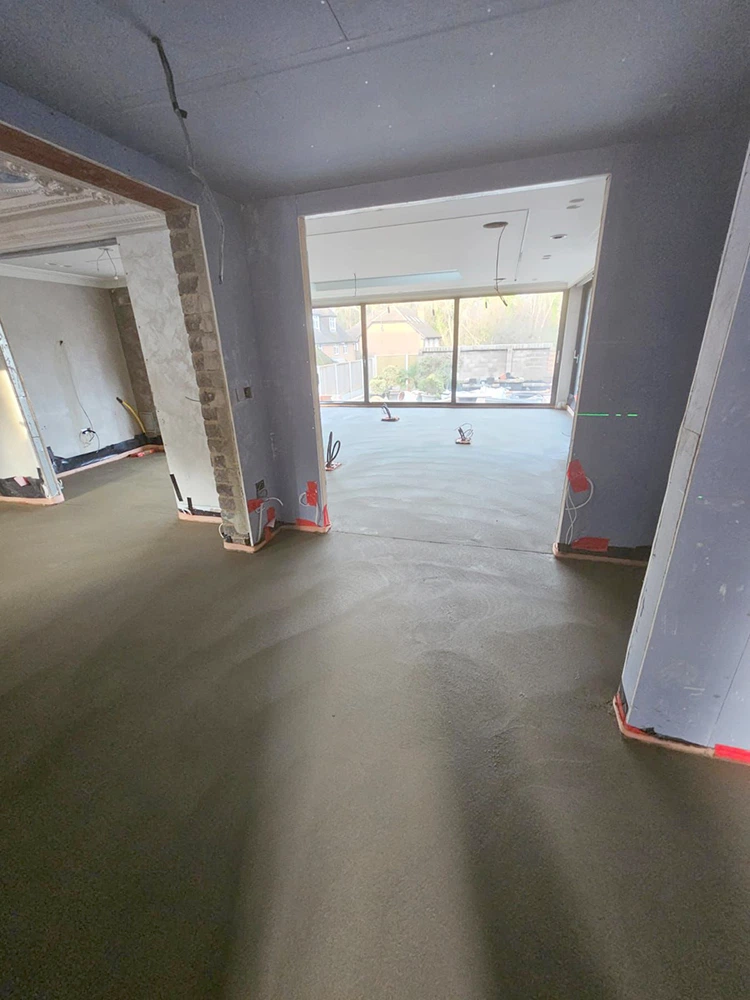
A heated kitchen extension, the typical Crouch End or Muswell Hill project, is a good match for liquid screed. It flows fully around heating pipes with no voids, warms up faster and gives a flat, open floor with no joints across a knocked-through room.
The practical question in a terraced street is how the pump reaches the back of the house. We set the lorry and pump up out front, then run the hose along the hall or a side passage to reach the extension. Floors along the route are protected first. If the flat is upstairs, the hose simply follows the staircase.
Once the floor takes foot traffic, usually 24 to 48 hours after the pour, other trades can get back in. Drying is a separate matter. Each millimetre of the first 40mm takes around a day, deeper screed takes longer, and the flooring date comes from a moisture test. The guide on screed drying times goes into more depth.
On 2026 UK figures, expect £24 to £31 per m² for liquid screed. In the neighbouring borough, see liquid screed in Hackney.
Liquid Screed prices in Haringey
Liquid screed: £24 to £31 per m² supplied and laid (MyJobQuote, August 2026), so £960 to £1,240 for 40 m². MyJobQuote does not say whether these figures include VAT. See our floor screeding cost guide or screed calculator.
Who lays your liquid screed in Haringey
K & B Screeding’s own team, led by director Donatas Bardisevicius. Founded 2019, company 12298780.
See what customers say in our Google reviews and on our testimonials page.
Liquid Screed from Slough to Haringey
Haringey is about 23.1 miles east of our Slough base as the crow flies, with postcodes including N22, N11, N2 and N10. The nearest towns to it are Islington (3.1 miles), Hackney (3.5 miles), Camden (3.5 miles) and Barnet (4 miles).
More on liquid screed, part of our screeding services.