
Reading an Islington flow screed specification
Islington specifications for calcium sulphate screed read like a code, and each part of it tells you something. CA marks the binder as calcium sulphate. The figure after C gives crushing strength and the figure after F gives bending strength, each in N/mm2, as the European screed standard defines them. So a Holloway flat drawn at CA-C25-F5 is asking for 25 and 5.
Three codes cover nearly every Islington floor. CA-C20-F4 is pitched at domestic rooms with gentle foot traffic. CA-C25-F5 is the everyday grade for houses, apartment blocks and offices alike. CA-C30-F6 is kept for floors that will be worked harder. Whoever designs the block picks one, and that one is what we pour.
A brief from the Triangle Site off York Way or from Holloway Park might instead name an alpha hemihydrate product. Designers reach for those when a floor has to dry sooner or sit thinner, and the maker's own sheet then rules depth, drying and heat-up. We follow that sheet rather than general rules of thumb.
Why do Islington block designers like calcium sulphate at all? It barely shrinks as it cures. That lets a whole flat go down in big bays with only a handful of joints, which helps on long open plan floors in a new block. We still draw the bays and joints before the pump arrives, normally at each flat's front door and where a flat meets the common corridor, and our own crew prepares the insulation and membrane below.
For the pumping side of things, see liquid screed across Islington. The anhydrite screed explainer covers the material itself.
Laitance, moisture and wet areas in Islington flats
Three jobs stand between a cured Islington pour and the tiler.
Sanding comes first. As the screed sets, a soft, chalky film rises to its face. Glue spread onto that film grips the film rather than the floor, so it is ground away once the floor is dry and the dust is lifted. If the main contractor on a Holloway or Clerkenwell job has nobody for this, our floor preparation crew can sand and prime.
Testing comes next. Plenty of flooring brands accept less moisture in a calcium sulphate base than in a cement one, so a reading that would clear a cement screed can still hold up an Islington handover. Take a hygrometer reading against the flooring maker's own limit. Where pipes run beneath, the heating can usually start helping the drying at around seven days.
Priming comes last, with a primer made for calcium sulphate going on before any cement based adhesive or compound touches the surface.
Then there are the rooms where this material should not go. Where an Islington house has become three flats, it may gain three new shower rooms, and calcium sulphate does not belong anywhere water may sit. Those rooms take a cement based flowing screed, or a hand-laid cement screed shaped to fall, and our written drying and laitance notes cover both.
Anhydrite & Flow Screed prices in Islington
Liquid flowing screed (which includes anhydrite): £24 to £31 per m² supplied and laid (MyJobQuote, August 2026), so £960 to £1,240 for 40 m². MyJobQuote does not say whether these figures include VAT. See our floor screeding cost guide or screed calculator.
Who lays your anhydrite and flow screed in Islington
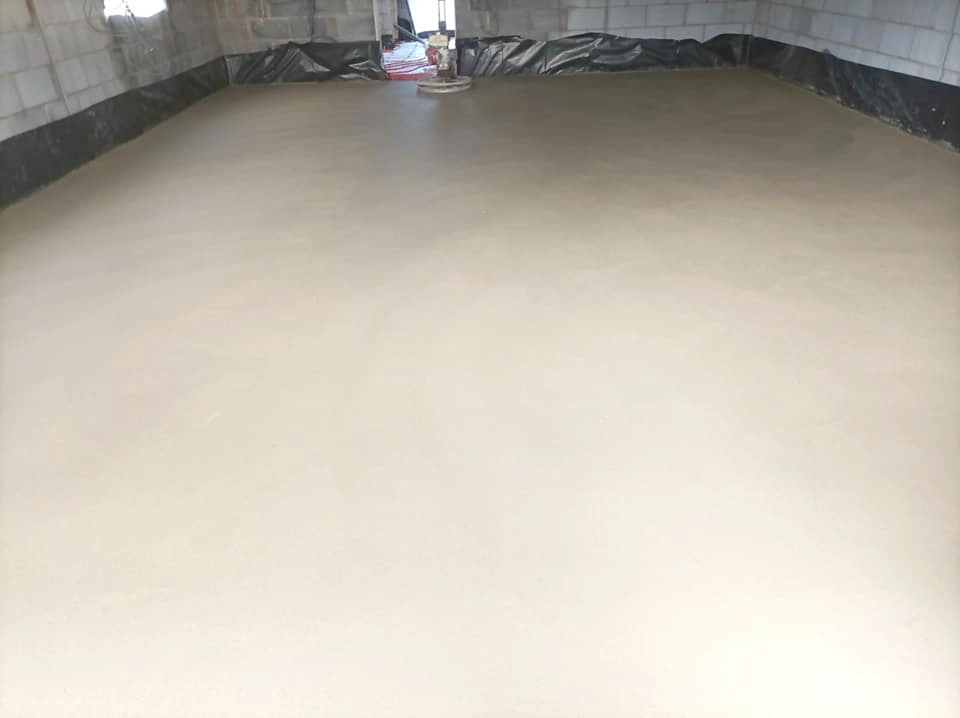
K & B Screeding’s own team, led by director Donatas Bardisevicius. Founded 2019, company 12298780.
See what customers say in our Google reviews and on our testimonials page.
Anhydrite & Flow Screed from Slough to Islington
On the map, Islington sits east of Slough, about 23 miles from our base in a straight line (postcodes including N1, EC1R, WC1X and N4), next to Camden (1.7 miles), Hackney (2.1 miles), Westminster (3 miles) and Haringey (3.1 miles).
More on anhydrite screed, part of our screeding services.
