
Calcium sulphate grades for Colindale and Grahame Park blocks
Calcium sulphate screeds are labelled with a code from the European screed material standard. Its C figure is the crushing (compressive) strength and its F figure the bending (flexural) strength, both measured in N/mm2. CA-C20-F4 covers lightly used domestic floors. For everyday houses, flats, apartments and offices the usual choice is CA-C25-F5, with CA-C30-F6 kept for floors that take a harder beating.
On a new block at Colindale or Grahame Park, the grade is whatever the engineer has put on the drawings, and that is what we pour. Occasionally the specification swaps in a product based on alpha hemihydrate, chosen because it dries quicker or can go down thinner. Such products set their own depths and drying times on the maker's sheet, and we follow it to the letter. If the drawings are silent on grade, we check with the designer before we price.
The material earns its place on apartment floors by barely shrinking. Big bays go down with hardly any joints, over insulation board, acoustic matting and frequently heating pipes as well. Where a joint cannot be avoided, at a threshold or a change of heating zone, we set out the bays before the pour instead of sawing joints in afterwards.
Keep calcium sulphate away from water. Bathrooms, plant rooms and anywhere a leak could happen want a flowing screed with a cement binder, or sand and cement screed in Barnet, laid by hand. We go further into the material itself in what anhydrite screed is.
Sanding, priming and testing anhydrite in Barnet
Pouring gets you halfway. As the screed cures, a weak, chalky film called laitance rises to the top, and our sander takes it off before adhesive or smoothing compound touches the floor, otherwise the flooring is glued to a crust. A primer suited to calcium sulphate goes on once the sanding is done.
Moisture is the next hurdle. Flooring makers often set a tighter limit for a calcium sulphate base than for a cement one, so a Colindale flat that looks bone dry can still be too wet for LVT or timber. We take a hygrometer reading rather than trusting the calendar, and if heating pipes run through the floor, switching them on can usually speed drying from about 7 days.
Across a block of dozens of flats, those checks are easy to drop as one trade hands over to the next. We put our drying and laitance notes in writing, so whoever lays the flooring starts on a floor that has already been tested, sanded and primed. If an older anhydrite floor in the borough has already failed beneath its finish, screed repairs cover lifting and debonded patches.
Anhydrite & Flow Screed prices in Barnet
Liquid flowing screed (which includes anhydrite): £24 to £31 per m² supplied and laid (MyJobQuote, August 2026), so £960 to £1,240 for 40 m². MyJobQuote does not say whether these figures include VAT. See our floor screeding cost guide or screed calculator.
Who lays your anhydrite and flow screed in Barnet
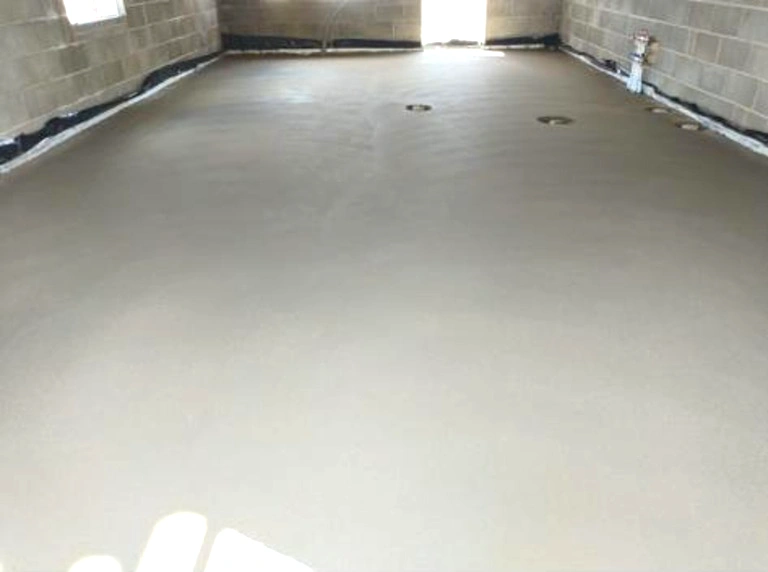
K & B Screeding’s own team, led by director Donatas Bardisevicius. Founded 2019, company 12298780.
See what customers say in our Google reviews and on our testimonials page.
Anhydrite & Flow Screed from Slough to Barnet
Barnet is about 19.9 miles east-north-east of our Slough base as the crow flies, with postcodes including EN5, N11, HA8 and NW11. The nearest towns to it are Haringey (4 miles), Borehamwood (4.4 miles), Brent (4.7 miles) and Camden (5.2 miles).
More on anhydrite screed, part of our screeding services.