
Rebuilding old solid floors in Barnsbury period houses
Strip a Barnsbury terrace back to its joists and the basement or ground floor often turns out to have no damp proof membrane at all. Damp rises through a floor like that, lifts whatever is laid on it and spoils the timber around it. Patches seldom hold, so the lasting answer in a Barnsbury house is to break the old floor out, put down a membrane and insulation, and screed over the top.
Hand-laid sand and cement fits that kind of Islington job well. Our crew mixes it in small loads on site, so it can go down a basement stair by barrow or bucket where no hose can follow. It is packed down and floated by hand, which copes with chimney breasts, alcoves and awkward corners. Being cement based, it also suits a floor that must give a cement substrate or may get wet.
Depth decides how far the dig goes in an Islington basement. Floating over insulation, the screed sits at 65mm in a home and 75mm in commercial space. A bonded sand and cement layer fixed straight to a sound slab needs only 25 to 40mm, which can save headroom where the slab below is good. Our guide to screed thickness lays out each option.
Time is the cost of all this. Hand-laid screed dries more slowly than a pumped floor, at about one day per mm up to 40mm and then slower again, so a basement programme in an Islington period house needs slack built into it.
Wet rooms and falls in Islington conversions
Converted flats and shared houses make up 24% of Islington homes, and turning one house into several flats usually means fitting shower rooms into spaces built for something else. A level access shower in an Islington conversion needs a floor that slopes to its drain. Sand and cement can be shaped by hand into that fall and stands up to water once cured, while calcium sulphate should be kept out of any room likely to get wet.
The mix can be tuned for an Islington programme. Fibres can be added for £1 to £3 per m², and rapid drying additives cut the wait when a flat has to be handed over quickly; our quick drying screed page has more on that.
Where a house has become three flats, the separating floors need acoustic treatment, and that layer goes in before any screed, which then floats on top. A small Islington shower room rarely justifies the standing cost of a lorry and pump, so a hand-laid floor tends to suit it. On a bigger open plan level, weigh it against pumped liquid screed in Islington.
Sand and Cement Screed prices in Islington
Sand and cement screed: £18 to £25 per m² supplied and laid (MyJobQuote, August 2026), so £450 to £630 for 25 m². MyJobQuote does not say whether these figures include VAT. See our floor screeding cost guide or screed calculator.
Who lays your sand and cement screed in Islington
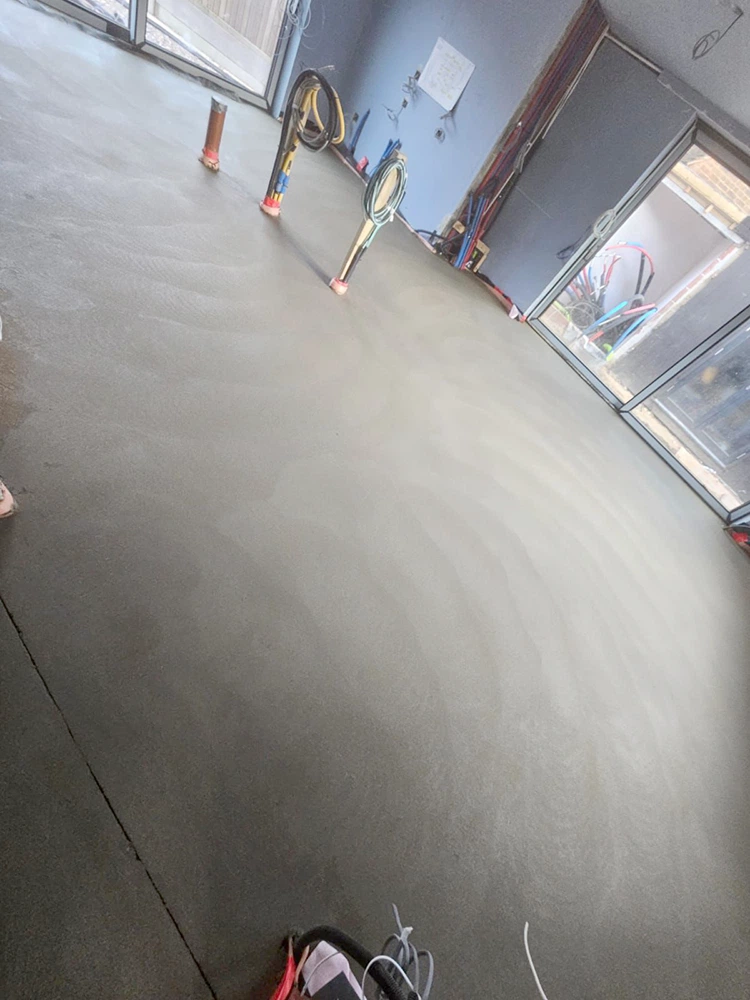
K & B Screeding’s own team, led by director Donatas Bardisevicius. Founded 2019, company 12298780.
See what customers say in our Google reviews and on our testimonials page.
Sand and Cement Screed from Slough to Islington
On the map, Islington sits east of Slough, about 23 miles from our base in a straight line (postcodes including N1, EC1R, WC1X and N4), next to Camden (1.7 miles), Hackney (2.1 miles), Westminster (3 miles) and Haringey (3.1 miles).
More on sand & cement screed, part of our screeding services.