
Rebuilding floors in Kilburn and Brondesbury conversions
Turning a big period house into flats changes what its floors must do. Every flat needs its own kitchen and bathroom, pipes take new routes, and the floors between flats must stop sound getting through. If the original solid floor is cracked, out of level or missing damp protection, we dig it out and lay a new floor: insulation, a membrane, then screed.
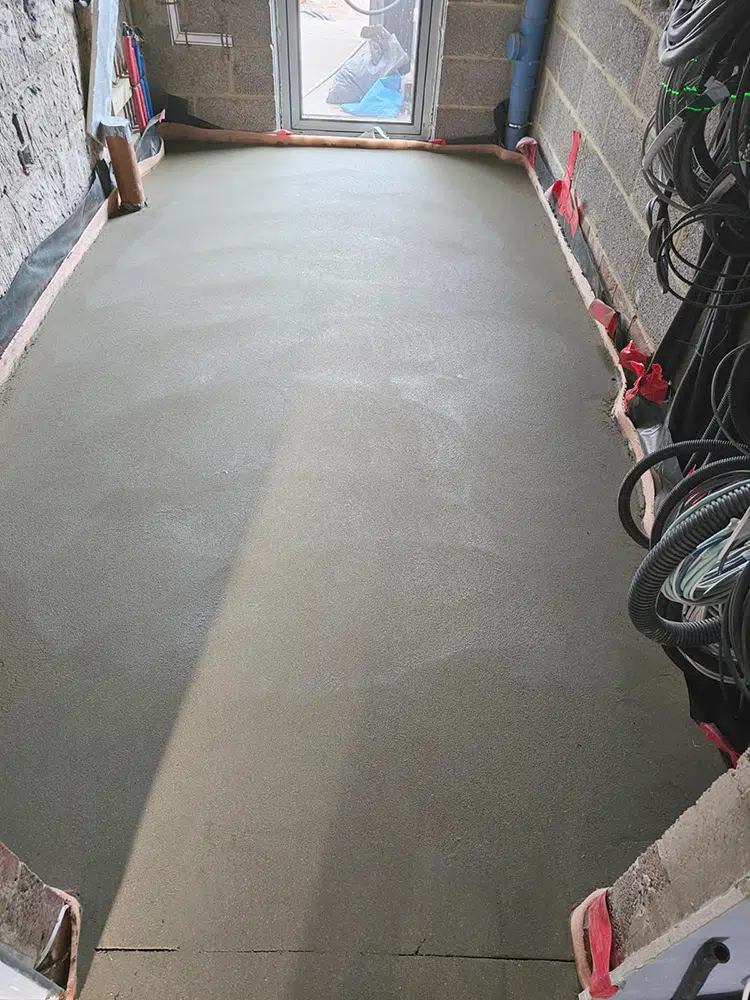
For a rebuild like this, a sand and cement mix is the practical choice. Because it is mixed on site, a hallway, a bathroom and a living room can each be laid at their own depth to meet the thresholds already there, and finishing by hand copes with the odd shapes and doorways of these houses.
There are three ways to lay it. Bonded to sound concrete, it goes down at 25mm to 40mm. Floating on insulation, homes need about 65mm and commercial floors about 75mm. How those depths are picked is explained in our screed thickness guide.
On upper floors it is carried up rather than pumped, which suits a single flat where parking a pump would be hard. When dates are tight, quick drying screed brings flooring forward. Adding fibres, at £1 to £3 per m², helps the screed resist cracking. Brent's terraces, 15% of its homes, sit on narrow plots too, and there a barrow and trowel often beats a pump.
Bathrooms and wet rooms in Brent flats
Each flat carved out of a Brent period house needs a bathroom at least, and that is where screed choice counts most. Water weakens calcium sulphate, so a shower enclosure, a wet room or a utility area gets a cement screed, and laying it by hand lets us shape the fall towards the drain while it is still wet.
Sand and cement also carries early loads well and makes a good base for tiles, stone and waterproofing systems. In a garage conversion it raises a low floor to house level over new insulation, which the garage conversion screed guide walks through.
Drying is the catch. Allow roughly a day per millimetre across the first 40mm and slower drying after that, which leaves a 65mm Kilburn conversion floor weeks, not days, away from its tiles. Give the tiler a start date that allows for it.
Not every period floor needs rebuilding. Where the base is sound and simply uneven, compound may do, as the Brent floor levelling page explains. Sand and cement is published at £18 to £25 per m² in UK figures for 2026, so budget on that basis.
Sand and Cement Screed prices in Brent
Sand and cement screed: £18 to £25 per m² supplied and laid (MyJobQuote, August 2026), so £450 to £630 for 25 m². MyJobQuote does not say whether these figures include VAT. See our floor screeding cost guide or screed calculator.
Who lays your sand and cement screed in Brent
K & B Screeding’s own team, led by director Donatas Bardisevicius. Founded 2019, company 12298780.
See what customers say in our Google reviews and on our testimonials page.
Sand and Cement Screed from Slough to Brent
On the map, Brent sits east of Slough, about 16.8 miles from our base in a straight line (postcodes including HA0, NW2, NW10 and NW6), next to Ealing (3.5 miles), Hammersmith and Fulham (4.3 miles), Kensington and Chelsea (4.5 miles) and Camden (4.5 miles).
More on sand & cement screed, part of our screeding services.