
Relaying inter-war solid floors in Bushey
Homes built between 1919 and 1944 make up 16% of Bushey, and another 12% date from before 1919. Solid floors in 1920s and 1930s houses may have been laid with no damp proof membrane at all, and a floor like that can let moisture through into the finish above it.
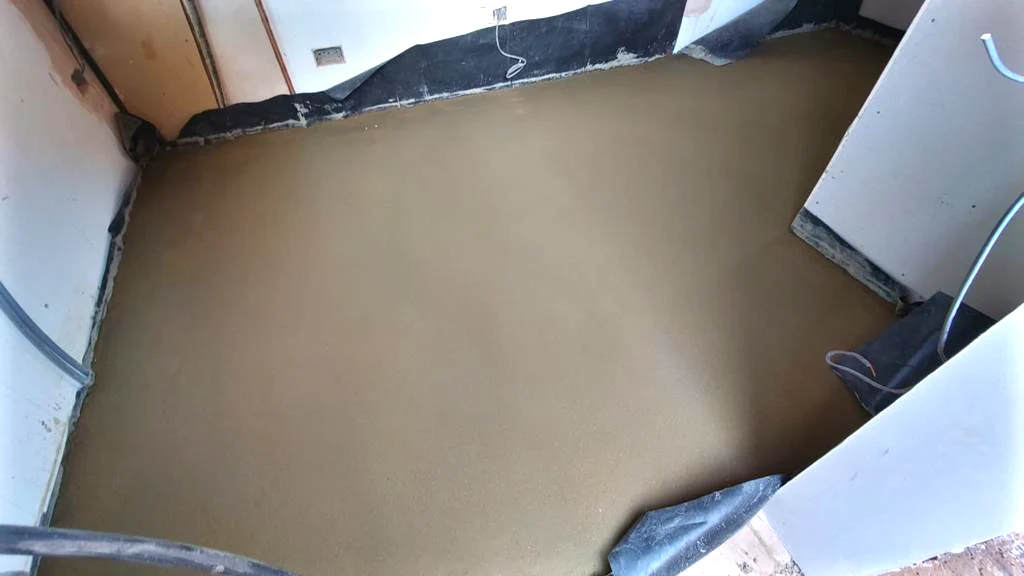
Patching does not cure that, so the answer is lifting the whole floor and relaying it. The old screed and slab are broken out to the depth needed, a membrane goes down and is lapped up the walls, insulation is added where there is height for it, and a new sand and cement screed is laid on top. A domestic screed floated over insulation is laid 65mm thick. Where the slab underneath is sound and the new screed bonds to it, a 25 to 40mm layer is enough.
This is traditional work, done by hand. We mix it on site at a consistency to suit its depth, then compact it, rule it off and power float it until the surface is dense and level. It suits a single front room or hallway better than a liquid screed would, because there is no pump to set up and no need to seal the whole room against flow.
If you are extending at the same time, the relaid floor can be set to the same finished level as the extension, so the whole ground floor runs through without a step. The membranes and insulation for the build-up come through our membrane and insulation supply, and how the layers add up is shown in our guide to screed thickness.
Bushey wet rooms, garages and early loads
Even in a Bushey house with liquid screed elsewhere, certain rooms have to be cement. One is a wet room or a walk-in shower with level access, where the falls to the drain are shaped by hand and calcium sulphate cannot be used because the floor may get wet. A garage kept for a car or a workshop is another, because a cement floor suits a floor that needs to take load early. For heavier use the mix can be made stronger; see high strength screed.
Garage conversions raise a separate problem. Its floor normally sits below the house, so it is built up with a membrane and insulation beneath a floating screed until it is level, and our garage conversion floor guide takes you through each stage.
Plan for drying time. Each millimetre of cement screed needs about a day to dry up to 40mm, then longer, so a 65mm floor means a long wait before timber or vinyl goes down. Fast drying mixes shorten it; published 2026 prices for them run from £20 up to £28 per m², where a standard mix is £18 to £25 per m². If the floor is heated, give it a minimum of 21 days before switching on.
Sand and Cement Screed prices in Bushey
Sand and cement screed: £18 to £25 per m² supplied and laid (MyJobQuote, August 2026), so £450 to £630 for 25 m². MyJobQuote does not say whether these figures include VAT. See our floor screeding cost guide or screed calculator.
Who lays your sand and cement screed in Bushey
K & B Screeding’s own team, led by director Donatas Bardisevicius. Founded 2019, company 12298780.
See what customers say in our Google reviews and on our testimonials page.
Sand and Cement Screed from Slough to Bushey
On the map, Bushey sits north-east of Slough, about 14.4 miles from our base in a straight line (postcodes including WD23 and WD7), next to Watford (1.5 miles), Harrow (3.8 miles), Borehamwood (4.2 miles) and Rickmansworth (4.5 miles).
More on sand & cement screed, part of our screeding services.
