
Period floors in Kentish Town, Primrose Hill and West Hampstead
The period houses of Kentish Town, Primrose Hill and West Hampstead have often been split into flats, and their floors show it. A kitchen at the back may sit on an old solid floor that has sunk or lost its damp protection, while the front rooms run on timber joists. When a solid floor fails, the lasting repair is to take it out, lower the dig if needed and rebuild with a membrane, insulation and a new screed.
That rebuild is classic hand-laid territory. It can be laid room by room, to exact levels, around chimney breasts, hearths and old thresholds that have to be kept. It is mixed in small batches on site, which matters when every barrow load is carried through the house.
Only 8% of Camden's homes are terraced houses, while many of its period houses now hold several separate flats each. That changes the job. A new floor in a flat has to satisfy acoustic rules and meet existing levels, so the depth is often set by the floor above or below rather than by choice. A floating screed over insulation is laid at about 65mm in a home, while a bonded screed of 25 to 40mm onto a sound base is the thinner route when height is tight. Our screed thickness guide compares the options.
Basement wet rooms and lower ground floors in Camden
Below ground, the screed is only as good as what lies under it. A basement or lower ground floor conversion in Camden needs a membrane and insulation in place first, with the detail around the edges and any drainage settled before the screed goes in. We can put those layers in too; see membranes and insulation below screed.
Down there, a cement screed earns its place. It is cement based, so it copes with moisture far better than calcium sulphate, and it can be laid to falls for a basement shower or wet room, giving the tanking and tiles a true slope towards the drain. It is also mixed in small quantities at the door, which suits a room reached by a narrow stair.
Drying is the price of that robustness. A 65mm floor gives up its water slowly, roughly one day per millimetre over the first 40, the remainder more slowly, and a lower ground room with stale air drags that out further. A fibre reinforced screed or a rapid drying additive can help where the programme or the load demands it. Published 2026 prices for sand and cement run from £18 to £25 per m².
Sand and Cement Screed prices in Camden
Sand and cement screed: £18 to £25 per m² supplied and laid (MyJobQuote, August 2026), so £450 to £630 for 25 m². MyJobQuote does not say whether these figures include VAT. See our floor screeding cost guide or screed calculator.
Who lays your sand and cement screed in Camden
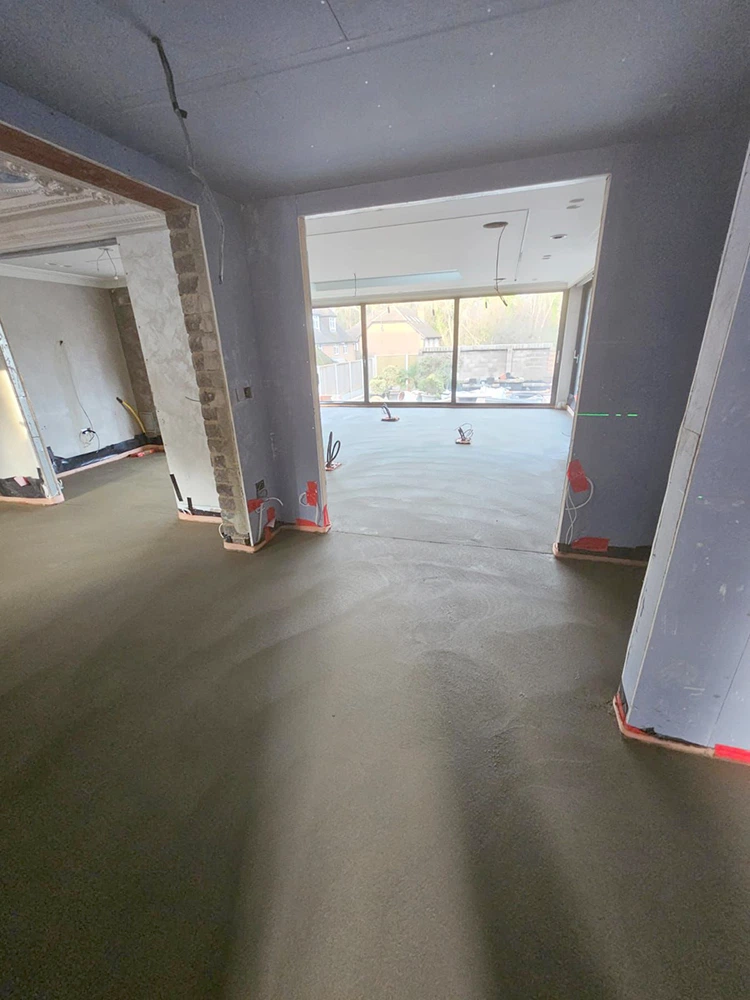
K & B Screeding’s own team, led by director Donatas Bardisevicius. Founded 2019, company 12298780.
See what customers say in our Google reviews and on our testimonials page.
Sand and Cement Screed from Slough to Camden
On the map, Camden sits east of Slough, about 21.3 miles from our base in a straight line (postcodes including WC1B, NW1, N6 and W1T), next to Islington (1.7 miles), Westminster (2.1 miles), Kensington and Chelsea (3.4 miles) and Haringey (3.5 miles).
More on sand & cement screed, part of our screeding services.
