
Heated extension floors in Kingsbury and Queensbury
On a Kingsbury or Queensbury semi, a rear extension is usually turned into a kitchen with space to sit, and heating in the floor leaves the walls free for units and glazing. It is the screed that turns a mat of pipes into a working heated floor: it protects them, spreads their heat and gives the finish a flat base.
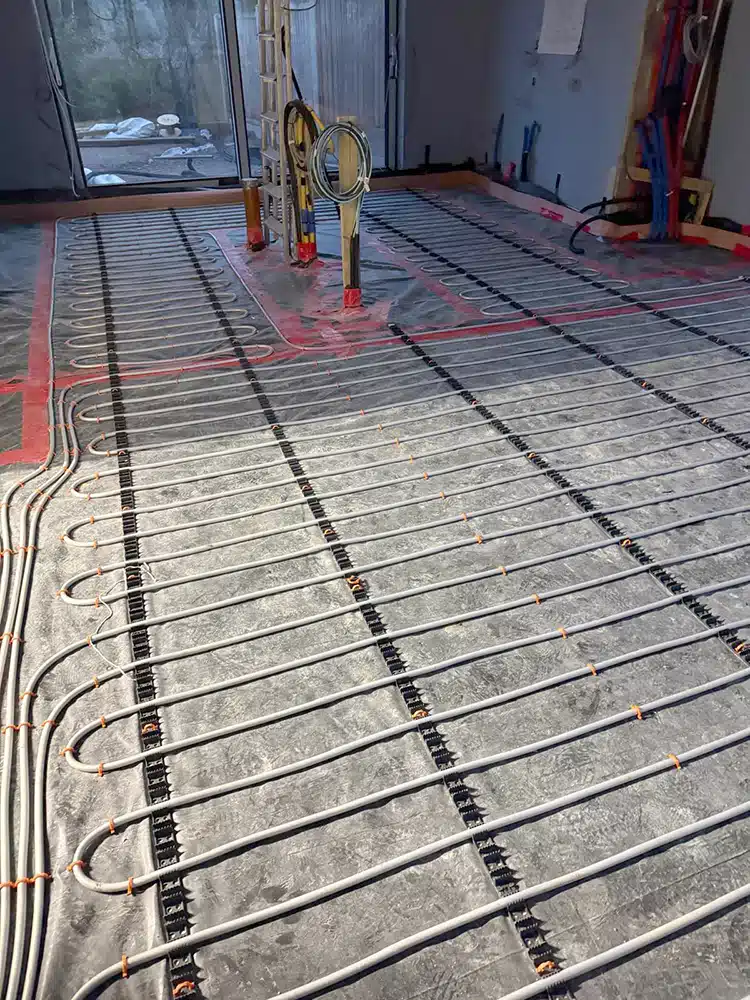
Most of the decisions come back to one measurement: the depth of screed above the pipes. Liquid screed needs 25mm or more on top of them, making 45mm to 50mm or thereabouts overall, against about 45mm for sand and cement. Go thinner and you risk cracks and patchy warmth. The pipes must also be fully encased with no air pockets, a good reason to choose a flowing screed; Brent liquid screed shows how it is laid.
The new floor must also end up flush with the house. We take that height as fixed and subtract the screed, pipes and insulation from it, and in an older house the room may have to be dug down to fit everything in.
Beneath the screed, insulation stops heat escaping downwards, an edge strip lets the screed expand without pushing on the walls, and a membrane separates the two layers. We check all of it on pour day, and if it is not yet in, our insulation and membranes work covers it. With semis at 22% of Brent's homes, heated extension floors like these are common in Kingsbury and Queensbury.
Commissioning heated floors in Wembley Park blocks
The new towers around Wembley Park and at Alperton are designed with heating in the floor, and the same rules hold there, only across far more square metres.
Never take a new screed straight to full heat. Calcium sulphate can usually be warmed from about 7 days, which also speeds its drying; sand and cement needs 21 days at least before the heating goes on. Either way, the first run is at a low temperature, raised step by step over several days. Our written heat-up schedule means the heating engineer and the flooring contractor follow one plan.
Before the pour, the pipes need laying, clipping and pressure testing, and the building must be closed in against the weather. Whether the heated floor is finished in tile, LVT or engineered boards, it has to be flat, and the screed drying times guide explains why the finish still waits for a moisture test.
Pumped screed over heating pipes costs £20 to £35 per m² in the UK figures for 2026. For the borough to the north, see Harrow underfloor heating screed.
Underfloor Heating Screed prices in Brent
Liquid screed over underfloor heating: £20 to £35 per m² supplied and laid (trade2base, June 2026), so £700 to £1,230 for 35 m². trade2base gives these figures excluding VAT. See our floor screeding cost guide or screed calculator.
Who lays your underfloor heating screed in Brent
K & B Screeding’s own team, led by director Donatas Bardisevicius. Founded 2019, company 12298780.
See what customers say in our Google reviews and on our testimonials page.
Underfloor Heating Screed from Slough to Brent
On the map, Brent sits east of Slough, about 16.8 miles from our base in a straight line (postcodes including HA0, NW2, NW10 and NW6), next to Ealing (3.5 miles), Hammersmith and Fulham (4.3 miles), Kensington and Chelsea (4.5 miles) and Camden (4.5 miles).
More on underfloor heating screed, part of our screeding services.
