Heated kitchen extensions behind Fulham's terraces
Houses here are rarely detached. Only 1% of homes in the borough are detached and 5% semi-detached, so a heated extension usually means building out behind a terrace, with the new floor meeting an old one at the kitchen doorway. The screed depth has to work backwards from that finished floor height.
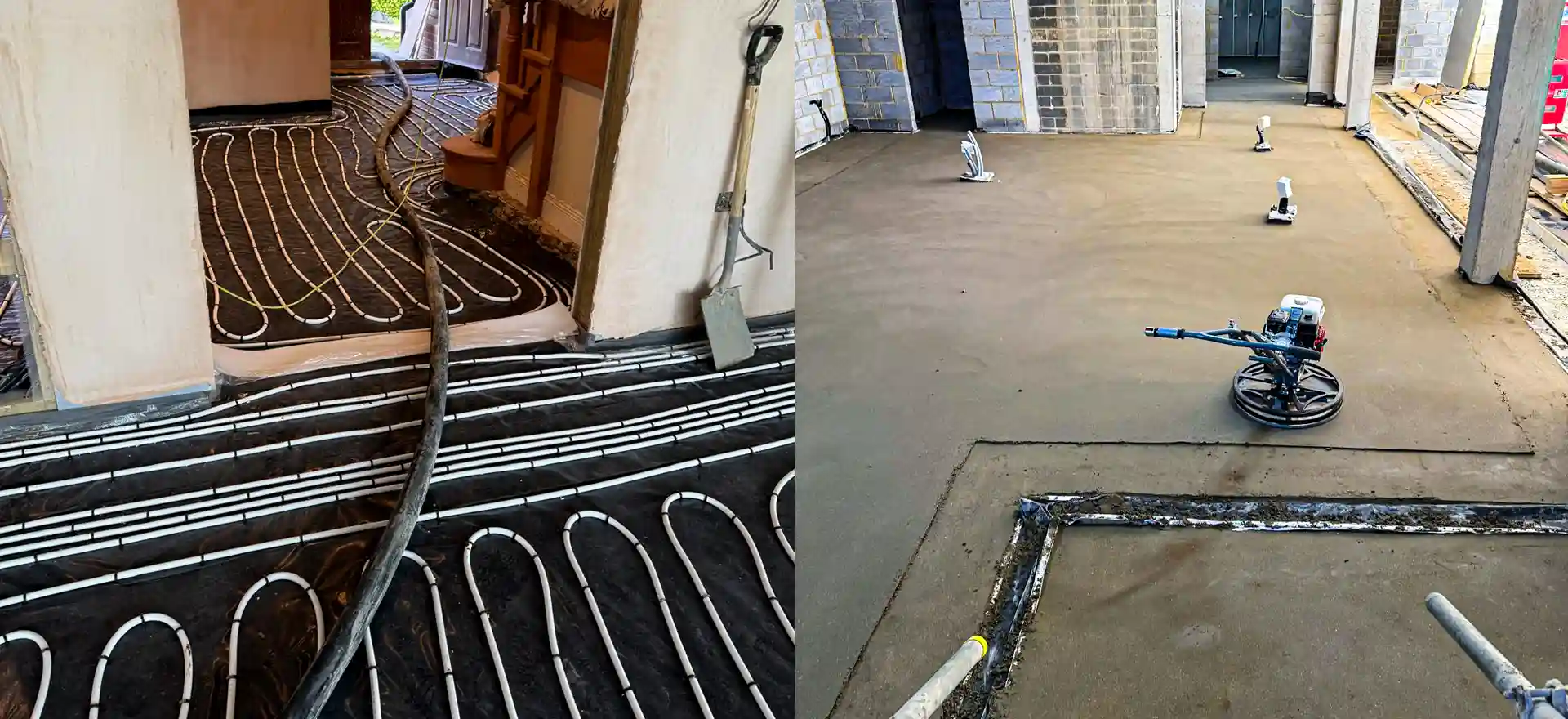
Behind a Fulham terrace, the figure everything turns on is the screed cover over the heating pipes. With a liquid pour, 25mm over the pipes is the least you can have, so the floor comes to about 45 to 50mm. Sand and cement has to bury them under about 45mm, which makes for a deeper floor. Skimp on it and cracks can open above the pipes; overdo it and the heating is slow to respond.
Liquid screed usually wins in an extension. Because the mix surrounds every pipe, no air pockets are left, heat spreads evenly, and the surface comes out flat enough for tiles, LVT or engineered wood. The result is a floor that warms up faster and uses the heat more efficiently than one with gaps around the pipes. At 2026 UK prices, a liquid pour over heating pipes comes to £20 to £35 per m².
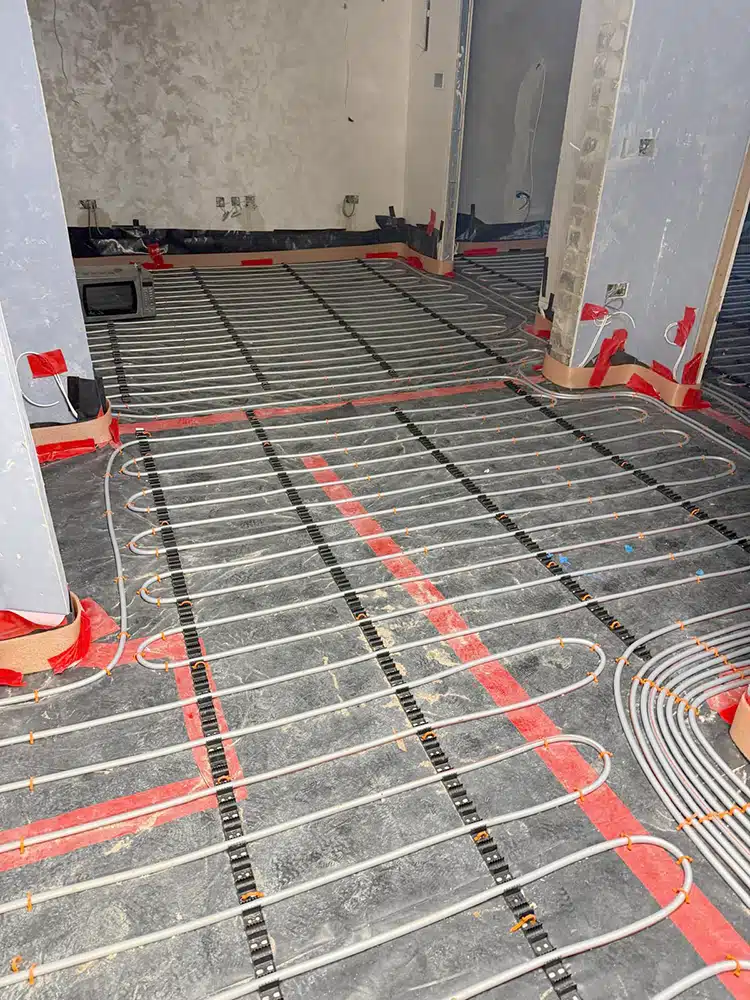
The build-up underneath matters as much. We either inspect the insulation, the membrane and the edge strip before pouring, or provide them ourselves. Our page on insulation boards, membranes and edge strip explains each layer. For how the pump reaches the back of a terrace, see liquid screed in Hammersmith and Fulham.
Retrofitting heating into older Hammersmith floors
Putting underfloor heating into an existing Victorian or Edwardian room is harder than building it into an extension. What usually stops it is height. Insulation, pipes and screed all have to squeeze in beneath the doors, skirting and stair nosings, which may mean taking the old floor out first.
In that situation the thinner option matters. A liquid screed at around 45 to 50mm total is often the only build-up that fits, and the solid floor underneath may need digging out and a new membrane laying before any of it goes in. Hand-laid sand and cement screed can still be the answer in a bathroom or wet area within the same project.
Warm the new floor up slowly. Calcium sulphate can generally take a first low heat at about 7 days, but a sand and cement floor needs a full 21 days before it is warmed at all. Your heating engineer's commissioning plan sets the steps, starting at a low temperature and stepping it up. The same rules apply in a neighbouring borough, as our page on underfloor heating screed in Wandsworth sets out.
Heated basement floors under Hammersmith and Fulham terraces
Basement and ground floor extensions under Victorian terraces are a common kind of job in the borough, and they usually come with new membranes. Underfloor heating can go into a basement floor, but the layers have to be planned with the waterproofing in mind.
The order runs from the slab upwards. The basement's waterproofing comes first, designed by whoever is responsible for keeping water out. Insulation goes over it, then a membrane where the build-up needs one, then the edge strip and the heating engineer's pipes. Only then does the screed go in.
The choice of screed deserves thought here. Calcium sulphate is weakened by prolonged moisture, so in a basement where any water risk remains, a cement based screed is often the safer choice. The waterproofing designer's advice should settle it before anything is ordered.
Height is the other limit. A basement ceiling is usually fixed by the excavation depth, so every millimetre of floor build-up counts, and the thinner liquid build-up described above is often the deciding factor.
In a basement with little airflow, drying takes longer, so allow time for it before the moisture test and the flooring.
Underfloor heating screed prices in Hammersmith and Fulham
Liquid screed over underfloor heating: £20 to £35 per m² supplied and laid (trade2base, June 2026), so £700 to £1,230 for 35 m². trade2base gives these figures excluding VAT. See our liquid screed cost per m² guide, the floor screeding cost guide or the screed calculator.
Who lays your underfloor heating screed in Hammersmith and Fulham
K & B Screeding’s own team, led by director Donatas Bardisevicius. Founded 2019, company 12298780.
See what customers say in our Google reviews and on our testimonials page.
Underfloor heating screed from Slough to Hammersmith and Fulham
On the map, Hammersmith and Fulham sits east of Slough, about 18.6 miles from our base in a straight line (postcodes including W6, NW10, W3 and SW6), next to Kensington and Chelsea (1.2 miles), Westminster (2.8 miles), Wandsworth (3.7 miles) and Brent (4.3 miles).
Your quote will say whether the screed lorry needs road space in Hammersmith and Fulham. If it does, a bay suspension can be requested from Hammersmith and Fulham Council (parking bay suspension). For an extension in Hammersmith and Fulham, the floor usually needs building regulations approval, including Part L insulation in England. Local building control is Hammersmith and Fulham Council Building Control.
More on underfloor heating screed, part of our screeding services. For every screed we lay locally, see floor screeding in Hammersmith and Fulham.
Further reading: screed thickness guide and underfloor heating on a concrete floor.