
Keeping heated floors thin in Kensington period rooms
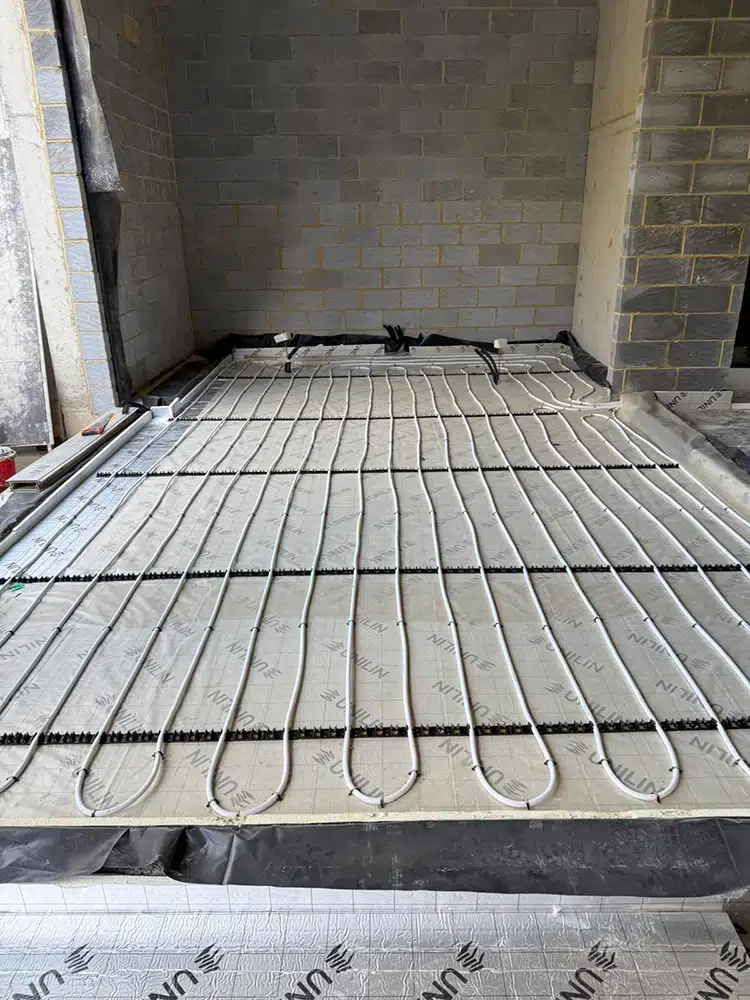
Retrofitting underfloor heating into a period house or flat usually happens as part of a wider refurbishment. The old floor comes up, insulation goes down, the heating installer fixes and pressure tests the pipes, and the screed goes over them. This is also the point to agree the target finished floor level with the flooring fitter. In a room with original skirting, panelled doors and stone thresholds, every millimetre added to the floor has to be accounted for.
Pipe cover sets the minimum. A liquid screed needs at least 25mm above the pipes, for a total of 45 to 50mm. A sand and cement screed needs about 45mm of cover, so the total is thicker. That is why a pumped liquid screed over heating is usually chosen where height is tight: it flows around every pipe with no air pockets and can be laid thinner. Where the final surface must be especially smooth for thin finishes, a latex levelled layer of a few mm goes over the cured screed.
In a converted building, the heated floor also sits over an acoustic layer, so the full build-up is insulation, acoustic treatment, pipes and screed. Each layer, including the edge strip, is checked before the pour, because none of them can be reached once the screed is down. Our insulation and membranes service covers what goes under the pipes.
Heat-up timing on newer Kensington and Chelsea floors
Only 7% of the borough's homes were built since 2000, so heated floors in new build plots are the smaller part of the picture. The Earls Court redevelopment, planned for around 4,000 homes, will add many new floors over the coming years, and any that are heated will need the same careful commissioning as a retrofit.
The heating must not go straight to full power. A calcium sulphate screed can usually be heated from about 7 days, starting low and raising the temperature a little at a time. A sand and cement screed needs at least 21 days first. Bringing the floor up slowly lets it dry evenly and reduces the risk of cracking. The same slow approach applies after a long cold spell or a break in the programme. We write down the schedule so the heating installer and the flooring fitter can both plan around it.
Heat speeds drying, but a moisture test still decides when stone, timber or LVT can go down. Our drying time guide explains how depth affects the wait. For the same service a short way west, see underfloor heating screed in Hammersmith and Fulham.
Underfloor heating screed in the borough's purpose-built blocks
Purpose-built flats are 57% of homes in Kensington and Chelsea, including council estates of the 1970s such as the World's End Estate and Trellick Tower. Adding wet underfloor heating to a flat in a block brings checks that a house does not.
The lease comes first. Many leases control changes to floors, so the freeholder or managing agent may need to approve the work, and they may ask for details of the acoustic build-up so that sound does not travel to the flat below. Get that answer before the pipes are ordered.
Height is the next limit. A flat's front door, the threshold to the communal landing and any fire door have to keep working, so insulation, acoustic layer, pipes and screed all have to fit beneath them. Measure those fixed points before the system is chosen, because they set the depth available and often decide that the thinner liquid screed is the one that fits.
Weight and access follow. A wet screed adds load, so the structure needs to be suitable, and the pump hose or buckets have to reach the floor through common parts that are protected and booked.
Timing matters in an occupied block. The pour, the drying and the slow heat-up all happen while neighbours live above and below, so the managing agent will want a date for each stage, and the written heat-up schedule should go to whoever controls the heating in the flat.
Underfloor heating screed prices in Kensington and Chelsea
Liquid screed over underfloor heating: £20 to £35 per m² supplied and laid (trade2base, June 2026), so £700 to £1,230 for 35 m². trade2base gives these figures excluding VAT. See our liquid screed cost per m² guide, the floor screeding cost guide or the screed calculator.
Who lays your underfloor heating screed in Kensington and Chelsea
K & B Screeding’s own team, led by director Donatas Bardisevicius. Founded 2019, company 12298780.
See what customers say in our Google reviews and on our testimonials page.
Underfloor heating screed from Slough to Kensington and Chelsea
As the crow flies, our base in Slough is about 19.6 miles from Kensington and Chelsea, which lies to the east. Postcodes here include SW7, SW3, SW5 and W10, and Hammersmith and Fulham (1.2 miles), Westminster (1.6 miles), Camden (3.4 miles) and Wandsworth (3.8 miles) are close by.
On Kensington and Chelsea streets where the screed lorry cannot park off the road, a bay suspension comes from Kensington and Chelsea Council (bay suspension). We confirm on the quote whether it is needed. New floors in Kensington and Chelsea extensions usually need building regulations approval, with Part L insulation rules in England; Kensington and Chelsea Council Building Control is the council building control service.
More on underfloor heating screed, part of our screeding services. For every screed we lay locally, see floor screeding in Kensington and Chelsea.
Further reading: screed thickness guide and underfloor heating on a concrete floor.