
Fitting heated floors into older Islington homes
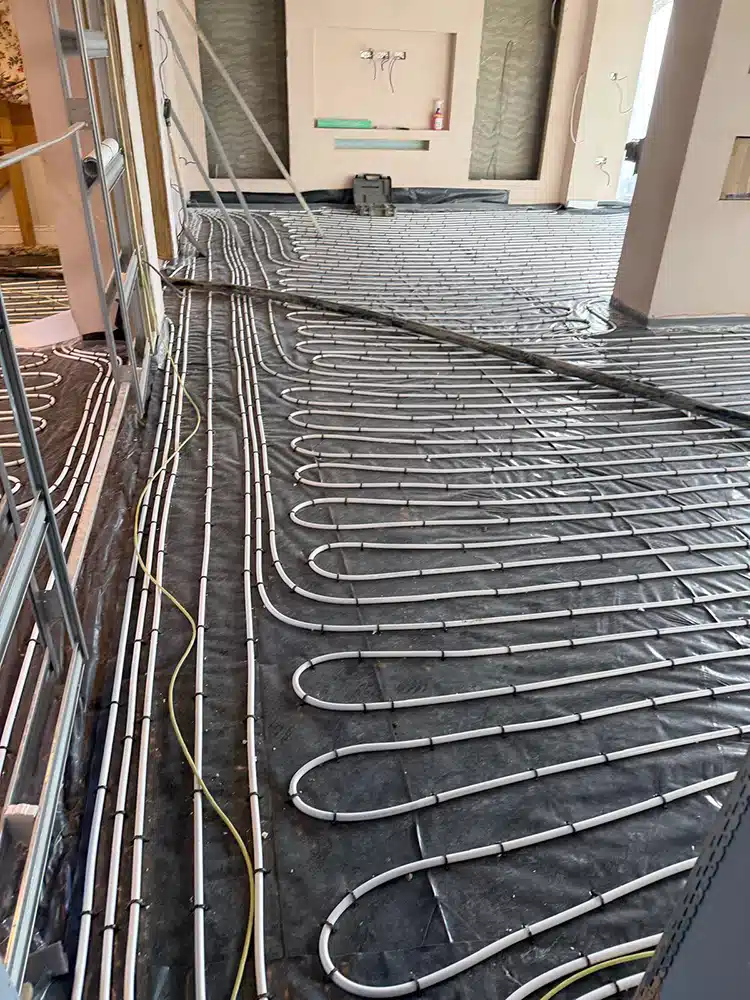
Only 13% of Islington's homes are terraced houses, so a heated floor here is more often going into a flat than into a whole house. Retrofitting it usually happens during a larger strip-out. The basement or ground floor is dug out, a membrane and insulation go down, the heating installer fixes and pressure tests the pipes, and then the screed is laid over them.
The screed does two jobs: it protects the pipes and spreads their heat evenly across the room. For that it needs enough cover above the pipes. A liquid screed needs at least 25mm of cover, giving a total depth of 45 to 50mm, while sand and cement needs about 45mm of cover, so the total is noticeably thicker. Where a room has little depth to spare, liquid screed usually wins, because it flows fully around each pipe with no air pockets and can be laid thinner.
In a flat above another home, the heating sits over an acoustic layer, so the build-up becomes insulation, acoustic treatment, pipes and screed. Every layer is checked before the pour, because a gap in the edge strip or a torn membrane cannot be put right once the screed is down. Our insulation and membrane service covers the layers under the pipes, and a liquid screed over heating pipes is the usual choice for these thin build-ups.
New Holloway Park flats and the heat-up schedule
On newer blocks such as Holloway Park, thin liquid screed over underfloor heating is the usual specification. 5% of Islington's homes were built from 2015 onwards, and floors of that age are generally designed with heating in the screed from the start.
Whatever the building, the heating cannot go on at full power straight away. A calcium sulphate screed can usually have the heating run from about 7 days, starting low and raising the temperature gradually. A sand and cement screed needs at least 21 days before the heating is used. Commissioning slowly lets the screed dry evenly and reduces the risk of cracking. We hand over the heat-up guidance in writing, so the heating installer and the flooring fitter both know the dates.
The heating helps dry the floor before the finish goes down, but it does not replace a moisture test. Tiles, LVT and engineered wood each have their own limits. Our screed drying guide explains why depth matters so much. For the same service a short distance west, see underfloor heating screed in Camden.
Underfloor Heating Screed prices in Islington
Liquid screed over underfloor heating: £20 to £35 per m² supplied and laid (trade2base, June 2026), so £700 to £1,230 for 35 m². trade2base gives these figures excluding VAT. See our floor screeding cost guide or screed calculator.
Who lays your underfloor heating screed in Islington
K & B Screeding’s own team, led by director Donatas Bardisevicius. Founded 2019, company 12298780.
See what customers say in our Google reviews and on our testimonials page.
Underfloor Heating Screed from Slough to Islington
On the map, Islington sits east of Slough, about 23 miles from our base in a straight line (postcodes including N1, EC1R, WC1X and N4), next to Camden (1.7 miles), Hackney (2.1 miles), Westminster (3 miles) and Haringey (3.1 miles).
More on underfloor heating screed, part of our screeding services.
