
Open-plan extension floors on Merton's older houses
A pumped screed earns its keep on a large, open area that can be poured in one go. On Merton's Victorian terraces, a rear kitchen extension that opens into the original house creates exactly that kind of floor. Poured in, it spreads to a level finish from wall to wall, hits SR1 or SR2 without fuss, and its low shrinkage means far fewer joints than a hand-laid floor would need.
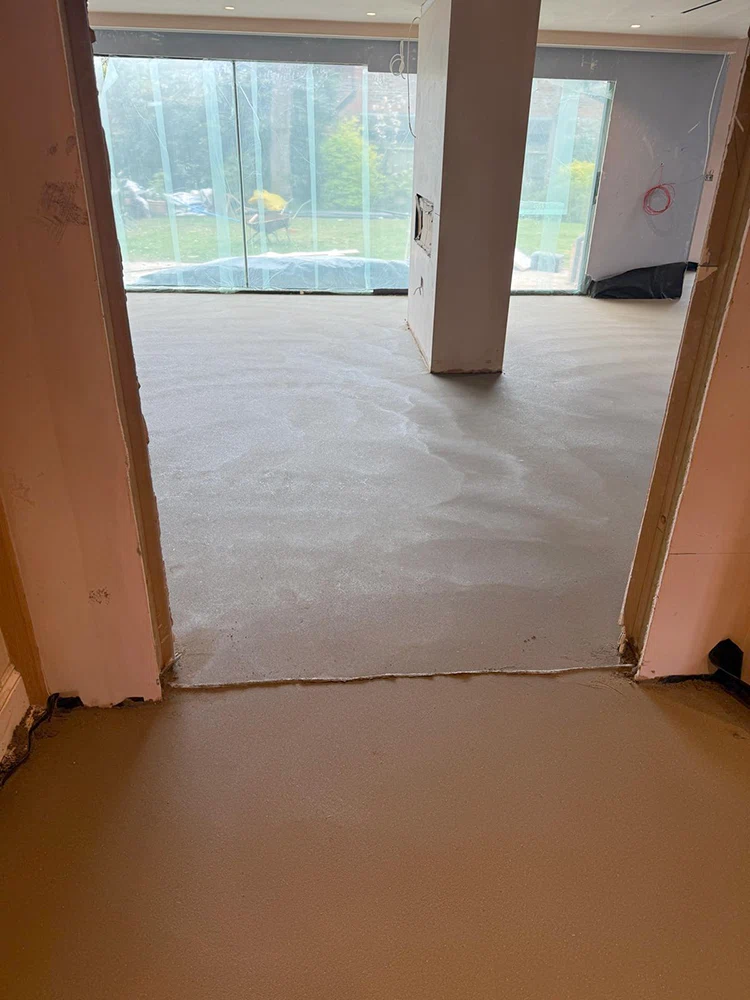
Thinner sections help where new has to meet old. Floated over insulation, a domestic liquid floor can be as thin as about 35mm, where sand and cement needs about 65mm, and those spare millimetres make it easier to line up with the old rooms so there is no step through the opening. Those millimetres count where the extension is built off an older floor that cannot be raised.
New homes suit it too. Merton has 12% of its housing from 2000 onwards, and buildings from those years generally allow enough floor depth for insulation plus a flowing screed. The large Clarion programme at High Path, Eastfields and Ravensbury will add many more over the coming years.
There is more than one kind of liquid screed: some are calcium sulphate, others cement. Grades and testing for the calcium sulphate type are explained under Merton anhydrite screed. If you are torn between pumped and traditional, our guide weighing liquid against sand and cement lays out the differences.
Parking the pump on Merton streets
We set up the mixer and pump outside and feed a hose in through whichever door is closest to the room. A driveway makes this easy. On terraced streets without off-street parking, the mixer may need a space on the road for several hours, so mention yellow lines, permit bays or bus routes when you ask for a price.
Flats make up 38% of Merton's homes, and for those above ground level the hose route matters. The hose will go up a staircase or in at a window, as long as the building manager has signed off the route and it is covered up beforehand.
Indoors, preparation has to be finished first: edge strip fixed along each wall, the membrane on top of the insulation taped at all its joints, and a dam across every doorway. After the pour, the room stays shut up and free of draughts for its first two days.
Walking across it gently is normally fine once 24 to 48 hours have gone by, yet the screed is still far from dry. The flooring only goes down when a moisture reading is inside the covering manufacturer's limit, which works out at roughly one millimetre per day for the first 40mm. There is more on the equipment under pumping screed, and Kingston upon Thames, about 3.4 miles away, has its own pumped screed page.
Liquid Screed prices in Merton
Liquid screed: £24 to £31 per m² supplied and laid (MyJobQuote, August 2026), so £960 to £1,240 for 40 m². MyJobQuote does not say whether these figures include VAT. See our floor screeding cost guide or screed calculator.
Who lays your liquid screed in Merton
K & B Screeding’s own team, led by director Donatas Bardisevicius. Founded 2019, company 12298780.
See what customers say in our Google reviews and on our testimonials page.
Liquid Screed from Slough to Merton
Merton is about 20.6 miles east-south-east of our Slough base as the crow flies, with postcodes including SW20, SW19, SM4 and CR4. The nearest towns to it are Wandsworth (2.8 miles), Kingston upon Thames (3.4 miles), Sutton (3.7 miles) and Ewell (4.5 miles).
More on liquid screed, part of our screeding services.