
Newer Newhaven homes: levelling before new flooring
Homes built from 2000 to 2014 make up 11% of Newhaven, and more have gone up since. Floors of that age are generally sound, so the usual problem is flatness: a floor that was fine for carpet shows every ridge through new LVT, and large tiles rock on a slight hollow. The answer there is compound, not a new screed.
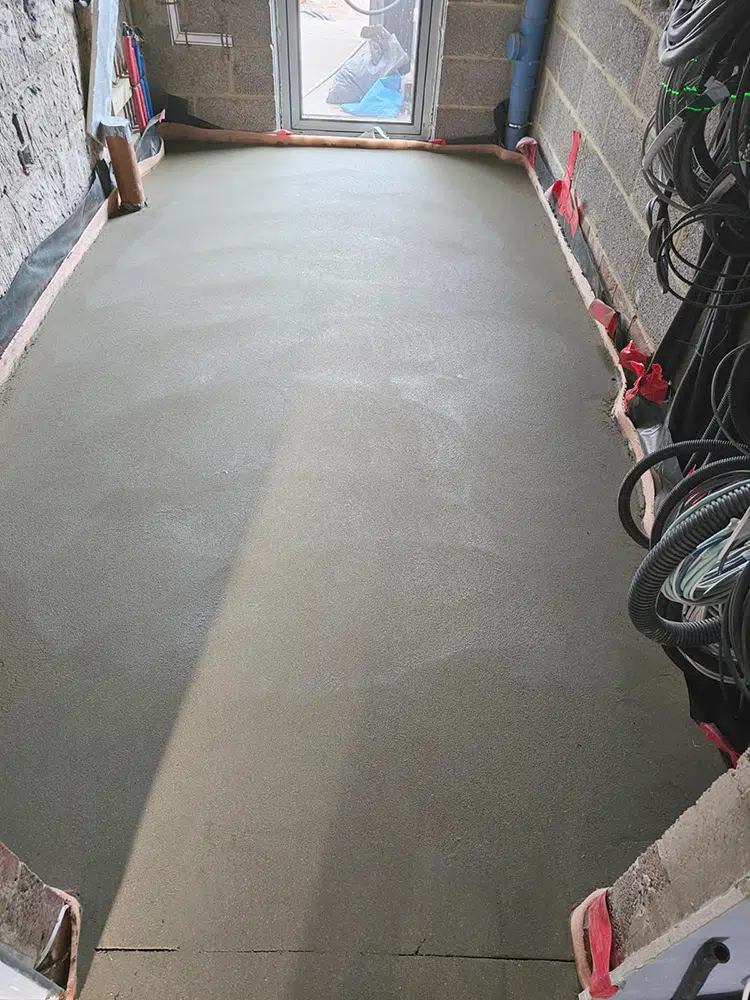
BS 8204 checks a floor by laying a 2m straightedge across it and measuring the gap beneath. Under SR1 the gap may be no more than 3mm, under SR2 no more than 5mm, and under SR3 up to 10mm; many thin sheet floorings will accept nothing worse than SR1. A compound layer of between about 2mm and around 10mm is normally enough for floors of this age. A thin latex screed of a few millimetres is enough where the base is nearly flat already.
Getting the primer right matters just as much. Calcium sulphate, sand and cement and old tiles each need their own primer, and on calcium sulphate the laitance has to come off before anything else.
Older houses are a different story. Between 1945 and 1972 the town built 29% of its present homes, and decades of wear have often left their solid floors out of true. Levelling works there if the slab is sound. If it is cracked right through, damp or crumbling, compound will crack and debond, and a new screed is the honest answer; the sand and cement screed page for Newhaven explains that route.
Unit refits from Avis Way to Denton Island
Business floors take the same approach with less time to spare. The Avis Way Industrial Estate covers about 26.7 hectares, Eastside Business Park has 26 light industrial and warehouse units, and Denton Island Business Park, centred on the Basepoint enterprise centre, adds smaller workshops. A refit of any of those units or offices needs the old floor turned into a flat, clean base before the new finish is laid.
Preparation comes first. Old adhesive, paint and weak surface layers stop a compound from bonding, so they are ground or blasted away; our floor preparation service includes shot blasting. Cracks and holes are filled, the base is primed to suit what it is, and only then is the compound poured.
Fast drying products keep the programme moving, and many can take the next trade quickly, depending on the product and depth. Where a unit floor is several centimetres out or breaking up, a thin compound is the wrong fix, and we will say so and price a screed instead. We do not lay resin, polished concrete or structural slabs, so warehouse floors needing those go to a specialist.
How we price floor levelling in Newhaven
A fixed written price within 24 hours, once we know the area and the base. See our floor screeding cost guide.
Who levels your floor in Newhaven
K & B Screeding’s own team, led by director Donatas Bardisevicius. Founded 2019, company 12298780.
See what customers say in our Google reviews and on our testimonials page.
Floor Levelling from Slough to Newhaven
As the crow flies, our yard in Slough is about 59.2 miles from Newhaven, which lies to the south-south-east. Postcodes here include BN9, and Peacehaven (2 miles), Seaford (2.9 miles), Lewes (5.7 miles) and Brighton and Hove (8.6 miles) are close by.
More on floor levelling, part of our screeding services. Not sure whether you need a thin compound or a full flowing screed? See self levelling screed explained.