
Latex over timber in Meads and Upperton flats
The name trips people up, because latex screed is not a screed in the usual sense. It comes in two parts: a cement based powder, and a latex liquid that takes the place of water. The latex lets the compound flex very slightly and helps it grip, which is why it goes onto bases that an ordinary compound would struggle to hold. It is laid thin, usually a few millimetres, and its job is to make a sound floor smooth.
That suits the converted villas of Meads and Upperton, where uneven timber is the normal starting point. Order is everything. Bare floorboards are never a base for latex, since each board moves on its own and the gaps between them come through as cracks. The boards are screwed down tight first, then covered with flooring grade plywood fixed at close centres. The latex goes onto the plywood, never onto the boards beneath.
A floor that still bounces underfoot needs the joists or boards putting right before anything is mixed. Latex cannot stiffen a springy floor, and it will crack if asked to.
With the plywood primed, the mix is poured and spread across the room in one go. Where a floor is badly out of level rather than just rough, our page on levelling Eastbourne floors with compound explains the deeper options, and a damaged base may need screed repairs first.
Old tiles and stripped floors across Eastbourne refits
With 69% of Eastbourne homes in council tax bands A to C, plenty of refits are priced with care, and breaking out an old tiled floor is noisy, slow and costly. It is often unnecessary. Quarry or ceramic tiles that are still firmly bonded can stay where they are, provided they are cleaned, any loose ones are reset and the surface is primed to suit. Latex then fills the grout lines and gives the new vinyl or LVT a flat face.
Carpet and old sheet flooring leave their own problem. Lift them and the concrete below is often patchy with glue. Some old adhesive is sound enough to stay under latex once primed, while loose or soft residue has to come off, which is where our concrete floor grinding in Eastbourne comes in.
Two checks come before any of this. The first is damp, because latex does not stop moisture rising through an old floor. The second is the base itself: a calcium sulphate screed must have its laitance removed and be primed with a compatible product before latex touches it.
We cover the whole town, from Roselands and St Anthony's Hill to Ratton Village and Friday Street, and the same work is available in Polegate.
How we price latex screed in Eastbourne
A fixed written price within 24 hours, once we know the area and the base. See our floor screeding cost guide.
Who lays your latex screed in Eastbourne
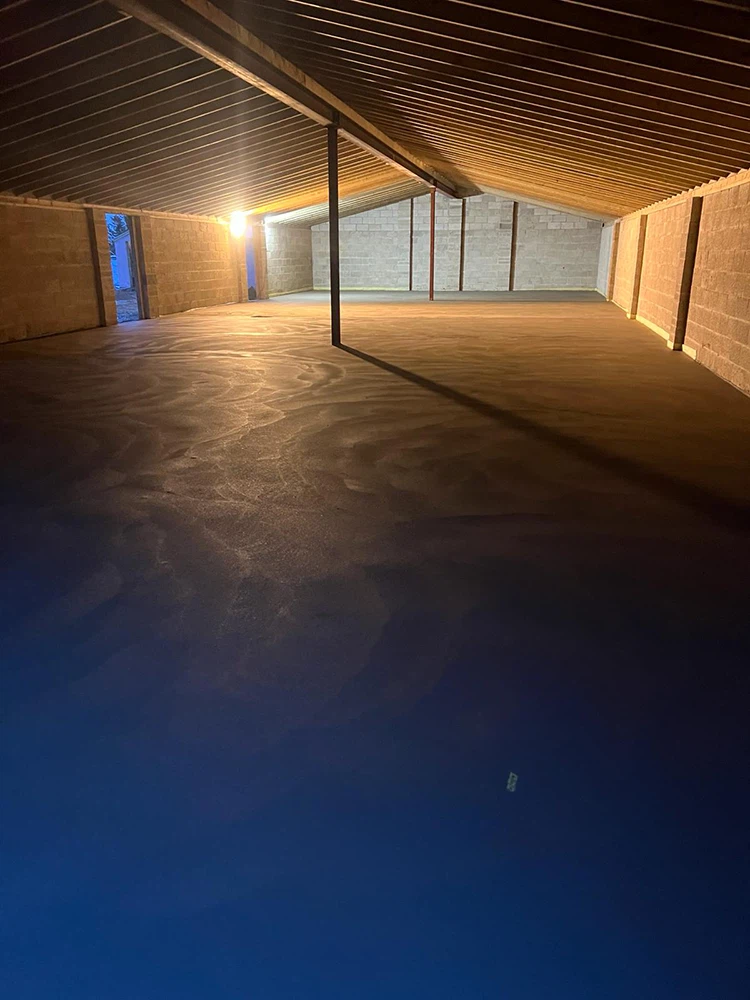
K & B Screeding’s own team, led by director Donatas Bardisevicius. Founded 2019, company 12298780.
See what customers say in our Google reviews and on our testimonials page.
Latex Screed from Slough to Eastbourne
On the map, Eastbourne sits south-east of Slough, about 66.4 miles from our base in a straight line (postcodes including BN21, BN20, BN23 and BN22), next to Polegate (4.1 miles), Hailsham (6.8 miles), Seaford (7.8 miles) and Bexhill-on-Sea (9.9 miles).
More on latex screed, part of our screeding services.
