
Preparing slabs at Ampress Park and Gordleton Industrial Estate
Beside Lymington New Forest Hospital, the 35 acre Ampress Park holds warehouse, office and manufacturing units, largely developed from the mid 2000s onwards. Gordleton Industrial Estate sits out in Upper Pennington. On both, a fit-out can mean a new floor over a slab that has already seen use.
That slab can carry plenty a new finish will not tolerate: painted walkway lines, sealer, glue from old carpet tiles, tyre marks, and lips where neighbouring bays were poured a few millimetres apart. Grinding deals with all of them. Diamond segments on rotating heads shave the surface off in shallow passes, exposing clean, firm concrete with an open texture that primers and adhesives can key into.
The incoming use decides what follows. Offices and showrooms tend to get compound and then vinyl, LVT or carpet tiles. A production area may take a new hard-wearing topping, and some occupiers specify resin. We prepare the slab for any of these, though resin coatings and polished concrete are laid by specialist firms, not by us.
Grinding has a firm limit. It removes local high points, but a floor that falls or dips over a large area cannot be ground flat without cutting too deep. Then we grind the peaks and correct the rest with levelling compound in Lymington or a screed. On a screed, as opposed to a structural slab, depth is checked first, because over-grinding can leave it below its minimum thickness. For broad areas or heavy coatings, our floor preparation work includes shot blasting and scarifying.
New slab against old in Pennington and Buckland
Single storey extensions on Pennington and Buckland's houses of the 1950s to 1990s are meant to finish flush with the existing slab. Even so, a small step or ridge can remain along the line where the old back wall stood. A grinder brings the high side down so one run of flooring can cross the join, and a skim of compound finishes the blend.
Lifting old flooring creates the other job. Under carpet, cork or vinyl tiles a solid floor can hide hard black adhesive or flaking paint. Both have to go before new adhesive or latex screed in Lymington is laid, because neither bonds to residue. With 28% of the town's homes built between 1945 and 1972, a floor of that age may have carried more than one covering.
We grind only with dust extraction. Concrete, screed and tiles contain silica, and the fine dust a grinder releases, respirable crystalline silica, is dangerous to breathe. Extraction runs from the machine, doorways are sheeted off and adjoining rooms protected, which counts in a home that stays lived in.
The work is done by our own team; we do not sell or hire grinders or tooling. Grinding is also available over in Christchurch.
How we price floor grinding in Lymington
A fixed written price within 24 hours, once we know the area and what has to come off. See our floor screeding cost guide.
Who grinds your concrete floor in Lymington
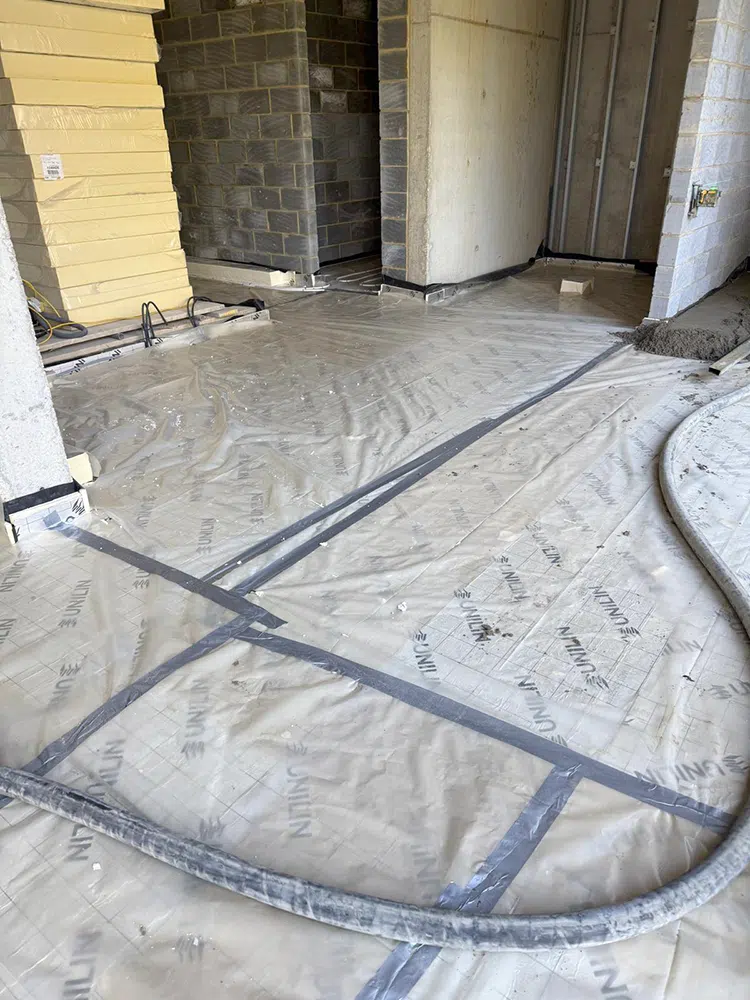
K & B Screeding’s own team, led by director Donatas Bardisevicius. Founded 2019, company 12298780.
See what customers say in our Google reviews and on our testimonials page.
Concrete Floor Grinding from Slough to Lymington
Lymington is about 66.2 miles south-west of our Slough base as the crow flies, with postcodes including SO41. The nearest towns to it are New Milton (5 miles), Christchurch (10.6 miles), Totton (11.3 miles) and Southampton (11.8 miles).
More on floor grinding, part of our screeding services.