
Latex over awkward bases in Ferndown bungalows
Bungalows and detached houses from the 1950s to the 1990s have usually had more than one kitchen and bathroom in their lifetime, and each refit may have left something behind on the floor. A latex screed lets the next one start on a smooth surface without stripping everything back.
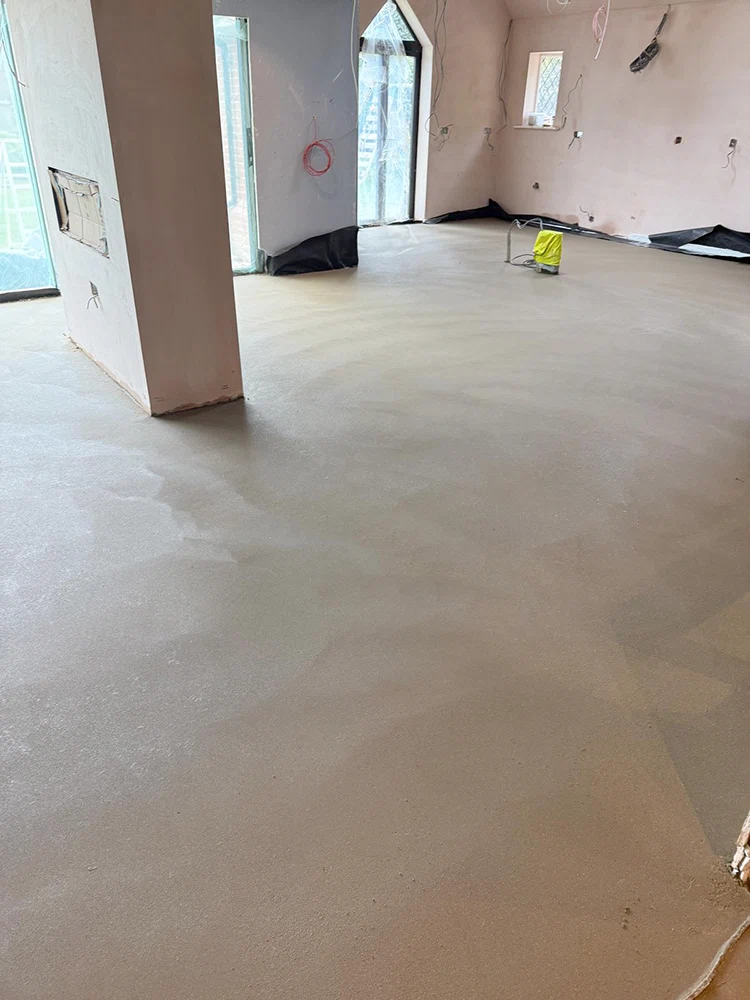
Latex itself is a two part product. A cement based powder is mixed with a latex liquid rather than water, and the mix is spread at a few millimetres. It bonds to a range of surfaces and finishes smooth enough for thin sheet flooring.
On timber floors, the boards are fixed down and overboarded with flooring grade plywood, never latexed bare. Bare boards shrink and swell, and the thin layer would split along every joint.
On old ceramic or quarry tiles, every tile has to be firm. Hollow ones are lifted and the holes made good, then a tile primer goes on.
On worn concrete, small hollows and old trowel marks can be filled and smoothed. Thin, hard adhesive residue can sometimes be primed over; thick or soft residue comes off first, often by grinding the slab clean.
Safety flooring in an adapted bathroom, rubber in a utility and sheet vinyl in a kitchen all show flaws in the base, which is why latex normally goes beneath them. If the original screed in a house turns out to be calcium sulphate, the laitance is sanded off and a compatible primer used before the latex.
Where the build-up needs more than smoothing, our floor preparation work covers it.
When a Ferndown floor needs more than latex
Latex has clear limits, and Ferndown's post war floors can test them. Some older solid floors from that building boom have cracked or settled. A few millimetres of latex will not bridge a crack that is still moving, and it will not lift a floor that has dropped at one side.
Three questions get answered before we price.
Is the floor dry? Many original floors here are cold and uninsulated, and an old slab may not have a reliable membrane under it. Latex does not stop damp, so a slab that tests wet needs a membrane or a new build-up first.
Is it stiff? Springy boards or plywood that moves underfoot must be fixed before latex, or the layer will crack.
Is it near level? Latex follows the floor's existing line. A room that runs out of level by more than a few millimetres needs deeper levelling compound, and a floor that has failed altogether is a case for new sand and cement screed in Ferndown.
Once those three are settled, latex is a quick, neat way to get a refit moving. Homes in Canford Bottom, Dudsbury, Trickett's Cross or St Leonard's Farm Park go through exactly the same questions as anywhere else in the town.
How we price latex screed in Ferndown
A fixed written price within 24 hours, once we know the area and the base. See our floor screeding cost guide.
Who lays your latex screed in Ferndown
K & B Screeding’s own team, led by director Donatas Bardisevicius. Founded 2019, company 12298780.
See what customers say in our Google reviews and on our testimonials page.
Latex Screed from Slough to Ferndown
Ferndown is about 74 miles south-west of our Slough base as the crow flies, with postcodes including BH22, BH21 and BH24. The nearest towns to it are Wimborne Minster (4.3 miles), Ringwood (5.3 miles), Bournemouth (5.6 miles) and Verwood (5.6 miles).
More on latex screed, part of our screeding services.