
Screeding integral garage conversions in Verwood homes
A garage slab was built for cars, not people. It is usually cold, often uninsulated and normally lower than the floor in the rest of the house, with a slight fall towards the door. Converting it into a study, playroom or bedroom means bringing it up to the same level and the same standard as the rooms beside it.
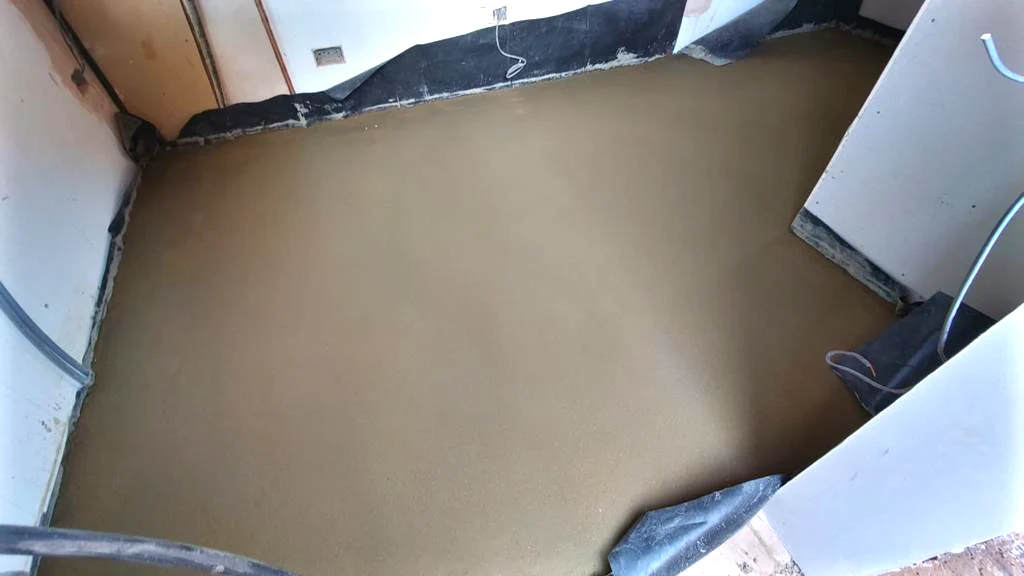
The build-up goes like this. The old slab is checked and cleaned, a damp proof membrane is laid, then rigid insulation, and the screed goes on top. Over the insulation, a house floor in sand and cement goes down 65mm thick. How those layers add up to the hall level is set out in our guide to garage conversion floors, and the boards and sheeting below are covered under membranes and insulation.
Sand and cement suits a garage because it is mixed in small batches, handles a room that is small and narrow, and can be built up locally where the slab dips. Mixing in fibres helps it resist cracking and adds roughly £1 to £3 a square metre.
The other common job in Verwood's older houses is replacing a tired sand and cement floor from the same period. If the screed has cracked, gone hollow or crumbled, it is broken out and relaid. National prices for 2026 have this kind of floor at £18 to £25 a square metre.
It dries more slowly than liquid, so plan the decorating and flooring around a proper drying period.
Wet rooms and ensuites in Verwood houses
In a house of the 1970s to 1990s, the original bathroom or ensuite may be due for replacement. When a shower tray is swapped for a walk-in wet room, the floor needs a gentle fall to the drain. We form that fall by hand in sand and cement, so water runs to the gully instead of sitting in a corner.
Calcium sulphate loses strength when it stays damp for long, which is why wet areas get cement. We would also reach for it if furniture or kit has to go on the floor early, or if your chosen flooring brand insists on cement underneath.
Where the slab underneath is solid, 25 to 40mm bonded directly onto it can lift the floor without needing all 65mm. On a commercial floor, a floating screed rises to 75mm.
Drying is the one drawback. At 40mm deep, sand and cement needs about 40 days to dry, and each millimetre beyond that takes longer again. If the builder's timetable has no slack, a faster drying mix cuts that down. If the new floor is sound but slightly uneven when it is dry, floor levelling in Verwood can bring it within tolerance for large tiles.
Sand and Cement Screed prices in Verwood
Sand and cement screed: £18 to £25 per m² supplied and laid (MyJobQuote, August 2026), so £450 to £630 for 25 m². MyJobQuote does not say whether these figures include VAT. See our floor screeding cost guide or screed calculator.
Who lays your sand and cement screed in Verwood
K & B Screeding’s own team, led by director Donatas Bardisevicius. Founded 2019, company 12298780.
See what customers say in our Google reviews and on our testimonials page.
Sand and Cement Screed from Slough to Verwood
Verwood is about 69.9 miles south-west of our Slough base as the crow flies, with postcodes including BH31 and BH21. The nearest towns to it are Ringwood (4.6 miles), Ferndown (5.6 miles), Wimborne Minster (7.4 miles) and Christchurch (10.8 miles).
More on sand & cement screed, part of our screeding services.