
Relaying older floors around Portfield and the centre
Portfield grew from 300 acres of common land enclosed and built on from 1873, and older homes there and around the town centre may have solid floors that need relaying. The signs are a floor that has cracked, sunk away from the skirting or shows damp at the edges.
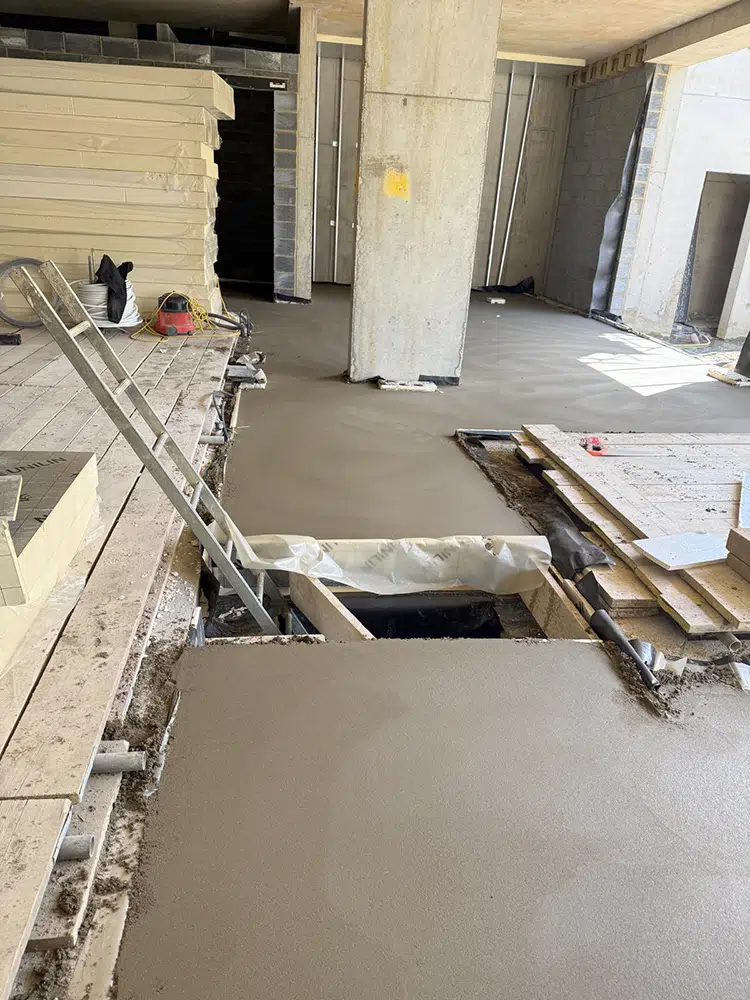
For a fix that lasts, a Portfield floor in that state comes up completely, and a damp proof membrane, insulation and fresh screed go back in its place. Sand and cement suits this because it is mixed in small batches on site and barrowed in, which works through narrow hallways and into small rooms. It copes with steps between rooms and irregular walls, and it gives a cement substrate that tolerates damp far better than calcium sulphate.
Near the harbour and the river floodplains, that tolerance matters. A cement screed over a sound membrane is the sensible build-up where moisture is a risk, and the layers beneath are covered by our insulation and membranes service.
How thick it ends up depends on what lies beneath. Floated on insulation, it needs 65mm in a house, rising to 75mm for commercial premises. If the slab under a town centre house turns out solid and just needs a topping, 25 to 40mm bonded straight onto it may do instead.
Terraced houses make up 17% of Christchurch homes, and on tighter plots a hand-laid screed avoids the need to find room for a pump. Fibres mixed into the screed make it more resistant to cracking, as our fibre reinforced screed service explains.
Wet rooms and level access in Christchurch homes
Adapting a home often means changing the floor. Taking out a shower tray for level access means the floor itself must slope gently to the drain, and the screeder shapes that slope by hand in sand and cement. Self-levelling screeds cannot do this, and calcium sulphate should not be used in wet areas at all.
Removing a step is the other common adaptation. An old sunken floor can be filled with screed so it meets the next room, giving one level from hall to kitchen. The same approach suits a garage being turned into a bedroom or study, where the floor has to rise to match the house; our garage floor screed guide explains the build-up.
Drying is where sand and cement makes you wait. Reckon on a day per millimetre over the first 40mm and longer for the rest, so 65mm of screed leaves most finishes waiting several weeks; build that into the plan. Quick drying mixes can help where the wait is a problem.
As for cost, the 2026 published rate for a standard mix is £18 to £25 per m², and a fast drying one £20 to £28, which may be worth it for a Christchurch bathroom you need back quickly. For a large open floor in a Christchurch extension, compare liquid screed for open-plan rooms.
Sand and Cement Screed prices in Christchurch
Sand and cement screed: £18 to £25 per m² supplied and laid (MyJobQuote, August 2026), so £450 to £630 for 25 m². MyJobQuote does not say whether these figures include VAT. See our floor screeding cost guide or screed calculator.
Who lays your sand and cement screed in Christchurch
K & B Screeding’s own team, led by director Donatas Bardisevicius. Founded 2019, company 12298780.
See what customers say in our Google reviews and on our testimonials page.
Sand and Cement Screed from Slough to Christchurch
Christchurch is about 73.8 miles south-west of our Slough base as the crow flies, with postcodes including BH23. The nearest towns to it are Bournemouth (4.3 miles), New Milton (5.6 miles), Ferndown (6.4 miles) and Ringwood (7.5 miles).
More on sand & cement screed, part of our screeding services.
