
Levelling for shop refits in the Wimborne Minster centre
A shop that changes hands in an older building rarely has a floor ready for the new fit-out. Years of earlier refits leave old adhesive, patched screed, tile ridges and changes of level between rooms that were once separate. A new tenant laying sheet vinyl, LVT or large tiles needs all of that brought to one flat surface.
The flatness classes come from BS 8204, using a 2m rule across the shop floor. Under that rule, a gap up to 3mm counts as SR1, up to 5mm as SR2 and up to 10mm as SR3. SR1 is the class many thin sheet finishes demand, so we check the flooring supplier's requirement before pricing.
Everything depends on what lies under the old shop finish. Old coatings and adhesive are ground off with concrete floor grinding, loose or broken areas are repaired and the right primer is applied for the base type, whether sand and cement, calcium sulphate or concrete. Only then do we pour the compound, normally somewhere between 2mm and 10mm thick. Fast drying products let the fit-out continue quickly.
In the conservation area, older shops may have stone or early solid floors, and those need careful repair rather than a blanket of compound. We check what is under the existing finish before recommending anything.
Where a floor is too uneven for compound, deep pours risk cracking and debonding. A new sand and cement screed for older buildings is often the better answer.
Evening out Colehill and Leigh Park floors before LVT
Extensions on post-war family homes in Colehill and around Leigh Park often end with two floors of different ages side by side. The new screed and the old floor rarely finish at exactly the same height or with the same flatness, and thin LVT shows every step and hollow.
A thin coat of self levelling compound, feathered across the join after priming, gives one continuous surface. The same goes for an older floor in the main house that has settled or been patched over the years. Before any compound goes down, the base is cleaned, loose areas are cut out and the primer is matched to the material underneath, so the new layer bonds properly and does not lift at the joint.
For very thin smoothing work, our latex screed service covers compounds laid at just a few millimetres. Where the old floor has cracked or broken up, levelling on its own is not enough, and our screed repairs service deals with the damage first.
We do not sand timber floors or sell DIY products; this is professional levelling ahead of a new floor finish. Owners in Ringwood can have their floors levelled by us as well.
How we price floor levelling in Wimborne Minster
A fixed written price within 24 hours, once we know the area and the base. See our floor screeding cost guide.
Who levels your floor in Wimborne Minster
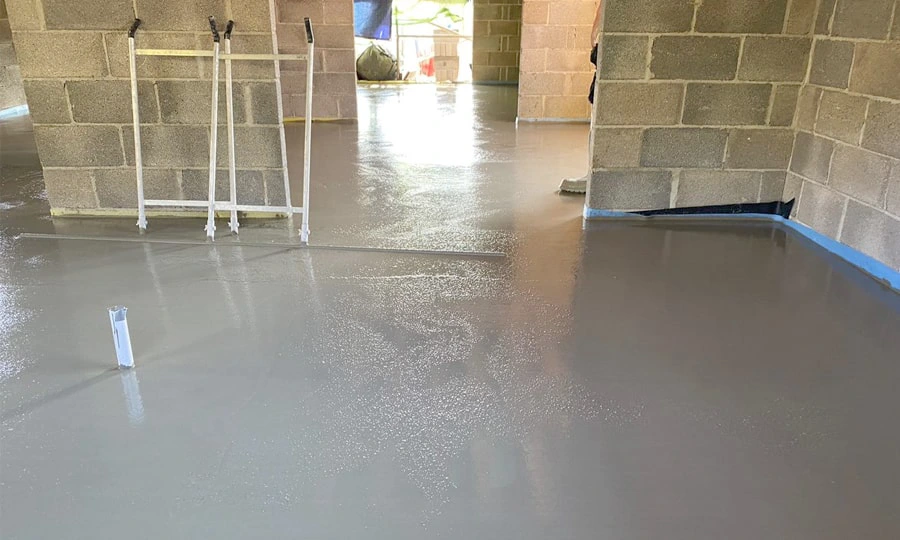
K & B Screeding’s own team, led by director Donatas Bardisevicius. Founded 2019, company 12298780.
See what customers say in our Google reviews and on our testimonials page.
Floor Levelling from Slough to Wimborne Minster
On the map, Wimborne Minster sits south-west of Slough, about 77.2 miles from our base in a straight line (postcodes including BH21), next to Ferndown (4.3 miles), Bournemouth (7.3 miles), Verwood (7.4 miles) and Ringwood (9.2 miles).
More on floor levelling, part of our screeding services. Not sure whether you need a thin compound or a full flowing screed? See self levelling screed explained.
