
Sand and cement work in Yate's 1960s and 1970s homes
Homes built between 1945 and 1972 make up 34% of Yate's stock, a period that includes the 1960s, when the town was designated a development area. Houses of that age are now reaching their first or second major refit, and some ground floors are no longer fit to keep.
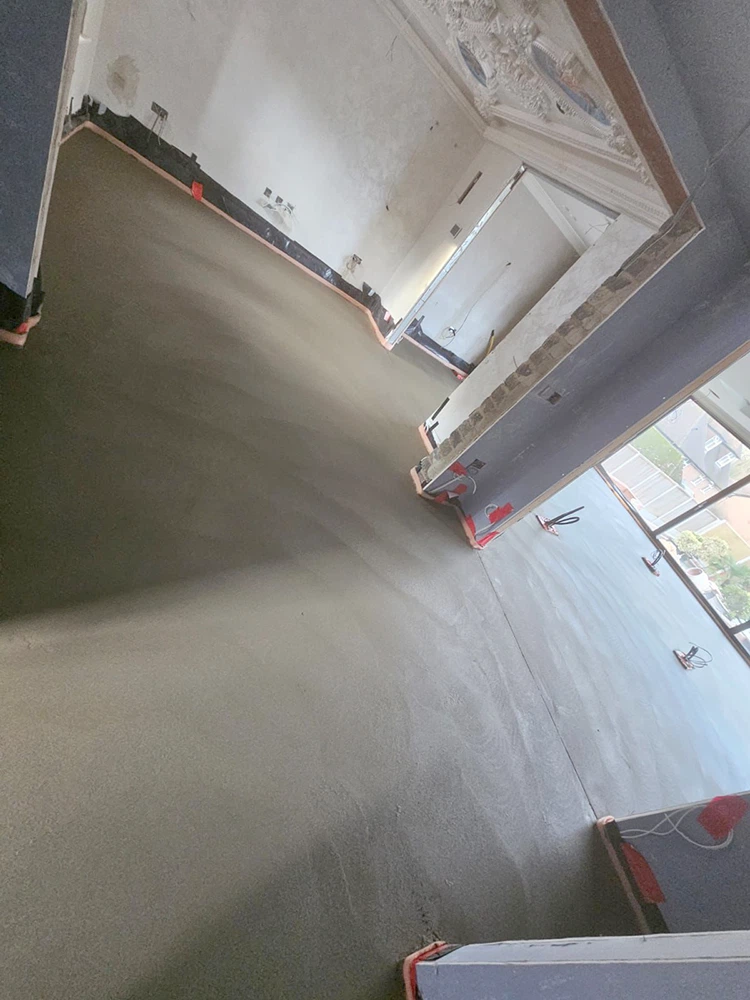
If a solid floor in one of these houses has cracked, dropped or no longer keeps damp out, it normally comes out altogether and goes back new. Fresh insulation and a new membrane are put down, then a floating cement screed goes over them, around 65mm thick in a house or 75mm in a commercial building. The layers below the screed come under our membranes and insulation work.
Sand and cement also suits the shape of these jobs. A single hallway, a small back room or a kitchen with several doorways can be laid in batches, mixed to suit each area, without bringing a pump truck. On a Radburn estate, where the lorry may park well away from the house, a small quantity of dry materials can be simpler to bring in than a long hose. The mix can also be adjusted room by room, which helps where depths vary across an old floor.
Where the floor is sound but uneven, digging it out is unnecessary. The floor levelling in Yate page explains when a thin compound is enough.
Garages, wet rooms and falls in Yate
Garage conversions are a typical reason to choose a hand-laid floor. Garage slabs in Yate normally sit lower than the rooms beside them, have no insulation and are sometimes cracked or marked with oil. The screed has to make up the height, sit on new insulation and meet the floor of the adjoining room. Our garage floor screeding guide walks through that build-up layer by layer.
In a shower or wet room, the floor has to fall towards the gully, and those falls are shaped by trowel. Calcium sulphate cannot be used anywhere that may get wet, so this is always a cement job.
Some floors need a stronger or tougher mix. Adding fibres improves crack resistance and costs £1 to £3 per m² extra; our fibre reinforced screed page explains when it is worth it. If the slab underneath is sound and headroom is short, a 25 to 40mm screed bonded to it can replace a floating one.
On 2026 UK figures, this kind of floor costs £18 to £25 per m². Working in Bath? Our page on hand-laid screed in Bath covers that town.
Sand and Cement Screed prices in Yate
Sand and cement screed: £18 to £25 per m² supplied and laid (MyJobQuote, August 2026), so £450 to £630 for 25 m². MyJobQuote does not say whether these figures include VAT. See our floor screeding cost guide or screed calculator.
Who lays your sand and cement screed in Yate
K & B Screeding’s own team, led by director Donatas Bardisevicius. Founded 2019, company 12298780.
See what customers say in our Google reviews and on our testimonials page.
Sand and Cement Screed from Slough to Yate
As the crow flies, our yard in Slough is about 76.5 miles from Yate, which lies to the west. Postcodes here include BS37 and BS36, and Bath (11.2 miles), Corsham (12.5 miles), Chippenham (14.3 miles) and Stroud (16.6 miles) are close by.
More on sand & cement screed, part of our screeding services.
