
Relaying solid floors near St Mary's Church and Mill Lane
Stotfold has 11% of its homes from before 1919 and another 7% from the inter-war years. They are a small share of the town, but they are the houses where floor problems run deepest.
Without a membrane, an old solid floor lets ground moisture rise into whatever is laid on it. That shows as lifting vinyl, loose tiles or damp at the skirting. Patching it rarely lasts. The sound approach is to break the floor out, dig to the depth the new layers need, then lay a damp proof membrane and insulation with a screed on top. What goes beneath the screed is explained under insulation and membranes.
For a dig-out like that, a traditional mix is the sensible pick. It is mixed on site to the right consistency for each room, carried in through narrow doors and compacted by hand, then finished to a dense, level surface. No pump or hose is needed, which helps where access is awkward.
The layers underneath decide how thick it goes. Over insulation in an older house near Mill Lane, a floating screed would be about 65mm. If there is good concrete to bond to, 25 to 40mm can be enough, and our bonded screed page says when that applies. Commercial floors are laid at 75mm.
The mix can be adapted, with fibres added for crack resistance or rapid drying additives to shorten the wait before flooring.
Garages, wet rooms and small rooms in Stotfold
Even in a newer Stotfold house, some rooms call for sand and cement. The floor of a wet room must slope towards the drain, and we can trowel a hand-laid mix to that slope. Water that would damage a calcium sulphate floor does no harm to cement, so this is what goes under a walk-in shower or in a utility room where a leak could happen.
Garage conversions call for it too. The floor usually has to rise to meet the house, with insulation beneath, and a traditional screed handles that depth in an awkward space. Each stage is walked through in our guide to raising a converted garage floor.
Small rooms such as cloakrooms and hallways are often quicker to do by hand than to set up a pump for, and the price per m² is easier to control.
The cost is a longer wait. Next to a liquid screed it dries slowly, taking about a day per millimetre up to 40mm and more after that. For homes just south, see sand and cement screed in Baldock.
Sand and Cement Screed prices in Stotfold
Sand and cement screed: £18 to £25 per m² supplied and laid (MyJobQuote, August 2026), so £450 to £630 for 25 m². MyJobQuote does not say whether these figures include VAT. See our floor screeding cost guide or screed calculator.
Who lays your sand and cement screed in Stotfold
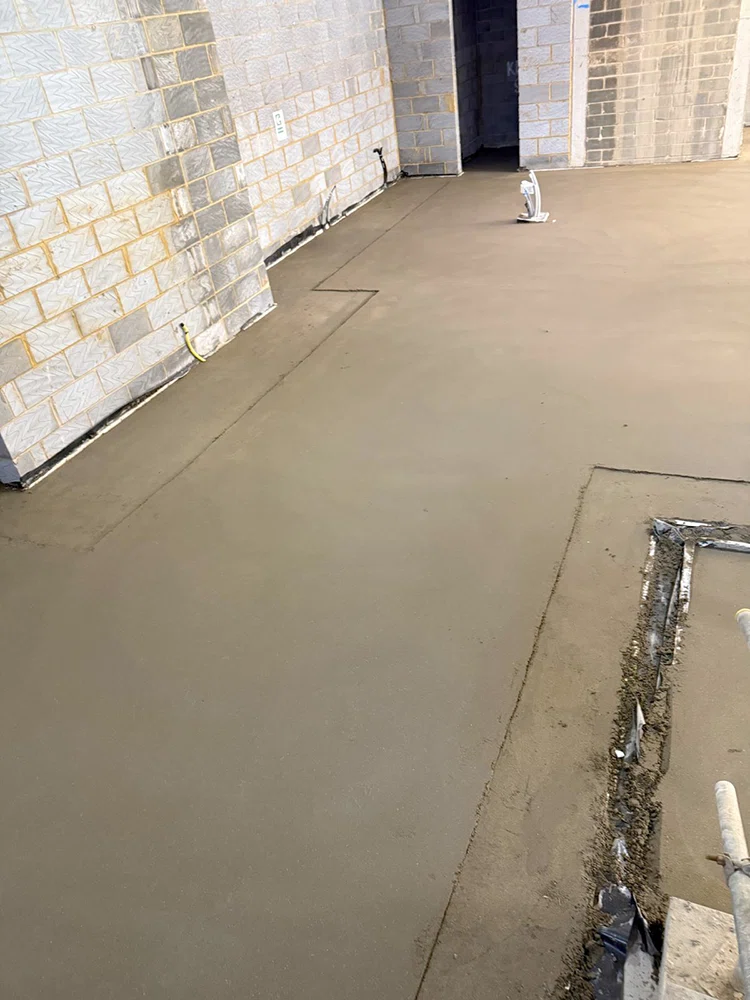
K & B Screeding’s own team, led by director Donatas Bardisevicius. Founded 2019, company 12298780.
See what customers say in our Google reviews and on our testimonials page.
Sand and Cement Screed from Slough to Stotfold
Stotfold is about 37.9 miles north-north-east of our Slough base as the crow flies, with postcodes including SG5 and SG15. The nearest towns to it are Baldock (2.6 miles), Letchworth (2.7 miles), Hitchin (5 miles) and Biggleswade (5.1 miles).
More on sand & cement screed, part of our screeding services.