
Grades and specifications on Aylesbury new build plots
Housebuilders' drawings for Aylesbury plots normally identify the calcium sulphate screed by grade. Houses, apartments and offices usually take CA-C25-F5. A domestic floor with only light use can be CA-C20-F4, and heavy use moves to CA-C30-F6. Those letters stand for compressive (C) and flexural (F) strength, with the numbers in N/mm2, so the grade is effectively a strength rating for the finished floor.
An alpha hemihydrate product sometimes appears on the drawings in place of a standard grade, usually because the programme needs quicker drying or the build-up only allows a thin section. The manufacturer's sheet for that product then decides the depth and the drying, and we follow it instead of any rule of thumb.
Why developers like it: it barely shrinks. Large bays with only a handful of joints are possible, which suits open-plan ground floors on new houses and long apartment floors. Bay and joint positions are worked out before we pour, with extra thought at doorways, corridors and anywhere the floor changes shape.
It has limits. Wet rooms and some utility spaces, anywhere that may get wet, get a flowing screed with a cement binder instead, which we can lay on the same plot. Plots with heating pipes can usually have the system warmed up from about day 7 to hurry the drying along; our Aylesbury underfloor heating screed page covers pipe cover and commissioning. Our guide to the anhydrite material goes deeper.
Preparing Aylesbury anhydrite floors for flooring
Being firm underfoot does not make an anhydrite floor ready for flooring. Three steps come first.
The laitance has to go. As the screed dries it forms a thin, weak surface layer. Glue that grabs onto that layer may let go later, which is why we sand it away when the screed is dry enough and vacuum up afterwards. Heavier surface layers on a larger floor come under our floor preparation work.
The moisture has to be right. Flooring manufacturers frequently set a stricter moisture figure for calcium sulphate than for cement, so a hygrometer reading is checked against the number your flooring maker publishes. On a site with many plots, testing each one before flooring avoids failures after handover.
The floor has to be primed. Adhesive and levelling compound only go down after a primer that is safe for calcium sulphate.
The flooring contractor receives our drying and laitance notes in writing, so they know exactly what is under them. Over in Berkhamsted, we cover the same material on our Berkhamsted anhydrite page.
Anhydrite & Flow Screed prices in Aylesbury
Liquid flowing screed (which includes anhydrite): £24 to £31 per m² supplied and laid (MyJobQuote, August 2026), so £960 to £1,240 for 40 m². MyJobQuote does not say whether these figures include VAT. See our floor screeding cost guide or screed calculator.
Who lays your anhydrite and flow screed in Aylesbury
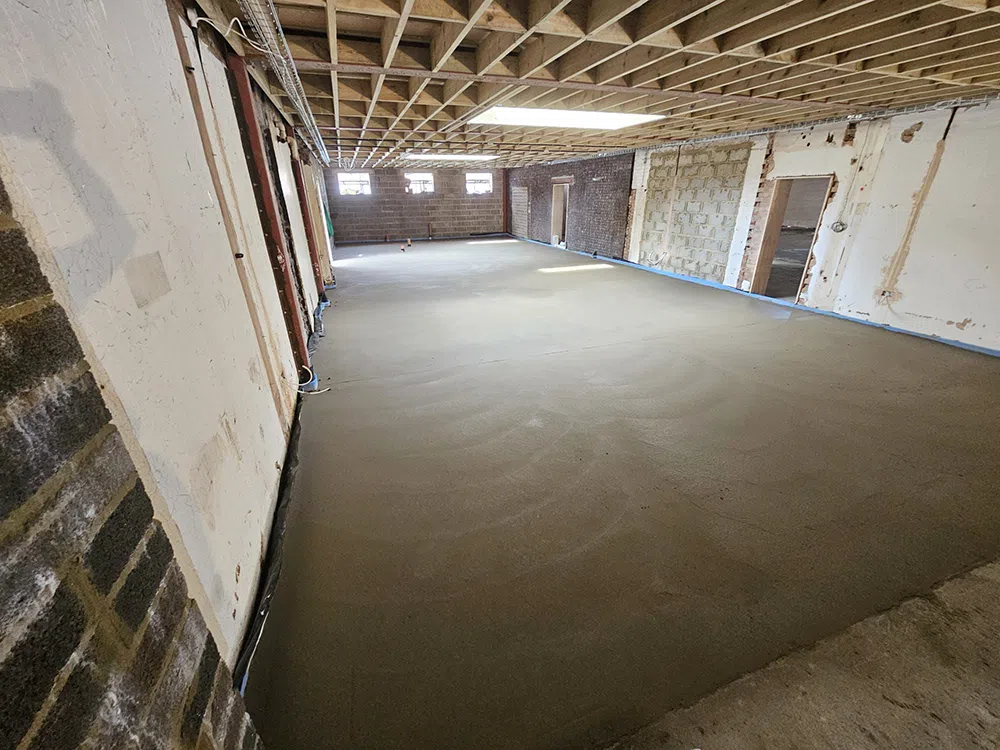
K & B Screeding’s own team, led by director Donatas Bardisevicius. Founded 2019, company 12298780.
See what customers say in our Google reviews and on our testimonials page.
Anhydrite & Flow Screed from Slough to Aylesbury
As the crow flies, our yard in Slough is about 21 miles from Aylesbury, which lies to the north-north-west. Postcodes here include HP20, HP21, HP18 and HP19, and Tring (6.6 miles), Thame (8.7 miles), Leighton Buzzard (9.4 miles) and Berkhamsted (10.8 miles) are close by.
More on anhydrite screed, part of our screeding services.
