
Heated extensions on the Harebreaks estate and beyond
An extension on an inter-war house has one fixed point: the floor level of the original rooms. With underfloor heating, the build-up below that level has to fit insulation, pipes and screed, plus the flooring on top.
The type of screed decides the depth. Pumped screed has to sit at least 25mm above the pipes, around 45 to 50mm in all. Laid by hand, sand and cement needs about 45mm above them, and the floor grows thicker as a result. Where every millimetre counts, the flowing option usually fits more easily, and it surrounds the pipes completely with no voids, which helps heat spread evenly.
Where depth is less tight, or the room is small, a hand-laid traditional screed over the pipes works well, provided it is compacted carefully around them.
Adding heating to an existing old ground floor is a bigger undertaking. In a West Watford or Callowland terrace without a membrane, it usually means digging out the whole floor, which at least creates the depth needed for insulation, pipes and screed in one go.
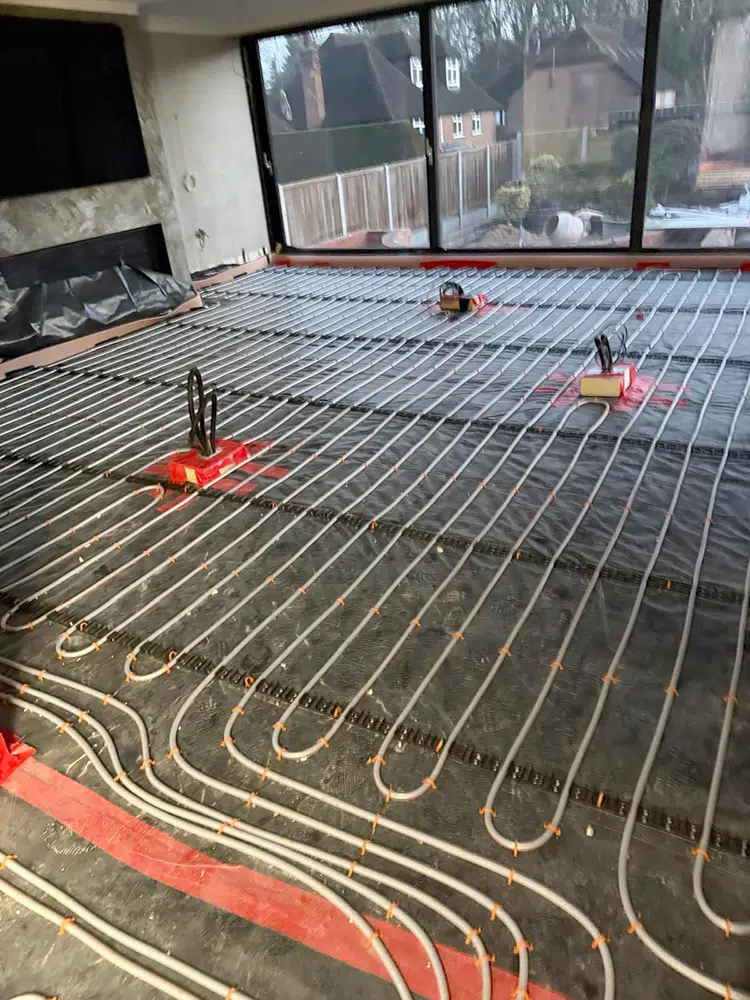
Before we pour, the heating engineer lays the pipes, clips them firmly and pressure tests the circuit. Our first job on site is to look over the edge strip, membrane and insulation. K & B does not install underfloor heating pipes, so the heating design, manifold and pipe layout stay with your installer, and we build the screed to suit what they have laid.
First heat-up for new Watford floors
Newer homes are also part of the picture: 21% of Watford homes were built since 2000, and a new home with wet underfloor heating needs the same care at first heat-up as an extension.
Whatever the building, the screed must cure before the heating is used. Calcium sulphate will usually accept warmth from about 7 days; sand and cement holds out for 21 days or more. Then the system is commissioned gradually, starting at a low flow temperature and rising a little each day. Cranking the heat up in one go risks cracks. Check the flooring maker's maximum surface temperature before choosing a covering.
On calcium sulphate, the heating doubles as a drying aid, and force drying can start from about 7 days. Flooring still waits for a moisture reading, and how long screed takes to dry sets out why.
Covering heating pipes in liquid screed is priced at £20 to £35 per m² in published 2026 UK figures. Over in St Albans, the same work has its own page: heated screeds in St Albans.
Underfloor Heating Screed prices in Watford
Liquid screed over underfloor heating: £20 to £35 per m² supplied and laid (trade2base, June 2026), so £700 to £1,230 for 35 m². trade2base gives these figures excluding VAT. See our floor screeding cost guide or screed calculator.
Who lays your underfloor heating screed in Watford
K & B Screeding’s own team, led by director Donatas Bardisevicius. Founded 2019, company 12298780.
See what customers say in our Google reviews and on our testimonials page.
Underfloor Heating Screed from Slough to Watford
Watford is about 13.7 miles north-east of our Slough base as the crow flies, with postcodes including WD17, WD19, WD25 and WD18. The nearest towns to it are Bushey (1.5 miles), Rickmansworth (3.4 miles), Harrow (5 miles) and Chorleywood (5.4 miles).
More on underfloor heating screed, part of our screeding services.